Much vs Many: Easy Grammar Guide with Examples for English Learners
Published: 18 Mar 2026
English learners often get confused between much and many. Both words mean “a large quantity,” but they are not used in the same way.
Don’t worry, this simple guide will explain the difference with easy rules, clear examples, a quick table, and practice exercises. By the end, you’ll never confuse them again!
What Does Much Mean?
Much = uncountable nouns (things you cannot count one by one).
Used mostly in questions and negatives, but also in formal or written English for positives.
Examples:
How much money do you have?
There isn’t much sugar left.
She doesn’t have much patience.
Quick tip: If you cannot add -s to the noun, use much. (money, water, sugar, information, patience).
What Does Many Mean?
Many = countable nouns (things you can count one by one).
Used in questions, negatives, and positives.
Examples:
How many books are on the table?
She doesn’t have many friends.
There are many chairs in the room.
Quick tip: If you can add -s to the noun, use many. (books, cars, apples, chairs).
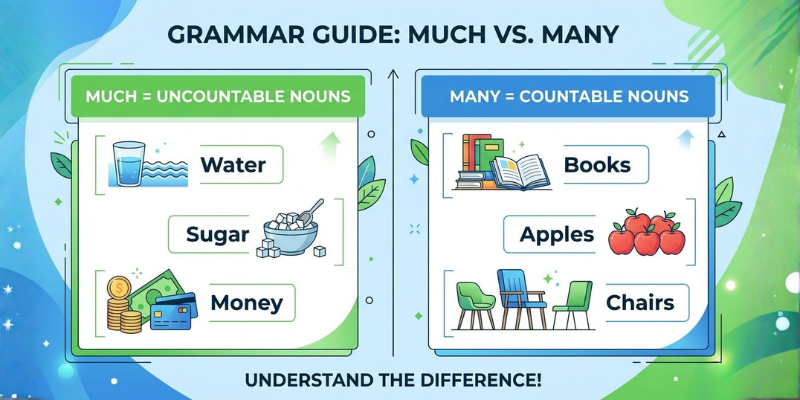
Comparision Table
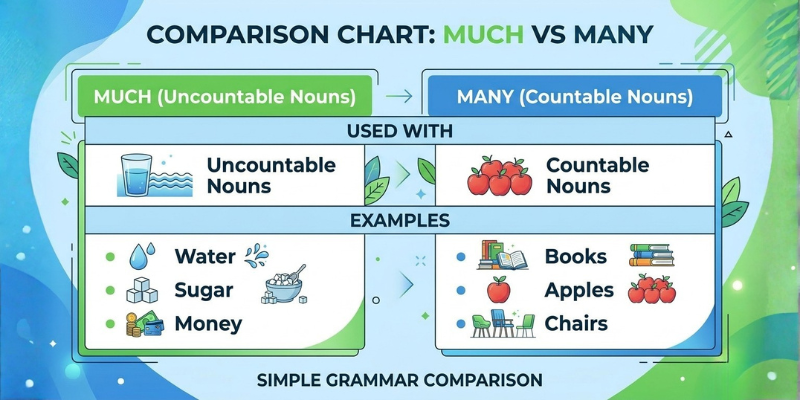
| Word | Used With | Example |
| Much | Uncountable nouns | She doesn’t have much money. |
| Many | Countable nouns | She has many books. |
| Much | Uncountable nouns | There isn’t much sugar in the tea. |
| Many | Countable nouns | How many chairs are in the classroom? |
| Much | Uncountable nouns | He doesn’t have much patience. |
| Many | Countable nouns | She has many cousins in her family. |
Common Mistakes Learners Make
❌ Wrong: I don’t have many money.
✅ Correct: I don’t have much money.
❌ Wrong: She doesn’t have much friends.
✅ Correct: She doesn’t have many friends.
❌ Wrong: How much apples are there?
✅ Correct: How many apples are there?
Rule recap: Much = Uncountable, Many = Countable.
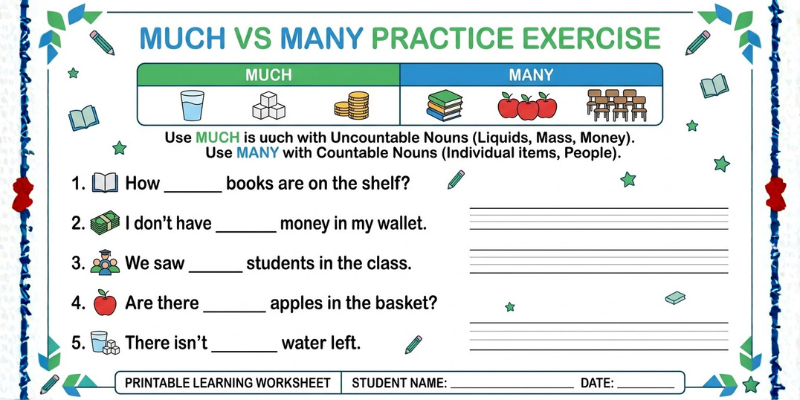
Practice Sentences
Fill in the blanks with much or many:
1. How __ water do you drink every day?
2. She doesn’t have __ time to finish this work.
3. Are there __ students in your class?
4. He doesn’t have __ books at home.
5. There isn’t __ sugar in the cup.
Answers: 1. much, 2. much, 3. many, 4. many, 5. much
Real-Life Examples
“I don’t have much free time because of my job.”
“She has many friends in her new school.”
“There isn’t much information about that topic online.”
“We met many people during our trip to Italy.”
Both are correct, but they depend on whether the noun is countable or uncountable.
Conclusion
At the end, we can say that much for things you cannot count (money, water, information) and many for things you can count (books, friends, chairs). This is the simple rule that fixes most mistakes.
To choose quickly, ask yourself: Can I count it? If yes, use many. If not, use much. That tiny question will save you time and errors.
Try this short practice: first, write three sentences using much (money, sugar, water, information). Then write three sentences using many (books, friends, cars, chairs). Finally, read them aloud and check whether each noun is countable or uncountable.
The reason this works is habit: the more you practise, the more natural it becomes. Within a few days of doing these simple steps, you’ll stop thinking about the rule and start using much and many correctly without effort.
If you want easier grammar lessons and clear examples, visit englishlearninghelp.com and keep learning step by step.
Yes, but usually in more formal or written English. Example: Much progress has been made in this project. In daily conversation, people prefer “a lot of.”
No. “Many” is used in positives, negatives, and questions. Example: I have many cousins (positive), I don’t have many cousins (negative), Do you have many cousins? (question).
“A lot of” works with both countable and uncountable nouns. It’s more common in spoken English. Example: I have a lot of books / I have a lot of money.
Yes, if the noun is understood. Example: How many (books) do you want? / There isn’t much (water) left.
Think: Much = you can’t count it. Many = you can count it. If you can add “s” to the noun, choose “many.” If not, choose “much.”




- Be Respectful
- Stay Relevant
- Stay Positive
- True Feedback
- Encourage Discussion
- Avoid Spamming
- No Fake News
- Don't Copy-Paste
- No Personal Attacks
- Be Respectful
- Stay Relevant
- Stay Positive
- True Feedback
- Encourage Discussion
- Avoid Spamming
- No Fake News
- Don't Copy-Paste
- No Personal Attacks
