Since vs For in English Grammar: Easy Guide with Examples
Published: 16 Mar 2026
Learning English grammar can sometimes feel confusing, especially when two words look similar but are used differently. One of the most common problems learners face is knowing when to use since and when to use for.
Don’t worry, this guide will make everything clear with easy rules, examples, and practice exercises. By the end, you’ll always know which one to use.
What Does Since Mean?
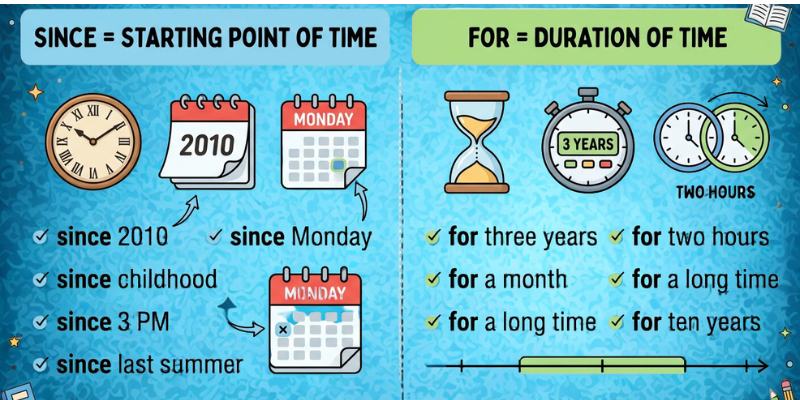
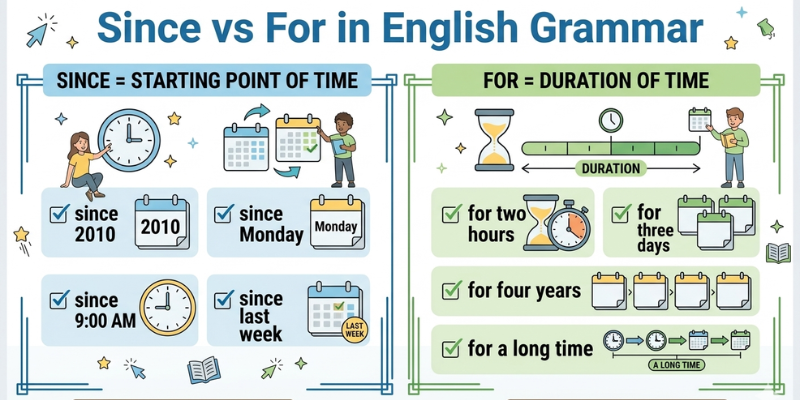
Since = the starting point of time.
It tells us when something began.
Usually used with the Present Perfect or Present Perfect Continuous tense.
Examples:
I have lived here since 2010.
She has been studying since morning.
We have known each other since childhood.
Quick tip: Since always points to a specific moment in time (year, date, day, or event).
What Does For Mean?
For = the duration of time.
It tells us how long something has continued.
It can be used with all tenses, not just Present Perfect.
Examples:
I have studied English for three years.
She stayed in London for two months.
We will travel for a week.
Quick tip: Always answer the question “How long?”
Using Since and For in Different Tenses
Learners often get confused when they see since and for used in different tenses, so this part clears that up in a simple way. These two words work best with perfect tenses, and knowing this helps you write and speak with more confidence.
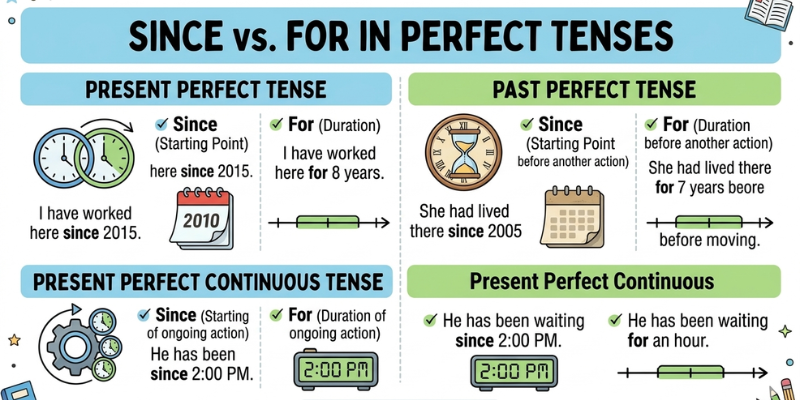
Present Perfect
We use this tense to show something that started in the past and continues now.
- “I have lived here since 2010.”
- “I have lived here for ten years.”
Past Perfect
We use this tense to show something that started before another action in the past.
- “She had studied English since 2005.”
- “She had studied English for five years.”
Present Perfect Continuous
This tense shows an action that started in the past and continues.
- “He has been waiting since 3 PM.”
- “He has been waiting for two hours.”
When you learn how these tenses work with since and for, it becomes easier to choose the right word in real conversations and writing.
Comparison Table: Since vs For
| Word | Use Case | Example |
| Since | Starting point | I have been here since Monday. |
| For | Duration | I have been here for three days. |
Common Mistakes Learners Make
❌ Wrong: I have lived here for 2010.
✅ Correct: I have lived here since 2010.
❌ Wrong: She has studied since three years.
✅ Correct: She has studied for three years.
Remember: Since = When it started. For = How long it lasted.
Practice Sentences
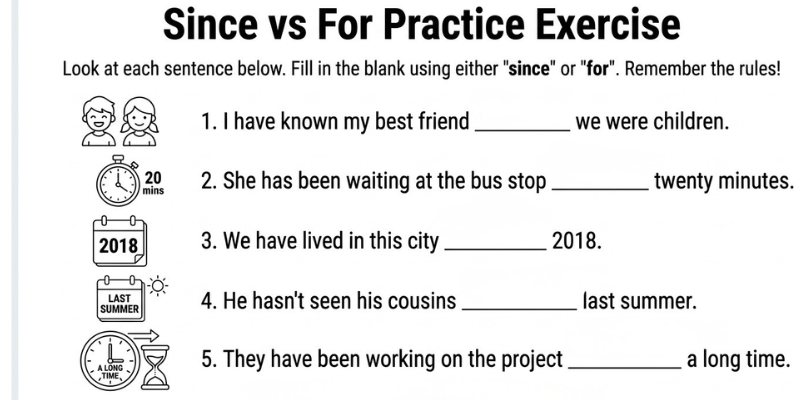
Fill in the blanks with since or for:
1. I have worked here __ 2015.
2. She has been waiting __ two hours.
3. They have been friends __ childhood.
4. He stayed in Paris __ a month.
5. We haven’t met __ last summer.
Answers: 1. since, 2. for, 3. since, 4. for, 5. since
Real-Life Examples
“I have been learning English for two years.”
“I have been learning English since 2022.”
Notice how both sentences are correct, but one shows the length of time (for) and the other shows the starting point (since).
Conclusion
“Since” shows the starting point of an action, while “for” tells us how long something has continued. Both are used in perfect tenses, but they answer different questions.
To check which one to use, try this quick test: ask yourself, “When did it start?” then use since. If you’re asking, “How long has it lasted?” use for.
Here’s a simple way to practice. Write three sentences about your life, using since focuses on specific dates or events. Then write three sentences using “for” to show durations of time. Finally, read them aloud and notice how each one naturally answers either when or how long.
With just a few minutes of daily practice, you’ll start using since and for correctly without even thinking about it. Keep learning step by step, and you’ll soon feel confident in your grammar.
For more simple English grammar lessons with examples, visit englishlearninghelp.com and continue improving your skills every day.

No. It is usually used with perfect tenses because it shows a time that continues until now. If the action ended in the past, use past simple instead (e.g., “I left in 2010”).
The answer is No. It can be used with many starting points, such as since yesterday, since morning, since my birthday, or since childhood. The key is that it marks the exact time something began.
The answer is Yes because For works with past, present, and future tenses to show duration. Example: “I will stay here for two weeks.” It always answers how long an action lasts.
Both are important, but for is more common because people often talk about durations in daily life (for example: for two hours, for a few days). Since is used to highlight the starting time.
The easiest way to remember Since and For is to think: Since = starting point, and For = period of time. Use since with a specific time (like Monday or 2020), and use for with a length (like two hours or five years). Make one sentence with each now: “I have lived here since 2018” and “I have lived here for seven years.” Seeing the difference in action helps you remember.




- Be Respectful
- Stay Relevant
- Stay Positive
- True Feedback
- Encourage Discussion
- Avoid Spamming
- No Fake News
- Don't Copy-Paste
- No Personal Attacks
- Be Respectful
- Stay Relevant
- Stay Positive
- True Feedback
- Encourage Discussion
- Avoid Spamming
- No Fake News
- Don't Copy-Paste
- No Personal Attacks
