English Writing Skills: A Practical Guide for Clear and Confident Writing
Published: 13 Apr 2026
Writing is one of the most important English skills for students and professionals. It helps people share ideas clearly and politely. Good writing shows your thinking and builds trust with the reader. Strong English writing skills matter in school, work, and daily life.
Many learners know grammar rules but still struggle to write clear sentences. They feel unsure about sentence flow, word choice, and structure. This makes exams stressful and emails confusing. The problem is not a lack of knowledge. It is a lack of writing practice.
The solution is to learn English writing skills step by step. Start with simple sentences. Use real examples. Practice a little every day. This method improves clarity and confidence over time.
Strong writing helps you score better in exams, write clear emails, and communicate ideas easily. When your English writing skills improve, your message becomes easy to understand and hard to ignore.
What Are Writing Skills in English?
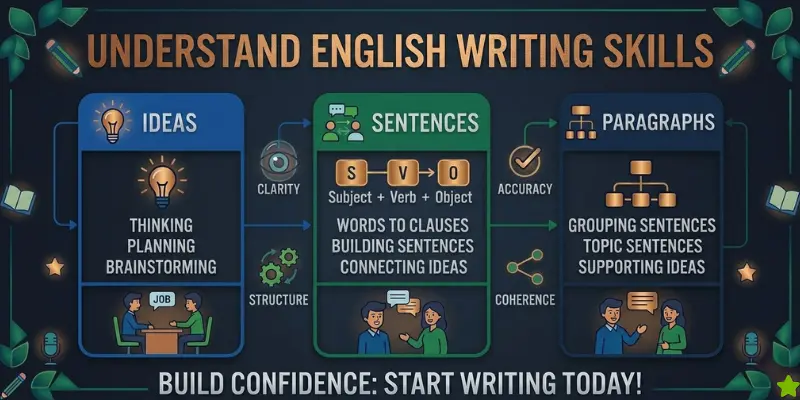
Writing skills in English mean the ability to share your ideas clearly using written words. It is not only about knowing vocabulary or grammar. It is about putting thoughts on paper in a way others can understand easily.
Many learners know English words but struggle to express ideas in writing. They know what they want to say, but their sentences feel confusing or incomplete. This happens when ideas are not organized well. Good English writing skills help you turn thoughts into clear sentences and connected paragraphs.
Writing needs structure, clarity, and accuracy. Structure helps your ideas flow in the right order. Clarity makes your message easy to read. Accuracy helps you avoid grammar and spelling mistakes. All three work together to improve written communication.
Writing skills are important for students, beginners, and ESL learners. Students need them for exams and assignments. Beginners use them to build confidence. ESL learners need them for emails, forms, and daily communication. Strong writing skills make English easier and more effective for everyone.
Importance of English Writing Skills
English writing skills play a big role in academic success. Students need clear writing for exams, assignments, and notes. Good writing helps teachers understand answers easily. It also improves exam scores.
Strong writing skills are important at work. Professionals write emails, reports, and messages every day. Clear writing avoids confusion and saves time. It also creates a good professional image.
Writing skills help in personal communication, too. People use written English in messages, applications, and online posts. Clear sentences help share thoughts in a simple way.
Good English writing builds confidence. When learners write without fear, they feel more comfortable using English. This confidence grows with regular practice and a clear understanding.
Basic Writing Skills Every English Learner Needs
The basic writing skills that every English learner needs are following:
Sentence Writing in English
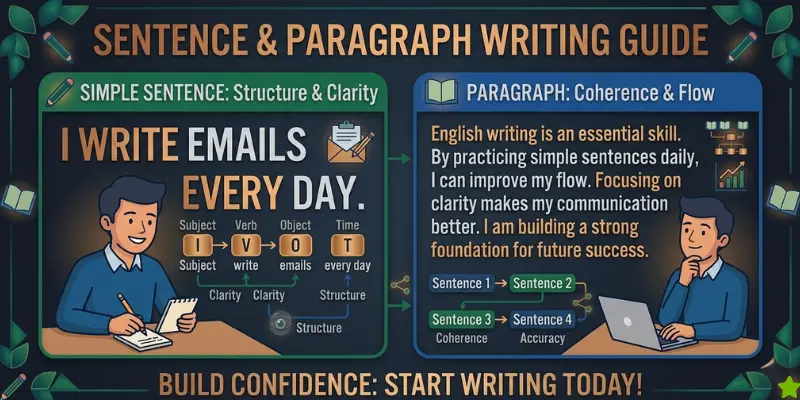
Sentence writing is the first step in English writing skills. A good sentence is clear and complete. It has a subject and a verb. This helps the reader understand the message.
Many learners write fragments. Some write very long sentences. Both create confusion. Try to share one idea in one sentence. Keep it short and clear.
Example
I write emails every day.
She studies English in the evening.
These sentences are simple. They are easy to read and easy to understand.
Paragraph Writing in English
Paragraph writing helps organize ideas. A good paragraph starts with a topic sentence. This sentence tells the main idea. Supporting details explain the idea. A short ending sentence closes the paragraph.
Good flow is important in paragraph writing. All sentences should talk about one topic. Do not jump to new ideas.
Example
English writing skills help students in exams. Clear writing shows correct thinking. Teachers understand answers quickly. This makes learning easier.
Structure and Organization in Writing
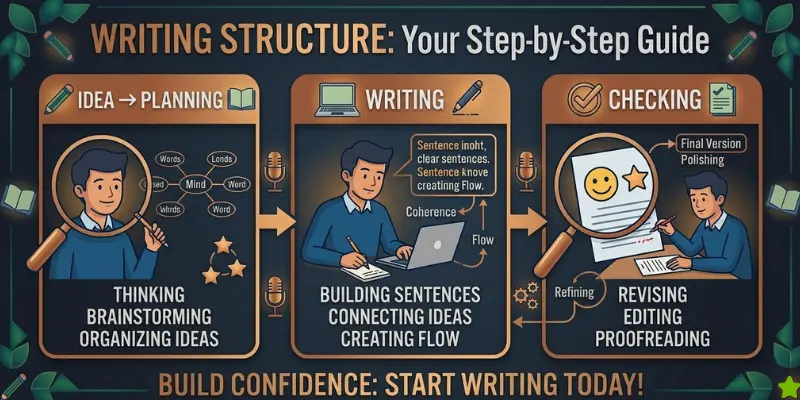
Good structure makes writing easy to read. Planning before writing saves time. It helps you decide what to write first and what to write next. This step improves English writing skills and reduces mistakes.
Start with one clear idea. Arrange ideas in a logical order. Put the most important point first. Add details after that. This helps the reader follow your thoughts without confusion.
Coherence means your ideas stay connected. Cohesion means your sentences stick together smoothly. When both work well, writing feels natural. The reader understands your message quickly.
Use simple transitions to link ideas. Words like first, next, because, and finally guide the reader.
Example
I planned my paragraph first. Then I wrote each point clearly. Finally, I checked my writing.
Strong structure and clear organization make writing confident and professional. Practice planning every paragraph. Your writing will improve step-by-step.
Grammar, Punctuation, and Spelling in Writing
Correct grammar, punctuation, and spelling make writing clear. They help readers trust your message. These skills are a core part of strong English writing skills.
Grammar Accuracy in Writing
Grammar accuracy keeps sentences correct and easy to read. Some rules matter more in writing.
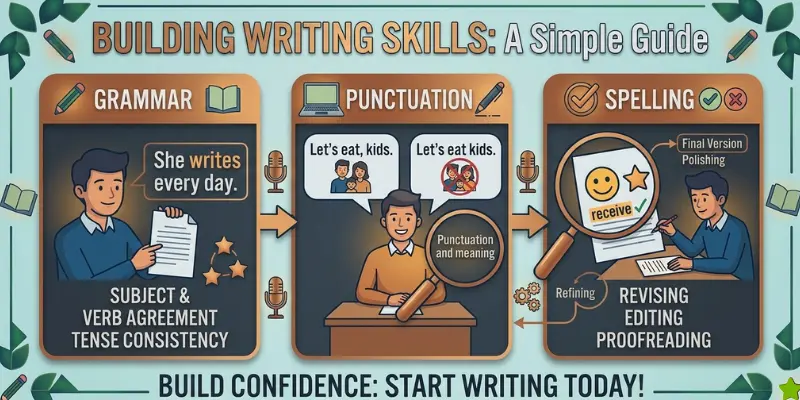
Subject-verb agreement is one key rule. A singular subject needs a singular verb.
Example
She writes every day.
They write every day.
Verb tense consistency is also important. Stay in one tense unless the meaning changes.
Example
I finished my work and sent the email.
When grammar is correct, writing feels smooth and professional.
Punctuation and Capitalization
Punctuation shows meaning. A full stop ends a thought. A comma adds a pause. A question mark shows a question.
Capital letters start sentences. They are used for names and places.
Example
My teacher lives in Lahore.
Punctuation can change meaning.
Example
Let’s eat, kids.
Let’s eat kids.
Small marks can change everything.
Spelling and Word Choice
Spelling mistakes distract the reader. Always check common words.
Example
Write receive, not recieve.
Choose simple and correct words. Clear words make writing stronger. Avoid long or confusing terms.
Word choice also depends on the situation. Use formal words in exams and emails. Use informal words with friends.
Example
Formal: I cannot attend the meeting.
Informal: I can’t come today.
Writing Style and Tone in English
Writing style and tone shape how readers feel about your message. The right tone makes your writing clear and respectful. It also helps you connect with the reader. Good English writing skills depend on using the right style in the right place.
Formal Writing
Formal writing is used in exams, official emails, and academic work. It follows clear rules. The tone stays polite and calm. Sentences are complete and well planned.
Writers avoid slang and short forms. They choose respectful words.
Example
I am writing to request information about the course.
Another example
Thank you for your time and support.
Formal writing shows seriousness and clarity. It works well in professional and academic settings.
Informal Writing
Informal writing is used in messages and personal communication. The tone feels friendly and relaxed. Sentences can be short and simple.
Writers often use common words and contractions.
Example
Hi, I hope you are doing well.
Another example
I got your message and will reply soon.
Informal writing sounds natural. It helps build easy and honest communication with friends and family.
Knowing when to use formal or informal style improves writing. It helps you sound confident in every situation.
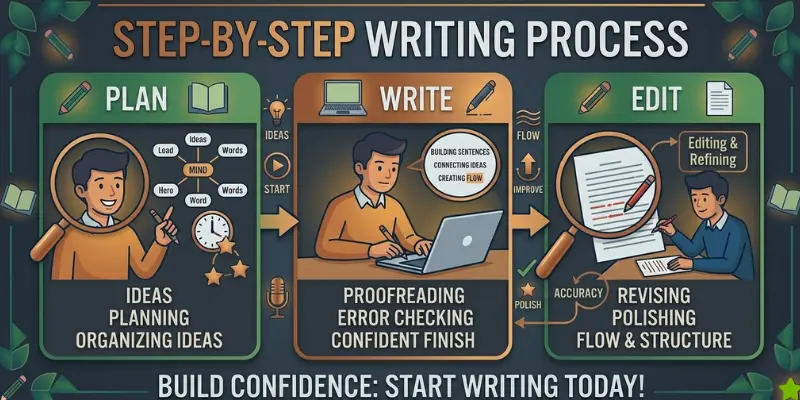
The Writing Process Explained Step by Step
Good writing does not happen in one try. Strong English writing skills grow through a clear process. Each step helps you write with clarity and confidence.
Planning Ideas Before Writing
Start by thinking about your topic. Ask yourself what you want to say. Write down key points. This helps you stay focused. Planning saves time and avoids confusion later.
Example
Before writing an email, note the purpose and main message.
Drafting the First Version
Now write your first draft. Do not worry about mistakes. Focus on sharing your ideas in simple words. Use short sentences. Keep your message clear.
Example
Write a paragraph without stopping to fix grammar.
Editing and Revising Content
Read your draft again. Check if your ideas make sense. Improve weak sentences. Remove extra words. Make sure each sentence supports your main point.
Example
Change long sentences into shorter ones for better flow.
Proofreading for Errors
This is the final step. Look for grammar, spelling, and punctuation mistakes. Read slowly. A clean text shows care and accuracy in writing.
Example
Check capital letters and full stops before sharing your work.
Follow this writing process step by step. It helps you write better every day.
Common English Writing Mistakes and How to Fix Them
Many learners work hard on their English writing skills, but still make small mistakes. These errors are common and easy to fix once you notice them.
Long and Unclear Sentences
Many students write very long sentences. The meaning becomes unclear. Readers get confused.
Fix:
Break long sentences into shorter ones. Share one idea at a time.
Example:
Wrong: I went to the market, and I saw my friend, and we talked about exams which were difficult.
Correct: I went to the market. I met my friend. We talked about the exams.
Grammar and Punctuation Errors
Small grammatical mistakes can change the meaning. Missing commas or full stops confuse readers.
Fix:
Check subject and verb forms. Add punctuation at the right places.
Example:
Wrong: She dont like coffee
Correct: She does not like coffee.
Poor Paragraph Structure
Some paragraphs have no clear focus. Ideas jump from one topic to another.
Fix:
Start with one main idea. Add two or three supporting sentences. End clearly.
Example:
Begin with a topic sentence about your day. Then add details. Finish the paragraph.
Repetition of Ideas
Repeating the same idea again and again makes writing boring.
Fix:
Say your point once. Use simple words. Move to the next idea.
Example:
Wrong: Writing is important. Writing helps us. Writing is useful.
Correct: Writing is important because it helps us share ideas clearly.
Tips to Improve English Writing Skills
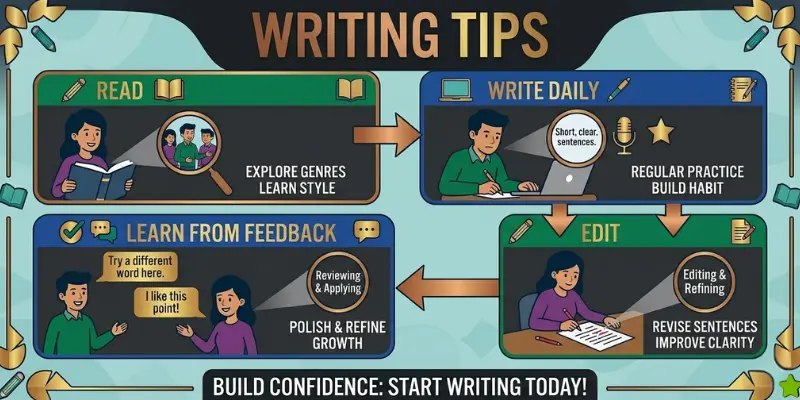
Improving English writing skills takes time and regular practice. Small habits can bring big change. Start simple and stay consistent.
Read Regularly
Reading helps you see how sentences work. You learn sentence patterns and word use. Read short stories, articles, or emails in English. Notice how ideas are shared clearly.
Practice Writing Daily
Write a little every day. It can be a message, a short paragraph, or a note. Daily writing builds confidence and fluency. Do not wait to be perfect.
Keep Sentences Short and Clear
Short sentences are easy to read. They help your reader understand your message fast. Share one idea in one sentence.
Edit Your Own Writing
Always check your writing after finishing. Look for grammar mistakes and spelling errors. Remove extra words. This step improves writing quality.
Learn From Feedback
Feedback helps you grow. Listen to teachers, friends, or readers. Learn from corrections and use them in your next writing task.
Writing Practice Exercises
Practice is the best way to improve English writing skills. These exercises help you write with clarity and confidence. Try them step by step.
Sentence Correction Activity
Read the sentence carefully. Find the mistake. Fix it.
Example
Wrong: She go to school every day.
Correct: She goes to school every day.
This exercise improves grammar and sentence structure.
Paragraph Writing Task
Write a short paragraph on a simple topic. Use five to six sentences. Start with one clear idea. Add supporting lines. End with a closing sentence.
Example topic
My favorite place
This task improves paragraph writing and idea flow.
Error Finding Exercise
Read a short text. Look for grammar, spelling, or punctuation errors. Circle them. Write the correct form.
This exercise sharpens your editing skills.
Rewrite Informal Text Into Formal Writing
Change casual language into polite and clear writing.
Example
Informal: Can you send me the file today?
Formal: Could you please send me the file today?
This practice builds awareness of formal and informal English.
Conclusion
So, guys, in this article, we’ve covered English Writing Skills in detail. We saw why writing skills matter for students, professionals, and everyday learners. Clear writing helps in exams, emails, and daily communication. It also builds confidence in written English.
Remember one thing. Focus on clarity, not perfection. Simple sentences work best. Mistakes are part of learning. The more you write, the better your sentence structure, grammar, and word choice become.
Now it is your turn. Start with one sentence today. Write every day. Improve step by step. With regular practice, your English writing skills will grow faster than you expect.
Start with short sentences. Write every day. Read simple English texts. Check your mistakes and fix them. This habit builds strong English writing skills over time.
Both matter. Grammar gives structure. Vocabulary gives meaning. Learn basic grammar first. Add new words slowly and use them in simple writing.
Even 15 to 20 minutes is enough. Write a few sentences or one short paragraph. Daily practice brings steady improvement in writing skills.
Yes. Beginners can learn the writing on their own. Use easy guides. Practice with examples. Review your work carefully. Feedback from friends also helps.
Start with simple topics. Write about daily life. Use clear sentences. Do not worry about mistakes. Writing is often the key to better English writing.




- Be Respectful
- Stay Relevant
- Stay Positive
- True Feedback
- Encourage Discussion
- Avoid Spamming
- No Fake News
- Don't Copy-Paste
- No Personal Attacks
- Be Respectful
- Stay Relevant
- Stay Positive
- True Feedback
- Encourage Discussion
- Avoid Spamming
- No Fake News
- Don't Copy-Paste
- No Personal Attacks
