Synonyms of Happy in English — Express Joy Like a Native Speaker!
Published: 30 May 2026
Imagine getting excellent exam results, receiving exciting news, or achieving a long-term goal. Would you describe all those feelings with the same word: happy? Probably not. Different situations create different emotions, and English has many words to express those feelings more clearly.
Learning the best synonyms of happy in English can help you express emotions naturally and make your speaking and writing more interesting. Whether you’re a student, English learner, teacher, or professional, building a stronger vocabulary is important for clear communication.
In this guide, you’ll explore useful happy synonyms, their meanings, examples, and opposite words (antonyms). You’ll also learn when to use each word in different situations so your English sounds more natural and fluent.
Definition of Synonyms
Synonyms are words that have the same or similar meanings.
They help you avoid repetition, make your speech more natural, and improve your writing style.
For example:
big – large, quick – fast, and happy – joyful are all pairs of synonyms.
Using synonyms shows that you understand word nuance, the subtle differences between meanings, which is an essential skill for English learners.
Definition of “Happy”
According to the Oxford Learner’s Dictionary, happy means “feeling or showing pleasure or contentment.”
It describes a positive emotional state when something goes well, when you succeed, or when you simply enjoy life.
Example:
- I’m happy to see you again!
- She felt happy after passing her exam.
But “happy” isn’t the only word for this feeling; let’s explore many more ways to express joy!
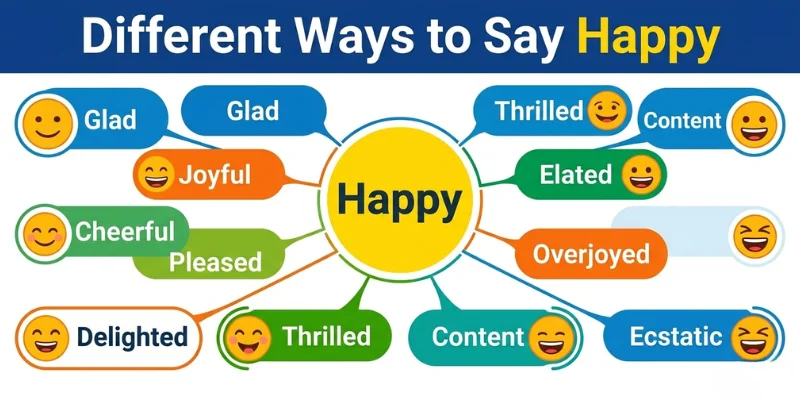
Synonyms & Similar Words for “Happy”
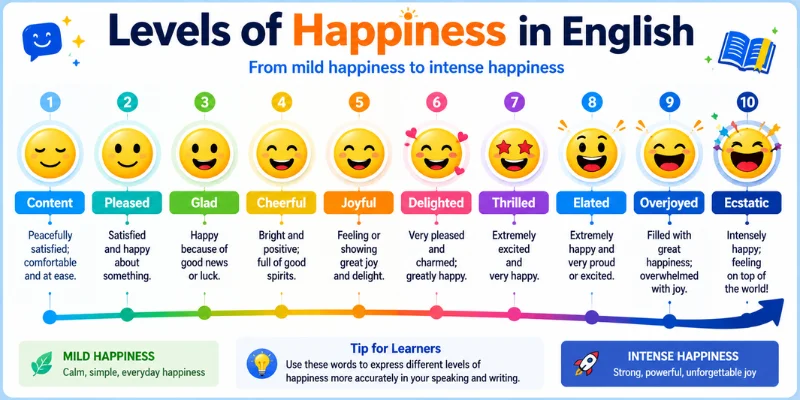
Here are some common and expressive synonyms of “happy” in English. Each conveys a slightly different tone or level of emotion.
| Synonym | Meaning | Example Sentence |
| Glad | Pleased about something | I’m glad you liked the gift. |
| Joyful | Full of happiness and delight | The kids were joyful during the celebration. |
| Cheerful | Bright and positive in attitude | She’s always cheerful, even on rainy days. |
| Delighted | Extremely pleased | We’re delighted to meet you! |
| Pleased | Satisfied or content | I’m pleased with your progress. |
| Elated | Extremely happy or proud | He was elated after getting the scholarship. |
| Thrilled | Very excited or joyful | I’m thrilled to hear the good news! |
| Overjoyed | Filled with great happiness | They were overjoyed when their baby was born. |
| Ecstatic | Intensely happy or excited | She was ecstatic after winning the award. |
| Content | Peacefully satisfied | He’s content with his simple life. |
Pro Tip: Use stronger words like ‘thrilled’ or ‘ecstatic’ in emotional moments, and softer words like ‘pleased’ or ‘content’ in polite or formal situations.
Examples of Synonyms in Sentences
Let’s see how these words work naturally in context:
- I was delighted to receive your message.
- They felt overjoyed when the results were announced.
- She’s always cheerful, no matter what happens.
- We’re thrilled to welcome you to our team.
- He seemed content after finishing his project.
These examples show how using the right synonym changes the tone and emotion of your sentence, a sign of real fluency.
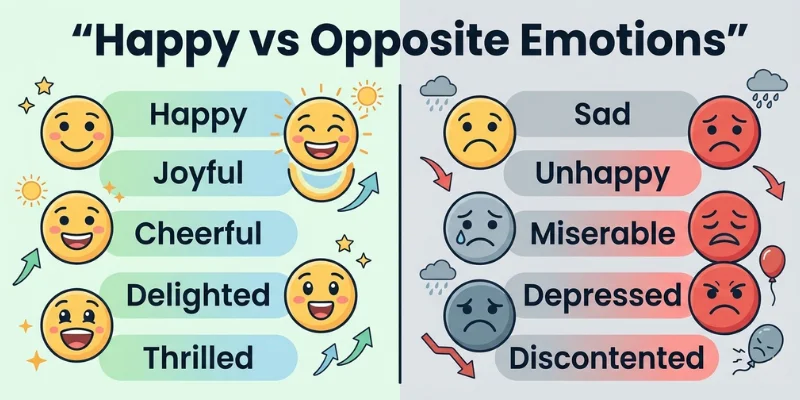
Antonyms & Near Antonyms of “Happy”
To fully understand a word, it is helpful to know its opposites (antonyms) as well.
| Antonym | Meaning | Example Sentence |
| Sad | Unhappy or sorrowful | She felt sad after saying goodbye. |
| Unhappy | Not happy or dissatisfied | He’s unhappy with his new job. |
| Miserable | Extremely unhappy | It was a miserable, rainy day. |
| Depressed | Deeply unhappy or hopeless | She’s been feeling depressed lately. |
| Discontented | Lacking satisfaction | He’s discontented with his current situation. |
Examples of Antonyms in Sentences
- After the party ended, everyone looked a bit sad.
- He was unhappy about the delay.
- She felt miserable when her plan failed.
- The cloudy weather made him depressed.
- They were discontented with their performance.
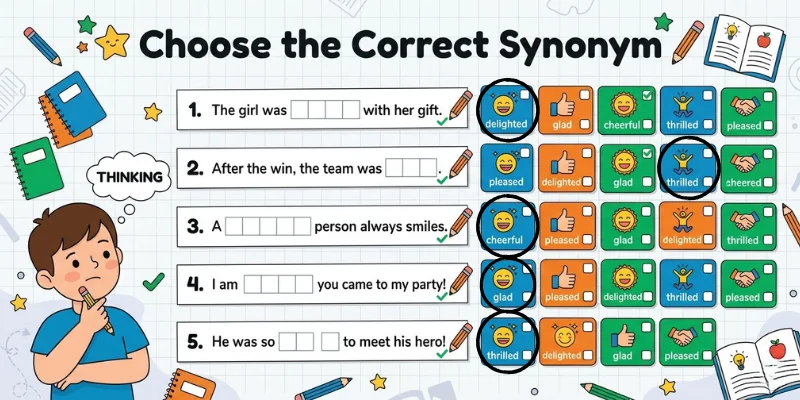
Practice Test: Pick the Right Synonym
Try this short quiz! Fill in each blank with the correct synonym of “happy”:
- She was __________ when she won the competition.
- I’m __________ to hear that you’re doing well.
- The kids looked __________ during the picnic.
- He was __________ about his new car.
- They were __________ with the exam results.
Answers:
- delighted
- glad
- cheerful
- thrilled
- pleased
Conclusion
At the end, we can say that words are powerful, and choosing the right synonym can transform a simple sentence into something expressive, emotional, and authentic.
In English, “happy” isn’t just one word; it’s a feeling that can be joyful, ecstatic, or content, depending on the situation.
Start using these synonyms in your conversations and writing, and you’ll sound more natural, confident, and fluent in no time!
Keep improving your vocabulary and confidence at englishlearninghelp.com, where learning feels natural and fun!
The word happy expresses a general feeling of pleasure or contentment, while glad is usually used for specific situations or moments. For example, you might say I’m happy with my life (a general emotion), but I’m glad you’re safe (a particular event). Both show positive feelings, but glad often sounds more personal and situation-based.
Ecstatic is much stronger than happy. When someone is ecstatic, they’re not just pleased; they’re bursting with excitement or extreme joy. You might be happy about meeting a friend, but ecstatic if you win a big prize or achieve something amazing. It’s one of the most powerful words to express deep happiness.
Yes, pleased works perfectly in formal or professional settings. It’s polite, respectful, and common in business English. For example, you might say, We’re pleased to inform you that you’ve been selected for the position. It’s a more refined way to show satisfaction without sounding too emotional or casual.
A simple way to remember them is to group the words by emotion level. For example: glad is mild, happy is normal, thrilled is strong, and ecstatic is extreme. Try using each word in short daily sentences or when describing real feelings. This helps you understand when and how to use them naturally in conversation.
Learning synonyms is essential for improving your vocabulary and fluency. They make your speech and writing more colorful, expressive, and precise. Instead of repeating the same words, you can choose the right synonym for each mood or tone, a skill that makes you sound more natural, confident, and fluent in English.






- Be Respectful
- Stay Relevant
- Stay Positive
- True Feedback
- Encourage Discussion
- Avoid Spamming
- No Fake News
- Don't Copy-Paste
- No Personal Attacks
- Be Respectful
- Stay Relevant
- Stay Positive
- True Feedback
- Encourage Discussion
- Avoid Spamming
- No Fake News
- Don't Copy-Paste
- No Personal Attacks
