Words to Avoid in Writing: The Complete Guide to Clear, Confident, and Effective English
Published: 17 May 2026
I’ve seen it time and time again, even strong English learners and professionals weaken their writing by using vague, boring, or filler words. These tiny mistakes often make good writing sound unconvincing or amateur.
So, what’s the secret to writing that sounds natural, confident, and powerful?
It starts with knowing the words to avoid in writing and what to use instead.
Let’s explore how you can eliminate weak language from your essays, resumes, academic papers, and even creative writing, with simple examples that work for both British and American English users.
What Are Weak or Filler Words (and Why Avoid Them)?
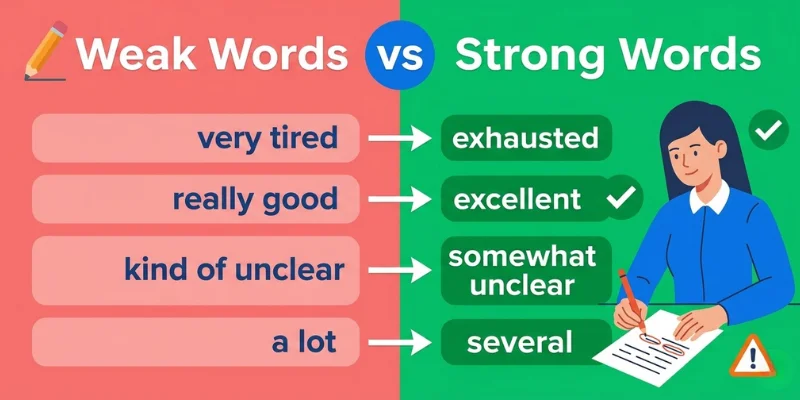
Weak words are words that don’t add value to your sentence. They often act as filler words you use out of habit rather than purpose. Common examples include very, really, just, maybe, and kind of.
These words make your sentences sound uncertain or dull. For example:
- ❌ She was very tired.
- ✅ She was exhausted.
See the difference? The second version is clearer, shorter, and more powerful.
Pro Tip: When editing your writing, read your sentences aloud. If a word doesn’t change the meaning, it probably doesn’t belong there.
Words to Avoid in Academic Writing
Academic writing demands clarity, precision, and professionalism. However, many students or English learners accidentally use casual or conversational words that make essays, reports, or research papers sound weak or less credible.
Avoid these:
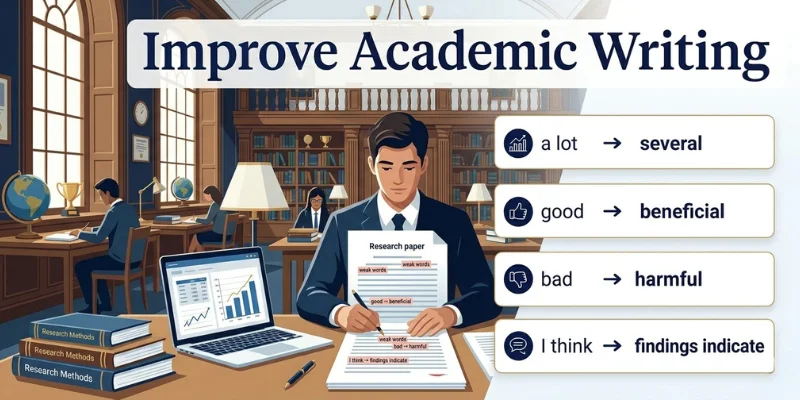
- A lot, lots of, stuff, things, kind of, good, bad, maybe, really.
Better alternatives:
- Many, several, factors, elements, beneficial, harmful, somewhat, significantly.
Example:
❌ There are a lot of problems in this study.
✅ Several issues are identified in this study.
❌ The results are kind of unclear.
✅ The results are somewhat unclear.
❌ Exercise is good for health.
✅ Exercise is beneficial for health.
❌ Pollution is bad for the environment.
✅ Pollution is harmful to the environment.
Quick Writing Tip
Avoid emotional or opinion-based words like I think, I believe, or in my opinion in research or essays unless the assignment specifically asks for your perspective.
✅ Replace them with evidence-based phrases:
- The data suggests…
- Findings indicate that…
- This research demonstrates…
🇬🇧 British VS 🇺🇸 American Academic Tone
| Style | Example | Usage Note |
| 🇬🇧 British | “The research was conducted in the laboratory.” | More passive and formal in tone. |
| 🇺🇸 American | “Researchers conducted the study in a laboratory.” | Slightly more active voice is acceptable. |
Both are correct, just be consistent throughout your paper.
Words to Avoid in Essays
Essays should be logical, focused, and polished. Overly casual or personal words can weaken your argument and distract the reader from your main idea. Clear, objective language helps your essay sound more credible and professional.
Avoid: I think, I believe, you know, basically, like, stuff, things.
Use instead: It appears that, evidence shows, the data suggests, research indicates.
Example:
❌ I think social media is bad for students.
✅ Research indicates that excessive social media use affects student concentration.
I believe technology makes people lazy. (Weak Sentence)
Evidence suggests that overreliance on technology can reduce productivity. (Improved Sentence)
Words to Avoid in Formal Writing
Formal writing, such as reports, academic papers, or professional communication, should sound precise, respectful, and confident. Many learners weaken their writing by using informal or emotional words that sound more like conversation than formal text. The goal is to sound objective and polished, not casual or uncertain.
Avoid: etc., and so on, kinda, gonna, wanna.
Use instead: for example, for instance, such as, intend to, going to.
Also, in formal British English, avoid contractions (don’t, can’t, won’t) and write them in full (do not, cannot, will not).
Examples:
| ❌ Informal Sentence | ✅ Formal / Professional Version |
| The results were really good. | The results were highly satisfactory. |
| We got a lot of feedback from students. | We received substantial feedback from students. |
| The teacher was kind of upset. | The teacher appeared somewhat disappointed. |
| The project was very big and hard. | The project was extensive and challenging. |
Words to Avoid in a Resume or CV
Your resume or CV is your first impression; it should show confidence, skill, and professionalism. However, many applicants unknowingly use weak, vague, or overused words that make their profiles sound generic. Recruiters read hundreds of resumes daily, so empty buzzwords can easily blend in.
Avoid These Common Resume Words:
Responsible for, hardworking, motivated, detail-oriented, team player, passionate, results-driven, dynamic, experienced, go-getter, amazing, creative, excellent communication skills.
These words sound impressive but say nothing specific. They don’t prove your value; they just describe what every candidate claims.
Use Instead (Show Action + Results):
Led, managed, created, improved, developed, implemented, coordinated, designed, achieved, analyzed, increased, reduced, introduced, optimized.
Action verbs demonstrate measurable results, the key to a strong resume.
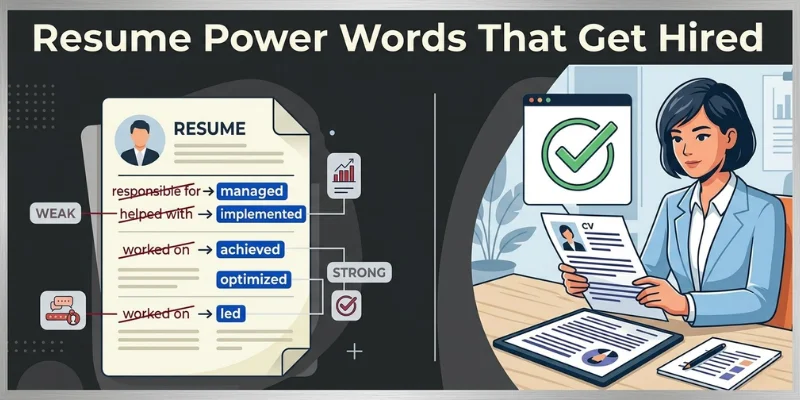
Avoid: Responsible for, worked on, helped with, duties included.
Use: Led, managed, achieved, designed, implemented, created.
Example Table
| Weak | Strong |
| Responsible for social media | Managed the company’s social media campaigns |
| Helped with data entry | Executed accurate data entry operations |
| Worked on projects | Led multiple high-impact projects |
Tip: Start every bullet point with an action verb.
Pro Tip:
Avoid filler phrases like “I helped with…” or “Assisted in…” instead, show impact.
✅ Implemented a new filing system that reduced errors by 30%.
❌ Helped with organizing files.
Recruiters prefer quantifiable achievements, not self-praise.
Words to Avoid in an Interview
A job interview is your chance to show confidence, clarity, and professionalism. But the wrong words can make you sound uncertain, unprepared, or even negative. Many candidates fail not because of poor skills, but because of the language they use. Let’s fix that.
Avoid These Common Words and Phrases:
Um, like, kinda, sorta, I guess, maybe, to be honest, obviously, whatever, actually, stuff, things, you know.
These words make you sound hesitant, nervous, or unconfident. They also distract the interviewer from your main message.
Also, avoid negative phrases such as:
I didn’t like my last job, I’m not sure, I think I can, I just need a chance, I’m bad at…
They give the impression that you lack direction or self-belief.
Use Instead:
Replace vague or filler words with clear, professional language:
Certainly, I believe, In my experience, I learned that, I’m confident that, I successfully, I improved, I contributed, My goal was, I ensured that.
Example:
❌ I kind of worked on that project.
✅ I contributed to that project as a team member.
✅ “In my role, I collaborated with my team to achieve…”
❌ “I did everything myself.”
Words to Avoid in Research and Academic Papers
Research writing is about precision, clarity, and authority. Every word you choose should strengthen your argument, not weaken it. However, many learners and even advanced writers use vague or informal words that make their papers sound unconvincing or unacademic.
Let’s look at the most common weak words and how to replace them with stronger, more scholarly alternatives.
Avoid These Words and Phrases:
Very, really, a lot, lots of, kind of, sort of, maybe, stuff, things, good, bad, nice, huge, big, small, amazing, basically, like, cool, etc.
These are filler or emotional words that belong in casual conversation, not academic writing. They don’t communicate precision or evidence.
Also, avoid phrases such as:
I think, I believe, I guess, you know, in my opinion, sort of, basically, kind of, etc.
They make your argument sound subjective or uncertain, which weakens your credibility.
Use Instead:
Choose formal, objective, and specific language.
Use quantifiable, descriptive, or evidence-based expressions such as:
Significant, considerable, substantial, minor, notable, demonstrates, suggests, indicates, supports, contradicts, highlights, implies, findings reveal, research shows.
Example:
❌ It’s obvious that pollution is harmful.
✅ The findings suggest that pollution has significant health effects.
Examples Table:
| ❌ Informal or Weak Sentence | ✅ Academic & Professional Alternative |
| There are a lot of problems in this research. | Several methodological issues are identified in this study. |
| I think this theory is good. | The evidence supports the validity of this theory. |
| It’s kind of hard to understand the results. | The results are complex and require further interpretation. |
| The study was really interesting. | The study presents significant insights into linguistic development. |
| There are some things that affect learning. | Multiple factors influence the process of language acquisition. |
Pro Writing Tip:
Academic tone means clarity, not complexity. Avoid long, confusing words that don’t add value. Replace “filler” with facts and replace “opinions” with evidence or citations.
Instead of:
❌ “I believe students learn better online.”
Use:
✅ “Recent studies indicate that online learning enhances student engagement and flexibility.”
British vs. American English: Key Differences
When writing internationally, maintain consistency. Here are a few spelling and vocabulary differences:
| British English | American English | Example |
| Colour | Color | The colour/color of the logo is blue. |
| Analyse | Analyze | Scientists analyse/analyze the results carefully. |
| Organisation | Organization | The organisation/organization held a seminar. |
| Programme | Program | The programme/program begins in March. |
Tip: Academic writing in the UK uses British English; American journals prefer American English.
Words to Avoid in Creative Writing
Creative writing gives you freedom, but not all words bring your story to life. Some make it dull, vague, or predictable. Great writers know that every word should create an image, emotion, or rhythm in the reader’s mind.
Let’s explore the common words to avoid in creative writing and what to use instead to make your stories vivid and powerful.
Don’t overuse Adjectives, avoid using filler words, weak verbs, Intensifiers and Empty Modifiers, Vague Words, and Clichés.
Example:
❌ It was a very nice day.
✅ The morning glowed with soft golden light.
Examples in Action
Before (Weak):
It was a really good day. She was very happy because she got a big present.
After (Strong):
Sunshine spilled through the window as she tore the wrapping paper open. Her laughter filled the room, light and free.
In creative writing, less is more, but the right word can do magic.
Avoid filler, clichés, and vague expressions. Instead, use precise, emotional, and sensory language that makes your reader see, hear, and feel every scene.
Words to Avoid in Professional and Business Writing
Professional and business writing reflects your credibility, clarity, and confidence. Using informal, vague, or emotional words can weaken your message and make you sound less professional. Whether you’re writing emails, reports, proposals, or presentations, word choice matters.
Let’s look at common words to avoid and what to use instead for polished, business-ready communication.
1. Informal and Slang Words
Words like guys, cool, awesome, stuff, things, kinda, gotta, yup, and okay are too casual for the workplace.
✅ Use professional, neutral alternatives that sound respectful and clear.
| Informal | Professional Alternative |
| Hey guys, let’s start the meeting. | Good morning, everyone. Let’s begin the meeting. |
| That idea is awesome! | That idea is excellent/impressive. |
| I gotta send this email soon. | I need to send this email soon. |
2. Unclear and Vague Words
Words such as stuff, things, a lot, maybe, kind of, or a bit sound uncertain. Business writing should be precise and confident.
✅ Be specific and measurable.
| Vague | Clear Alternative |
| We have a lot of issues to fix. | We have three key issues to address: budget, timeline, and quality. |
| Maybe we can meet tomorrow. | Let’s schedule a meeting tomorrow at 10 AM. |
3. Overly Emotional or Exaggerated Words
Words like amazing, fantastic, unbelievable, awesome, super, terrible, or horrible sound subjective and emotional, not professional.
✅ Use objective or factual language.
| Emotional | Professional Alternative |
| The results were amazing! | The results were highly effective / exceeded expectations. |
| That’s a terrible mistake. | That’s a significant error that needs correction. |
4. Weak or Uncertain Phrases
Phrases like I think, I guess, probably, sort of, kind of, or maybe make your message sound unsure.
✅ Show confidence and authority instead.
| Weak | Confident Alternative |
| I think we should update the policy. | We should update the policy to improve consistency. |
| Maybe we can try this method. | Let’s consider implementing this method. |
5. Redundant or Wordy Expressions
Phrases like at this point in time, due to the fact that, in order to, for the purpose of, and in the near future make sentences long and clunky.
✅ Simplify your language without losing meaning.
| Wordy | Concise Alternative |
| At this point in time | Now / Currently |
| Due to the fact that | Because |
| In order to | To |
| For the purpose of | For |
| In the near future | Soon |
6. Overused Business Buzzwords
Buzzwords such as synergy, leverage, innovative, impactful, game-changer, paradigm shift, or cutting-edge sound vague and overused.
✅ Replace with clear, plain English.
| Buzzword | Clear Alternative |
| Let’s leverage our resources. | Let’s use our resources effectively. |
| This is a game-changer for our business. | This significantly improves our business process. |
| We need to create synergy between teams. | We need better teamwork and collaboration. |
| It’s a cutting-edge solution. | It’s a modern and efficient solution. |
Examples in Action
Before (Weak):
I think we kinda need to make some changes soon because the current plan isn’t awesome.
After (Professional):
We should revise the current plan immediately to improve efficiency and performance.
Before (Wordy):
Due to the fact that our team members are busy, we are unable to complete the project at this point in time.
After (Concise):
Because the team is busy, we can’t complete the project now.
Pro Writing Tip:
When writing for professional or business contexts, ask yourself:
“Would I say this in a meeting with a client or manager?”
If not, rephrase it with clarity, precision, and confidence.
Strong professional writing uses simple, confident, and specific language, not buzzwords or filler. Avoid casual or emotional expressions, and replace them with neutral, clear, and purposeful words.
That’s how your writing builds trust, authority, and professionalism.
Example:
❌ We’ll leverage our assets for maximum synergy.
✅ We’ll use our resources effectively to reach our goals.
Words to Avoid in Emails
Emails should be polite, clear, and professional. However, many people use casual or unclear words that make messages sound unprofessional or confusing. The goal is to sound confident yet courteous, not overly casual or emotional.
Avoid these words and phrases and try the better options instead 👇
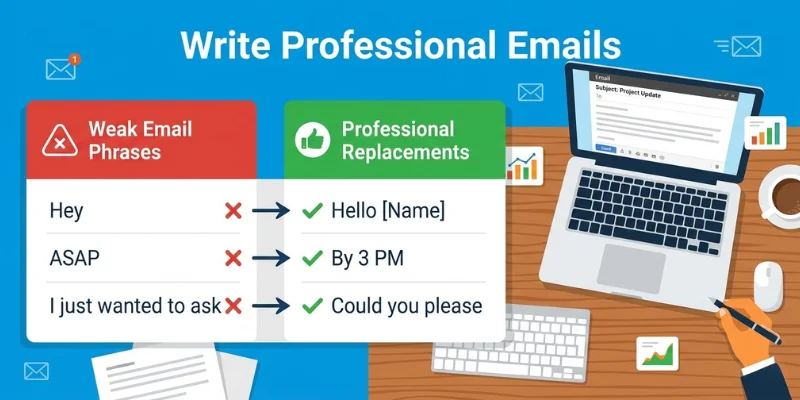
| ❌ Avoid | ✅ Use Instead |
| Hey / Hiya | Dear [Name] / Hello [Name] |
| Just / Actually / Kind of | (Remove or rewrite — these weaken tone) |
| ASAP | By [specific time] / As soon as possible (if polite) |
| Sorry to bother you | Thank you for your time / I appreciate your attention |
| No problem | You’re welcome / My pleasure |
| I think / I guess | I believe / I recommend / It seems |
| Thanks in advance | Thank you for your help / I appreciate your support |
Examples
Before (Weak):
Hey John, I just wanted to ask if you could send the file ASAP.
After (Professional):
Hello John, could you please send the file by 3 PM today? Thank you for your help.
Before (Vague):
I think the meeting should be soon.
After (Precise):
I suggest scheduling the meeting for Tuesday at 10 AM.
Words to Avoid in IELTS Writing and Speaking
In the IELTS exam, vocabulary plays a major role in your Band 7+ score. IELTS tests formal and academic English. Using informal or vague words can lower your lexical resource mark. To sound more academic and natural, replace weak or casual words with precise alternatives. Avoid slang, informal words, and exaggerations like awesome, cool, super, tons of.
| ❌ Avoid | ✅ Use Instead |
| a lot / lots of | numerous, several, many |
| stuff / things | items, aspects, factors |
| good / bad | beneficial / harmful, positive / negative |
| very / really | extremely, highly, significantly |
| like (as a filler) | such as, for example |
| so / really / kind of | quite, rather, somewhat |
| get / got | obtain, receive, achieve |
Examples
Writing Task Example:
❌ A lot of people think pollution is a big problem.
✅ Many people believe pollution is a serious environmental issue.
Speaking Part Example:
❌ I think the movie was really good.
✅ I found the movie quite interesting and well-made.
Writing Task 2 Example:
❌ There are lots of things that governments can do.
✅ Governments can take several effective measures to address the issue.
Speaking Part Example:
❌ I kinda agree with that idea.
✅ I generally agree with that point of view.
✅ Tip for IELTS Success:
Avoid fillers like you know, I mean, or sort of. They make your speech sound less fluent. Instead, pause briefly; silence is better than fillers in IELTS speaking!
Words to Avoid in a Cover Letter
A cover letter should sound professional, confident, and specific, not generic or desperate. Using weak or overused words can make your application sound less impressive. Choose action-driven, positive, and clear language instead.
| ❌ Avoid | ✅ Use Instead |
| I think / I believe | I am confident / I am certain |
| hardworking / motivated | dedicated / results-driven |
| good / nice / great | effective / valuable / strong |
| really / very | highly / exceptionally |
| stuff / things | tasks / responsibilities / objectives |
| helped / worked on | contributed to / collaborated on |
Examples
Example 1:
❌ I think I am a hardworking person who can do many things.
✅ I am a dedicated professional with proven experience managing multiple responsibilities effectively.
Example 2:
❌ I was responsible for helping the team with projects.
✅ I collaborated with cross-functional teams to deliver key projects on time.
Example 3:
❌ I’m looking for a job where I can learn new things.
✅ I’m seeking an opportunity to apply my skills and continue growing professionally.
✅ Quick Tip:
Avoid sounding uncertain; overly modest confidence attracts employers. Replace weak words with specific, measurable actions that highlight your achievements.
Words to Avoid in a College Essay or Personal Statement
College essays and personal statements should reflect your genuine voice, not clichés or filler words. Avoid language that sounds overused, vague, or overly dramatic. Instead, use words that show reflection, growth, and purpose.
| ❌ Avoid | ✅ Use Instead |
| very / really | truly / deeply / extremely (use sparingly) |
| a lot / lots of | many / several / numerous |
| stuff / things | experiences / challenges / goals |
| always / never | often / rarely / in many cases |
| I think / I believe | I have learned / I discovered |
Examples
Example 1:
❌ I really learned a lot from my volunteer work.
✅ I deeply valued the experience of volunteering because it strengthened my sense of community and leadership.
Example 2:
❌ It was an amazing journey that changed me a lot.
✅ It was a meaningful journey that helped me grow both personally and academically.
Example 3:
❌ I think I am a good candidate for this program.
✅ My experiences in research and community work make me a strong candidate for this program.
✅ Quick Tip:
Admissions officers read hundreds of essays; make yours stand out with specific details and reflective language, not generic adjectives. Show, don’t tell.
Words to Avoid in Marketing and Customer Service
In marketing and customer service, every word shapes how customers feel about your brand. Avoid weak, vague, or pushy language, as it can make your message sound untrustworthy or unprofessional. Instead, use words that build confidence, clarity, and connection.
| ❌ Avoid | ✅ Use Instead |
| cheap | affordable / cost-effective |
| buy now!!! | discover / explore / get started |
| honestly / to be honest | certainly / of course |
| problem | situation / concern / issue |
| calm down | I understand your concern / I’m here to help |
| no problem | my pleasure / happy to help |
| unfortunately | at this time / currently unavailable |
Examples
Example 1:
❌ Buy now before it’s too late!
✅ Discover the best plan for your needs today, simple, secure, and flexible.
Example 2:
❌ Calm down, we’re working on it.
✅ I completely understand your frustration. Let’s resolve this together right away.
Example 3:
❌ Sorry, but we can’t help with that.
✅ I understand your concern. While this option isn’t available right now, here’s what we can do for you.
✅ Quick Tip:
Great communication in marketing and customer service is about empathy and trust, not pressure or apology. Replace filler or negative words with phrases that reassure, respect, and guide the customer.
Avoiding Boring and Repetitive Words
Using the same dull words again and again makes writing sound flat and unoriginal. Replacing them with vivid, precise alternatives keeps your sentences fresh and engaging, whether you’re writing an essay, email, or story.
| ❌ Overused or Boring Words | ✅ Better Alternatives |
| good | excellent/effective/impressive |
| bad | poor/harmful/disappointing |
| very big | enormous/massive/huge |
| very small | tiny/compact/slight |
| said | explained/replied/mentioned/added |
| nice | pleasant/appealing/charming |
Examples
Example 1:
❌ It was a very good presentation.
✅ It was an impressive and well-structured presentation.
Example 2:
❌ She said it was a nice thing to do.
✅ She mentioned it was a thoughtful gesture.
Example 3:
❌ He made a very big mistake.
✅ He made a serious mistake that affected the results.
Example 4:
❌ He said he was sorry, and then he said he would leave.
✅ He apologised, then promised to leave.
✅ Quick Tip:
Read your writing aloud. If you notice the same words popping up too often, use synonyms or rephrase the sentence. Great writers sound natural, not repetitive.
Words to Avoid in Professional Writing and Speaking
Professional communication should sound confident, respectful, and precise. However, many people unintentionally use words that make them sound unsure, casual, or unprofessional. Replacing weak or filler terms with stronger alternatives instantly boosts your credibility and clarity.
| ❌ Words to Avoid | ✅ Professional Alternatives |
| kinda / sorta | somewhat / approximately |
| stuff / things | materials / matters / topics |
| honestly / frankly | (often unnecessary—just state the fact) |
| maybe / probably | likely / possibly / it seems |
| just / actually | (remove or replace with concise phrasing) |
| I think / I guess | I believe / I’m confident / It appears that |
Examples
Example 1:
❌ I just wanted to say that the report is kinda late.
✅ The report is slightly delayed and will be submitted by noon.
Example 2:
❌ I think we should probably review the data again.
✅ I believe we should review the data once more for accuracy.
Example 3:
❌ There are a lot of things to discuss in this meeting.
✅ There are several important points to discuss in today’s meeting.
Example 4:
❌ Honestly, I literally can’t believe it.
✅ I find it hard to believe.
✅ Quick Tip:
Professional tone is about clarity and confidence. Cut unnecessary words, replace vague terms, and speak directly, that’s how you sound polished and trustworthy in any setting.
Words to Avoid in Public Speaking or Presentations
When you are speaking to an audience, clarity and confidence matter more than fancy vocabulary. Some words make you sound unsure or distract from your message, even if your content is great.
| ❌ Words to Avoid | ✅ Better Alternatives |
| um / uh / like / you know | pause briefly instead — silence is powerful |
| maybe / I guess / sort of | I believe / It seems / Let’s consider |
| honestly / to be honest | (omit — it weakens your credibility) |
| basically / actually / literally | (use only when truly necessary) |
| stuff/things | ideas/points/strategies |
Examples
Example 1:
❌ Um, I think we kinda need to, like, focus on this topic.
✅ Let’s focus on this key point.
Example 2:
❌ Honestly, this project is, like, really important.
✅ This project is extremely important for our success.
Example 3:
❌ Sorry, I’m not sure if everyone can see the slide.
✅ Let me make sure everyone can see the slide clearly.
Example 4:
❌ So, um, I think this is basically our plan.
✅ This is our plan for the next phase.
✅ Quick Tip:
Record yourself speaking and notice filler words. Replacing them with intentional pauses makes you sound confident, calm, and professional.
Conclusion:
So, guys, in this article, we’ve covered words to avoid in writing in detail.
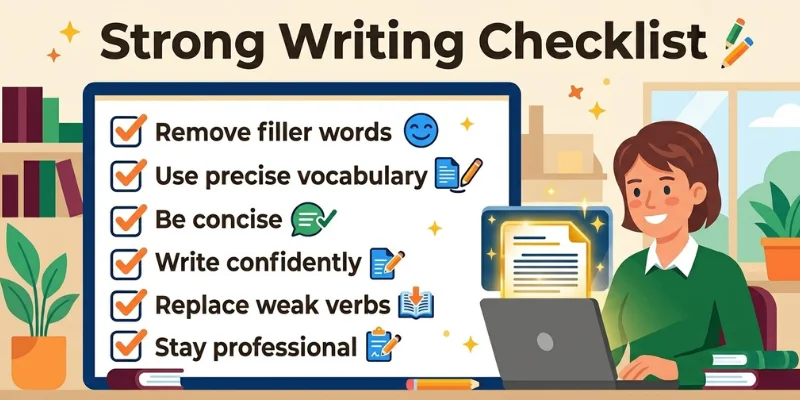
Now, we can say that strong writing isn’t about big words, it’s about clear and purposeful ones.
I hope you will now avoid weak, filler, and boring words, which will help you express your ideas confidently and build your readers’ trust.
Whether you’re writing an essay, an email, or a CV, remember: every word should earn its place. Don’t forget to share this article with your friends and colleagues who want to improve their English.
Keep refining your English, one word at a time — and explore more practical writing lessons on englishlearninghelp.com to continue growing as a confident English communicator.
Filler words make you sound unsure or nervous, even when you know your topic well. Replacing them with a short pause helps you appear calm and confident. Silence often sounds more professional than hesitation.
Occasionally, yes, if you’re sharing a personal opinion. But overusing “I think” weakens your authority. Instead, use phrases like “I believe” or “The evidence suggests” for a stronger impact.
Don’t worry, everyone does! The key is to become aware of it and reduce it over time. Practice speaking slowly and take natural pauses instead of filling the silence.
These words can make your audience wonder if you weren’t honest before. They add little meaning and may sound unprofessional. Simply state your point with confidence.
Yes, they sound vague and lazy. Use specific terms like “ideas,” “methods,” or “solutions,” so your audience clearly understands what you mean. Precision makes your speech more professional.
Confidence comes from clarity, not complexity. Use simple, powerful language and maintain eye contact. Speak naturally, your goal is connection, not perfection.
Yes, but carefully. Light humour can engage your audience, but avoid slang or overly casual words. Always match your tone to your topic and audience.
Pause, take a breath, and glance at your notes or slides. Avoid saying “sorry” or “I forgot.” Calmly continue; most audiences won’t even notice the mistake.
Practice out loud, record yourself, and rehearse key phrases. The more familiar you are with your content, the fewer filler words you’ll use. Preparation builds confidence.
Yes, even great speakers slip occasionally! The difference is that they stay aware and quickly recover. Focus on improvement, not perfection.





- Be Respectful
- Stay Relevant
- Stay Positive
- True Feedback
- Encourage Discussion
- Avoid Spamming
- No Fake News
- Don't Copy-Paste
- No Personal Attacks
- Be Respectful
- Stay Relevant
- Stay Positive
- True Feedback
- Encourage Discussion
- Avoid Spamming
- No Fake News
- Don't Copy-Paste
- No Personal Attacks
