Each vs Every: Clear Grammar Guide with Examples for English Learners
Published: 12 Sep 2026
Have you ever stopped while writing and thought, “Should I say ‘each’ or ‘every’?”
Both words seem similar, but they don’t always mean the same thing. The each vs every confusion is one that almost every English learner runs into at some point. The truth is, each and every are like close cousins. They look alike but express slightly different ideas, much like the confusion learners face with some and any or other quantifier pairs in English.
In this easy guide, we will break down the meaning of each and every, the rules behind them, and their usage with clear examples, a quick comparison table, and simple tips. By the end, you will know exactly when to use each and when to use every without ever hesitating again.
What Is the Main Rule: Each vs Every?
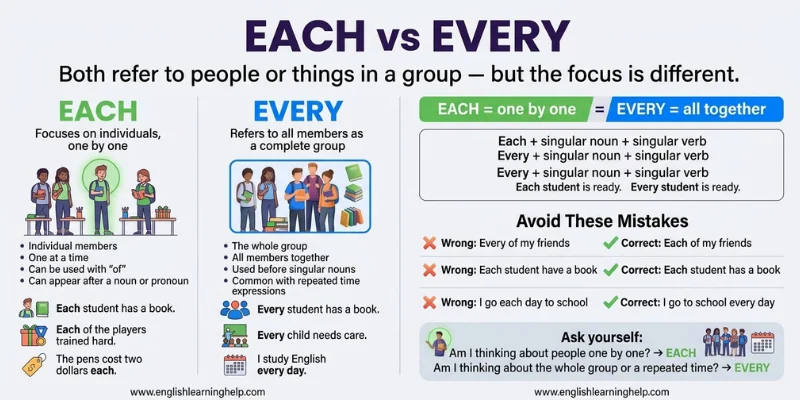
Both each and every refer to people or things in a group. But here is the key difference:
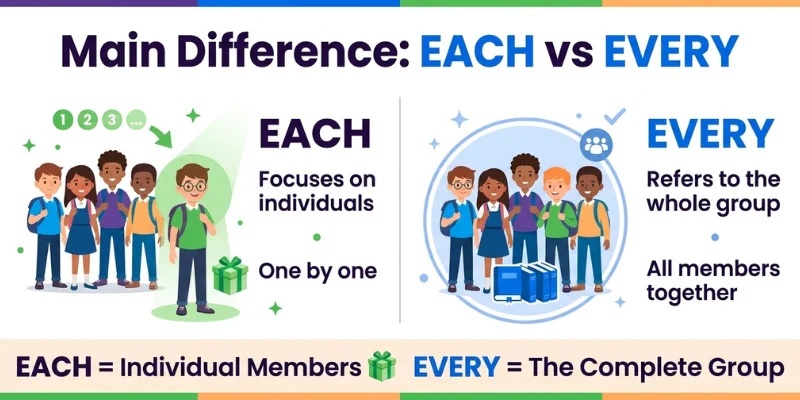
Each focuses on individuals in the group. Every focuses on the whole group as a single unit.
Think of each as zooming in on one person at a time, and every as looking at everyone together.
Comparison Table
| Feature | Each | Every |
| Meaning | Refers to individual items or people in a group, one by one | Refers to all items or people in a group as a whole |
| Usage Focus | Focus on individuals | Focus on the group collectively |
| Singular or Plural | Always singular | Always singular |
| Position in Sentence | Can appear at the start, middle, or end | Usually appears at the start or before the noun |
| Examples | Each student got a gift. She thanked each of her friends. | Every student got a gift. He visits every country in Europe. |
| Questions/Negatives | Can be used: Each of them didn’t come. | Usually not used in negatives; rarely in questions. |
Quick Tip: Think “each = one by one” and “every = all together.” If you want to stress individuality, use each. If you want to stress the whole group, use every.
What Does Each Mean?
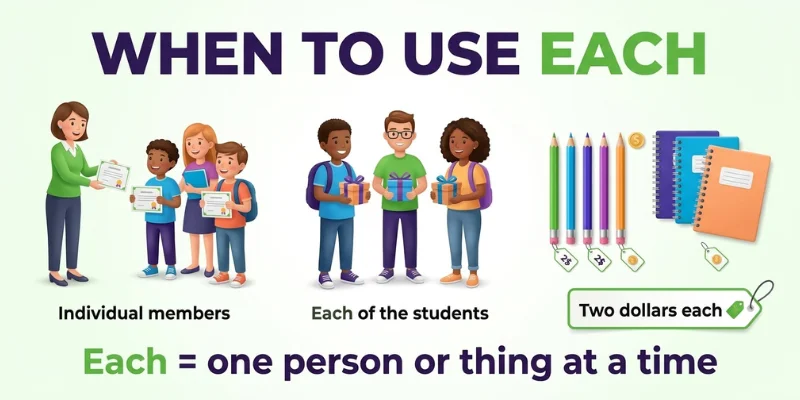
If you are looking for a simple definition of each, here it is: each means one member of a group, considered separately from the others.
Examples of each:
- Each student received a certificate.
- The teacher spoke to each child personally.
- We gave each guest a small gift.
- Each of the players trained individually before the match.
Quick Tip: Use each when you are talking about people or things one by one, not as a whole group.
Each is also commonly used to talk about a price or amount per item. For example, “The pens cost two dollars each” means the price applies to every single pen, individually. This particular use of each is one that many learners miss, since it functions almost like an adverb rather than a determiner.
What Does Every Mean?
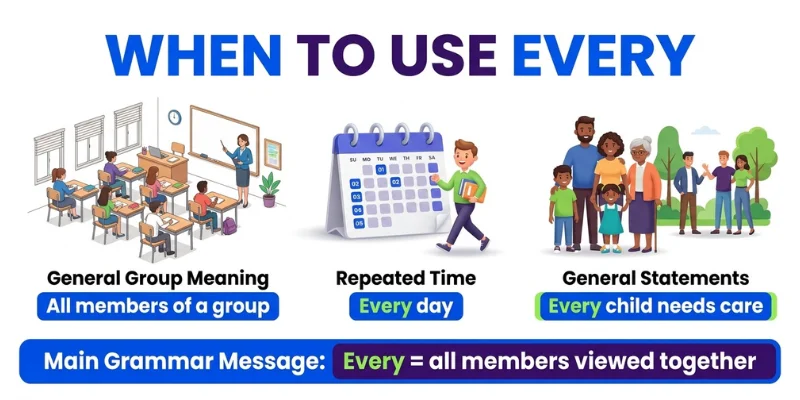
The meaning of every is a little different. Every looks at all the members of a group together, treating them as one complete set rather than separate individuals.
Examples of every:
- Every child needs love.
- I go to the gym every morning.
- Every room in this house is clean.
- Every employee attended the meeting.
Quick Tip: Use every when you are talking about people or things as a group or total set.
One specific case worth knowing is each year vs every year. Both are grammatically correct, but they carry a slightly different feel. “Every year” is the more common, natural choice for general statements, like “Every year, the school holds a sports day.” “Each year” is used when you want to emphasize the individual years one at a time, such as when comparing yearly progress: “Each year, our results improved a little more than the year before.” The same time-based logic applies to phrases like every day and every time as well.
Strengthening this kind of instinct connects closely to building overall English vocabulary, since small words like these carry meaning that only becomes clear through repeated exposure to real sentences.
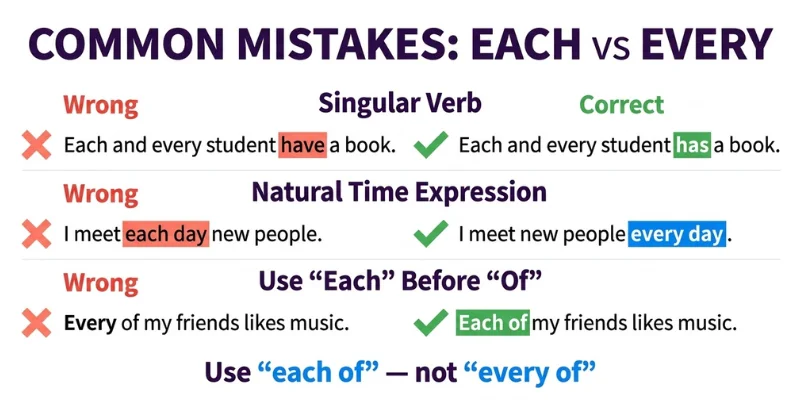
Common Mistakes to Avoid
Wrong: Each and every student have a book. Correct: Each and every student has a book. (Each and every takes a singular verb.)
Wrong: I meet each day new people. Correct: I meet new people every day.
Wrong: Every of my friends likes music. Correct: Each of my friends likes music.
Rule Reminder: Use each before “of,” not every. For example, “Each of them came on time” is correct, but “every of them” is not.
This is also a good place to note the difference between each and all. Each treats a group as separate individual members, while all treats a group as one combined total. Compare “Each student passed the test” (focus on individuals passing one by one) with “All students passed the test” (focus on the entire group as a whole). They often describe the same result, but the emphasis is different.
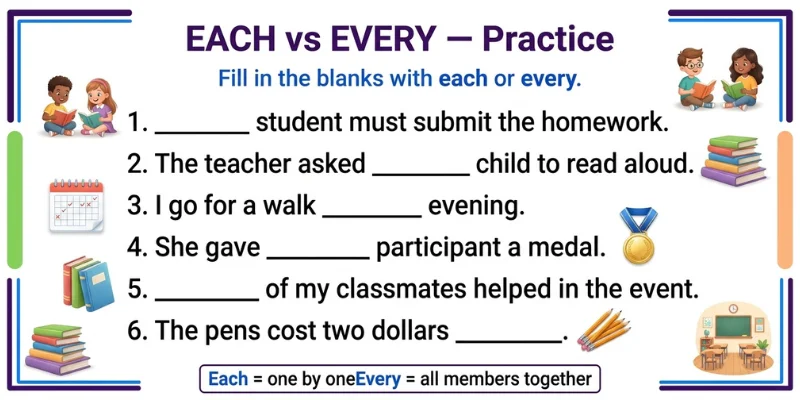
Practice Sentences
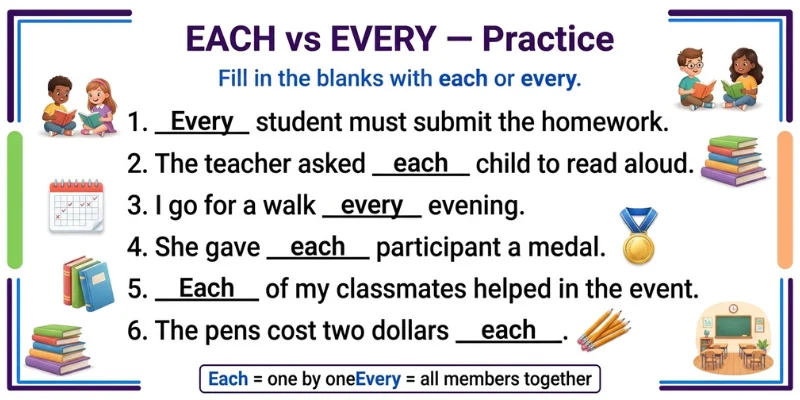
Fill in the blanks with each or every:
- ___ student must submit the homework.
- The teacher asked ___ child to read aloud.
- I go for a walk ___ evening.
- She gave ___ participant a medal.
- ___ of my classmates helped in the event.
Answers: 1. Every, 2. Each, 3. Every, 4. Each, 5. Each
Real-Life Examples
“Each country has its own culture.”
“Every country wants peace.”
“Each of the boxes is labeled carefully.”
“I learn something new every day.”
Notice how each focuses on individuals, while every talks about the whole group in general. In years of teaching this rule, the fastest way students grasp it is by asking themselves one simple question before speaking: am I thinking about people one at a time, or all of them together? That single question solves almost every mix-up between the two words.
Applying this kind of small grammar distinction consistently is really a part of broader English communication skills, since precision with small words like each and every often shapes how clear and natural your English sounds overall.
Conclusion
Once you understand each vs every clearly, this small but powerful distinction makes your English sound far more natural. Both words talk about all members of a group, but they do it from slightly different angles.
Each focuses on individuals, looking at people or things one by one. Every focuses on the whole group together, as in “Every child loves to play outside.”
Try a quick exercise. Write a few sentences using each with words like student, book, or guest. Then write some using every with words like morning, child, or rule. Read them aloud and notice the difference in meaning and tone.
With regular practice, using each and every will start to feel natural in both speaking and writing.
Both each and every are followed by singular nouns and take a singular verb. For example, “Each student is ready” and “Every child plays happily.” This is because both words focus on individuals rather than treating the group as plural.
Yes. You can use them together for extra emphasis, as in “Each and every student must try their best.” This phrase highlights that you mean every single person in the group, leaving no one out.
Each gives a more personal and specific tone, focusing on individuals one by one. Every sounds broader and more general, talking about the group as a whole.
Yes, but every cannot be followed by “of.” You can say “Each of the players performed well,” but “Every of the players” is incorrect. Each of highlights individuals within the group.
Think of each as focusing on things one by one, while every looks at the whole group together. Use each when you want to emphasize individuals, and every when you mean everyone as a total group.
Both are correct, but every year is more common in everyday speech for general statements. Each year is used when you want to highlight individual years separately, often when comparing something across time.






- Be Respectful
- Stay Relevant
- Stay Positive
- True Feedback
- Encourage Discussion
- Avoid Spamming
- No Fake News
- Don't Copy-Paste
- No Personal Attacks
- Be Respectful
- Stay Relevant
- Stay Positive
- True Feedback
- Encourage Discussion
- Avoid Spamming
- No Fake News
- Don't Copy-Paste
- No Personal Attacks
