Apostrophes After S: Easy Rules, Examples & Common Mistakes
Published: 9 Oct 2026
Have you ever wondered why we write student’s book but students’ books? Both words look almost the same, but the apostrophe changes their meaning.
This small punctuation mark can confuse English learners. The good news is that you do not need to learn dozens of difficult rules to use it correctly.
In this guide, you will learn when to put an apostrophe before or after S, how to use apostrophes with names and family names, and which common mistakes to avoid. You will also find simple examples, a quick comparison table, and a practice worksheet to test your skills.
What Does an Apostrophe After S Mean?
An apostrophe after S usually shows that something belongs to more than one person, animal, or thing.
For example:
- The students’ books are on the desk.
- The teachers’ room is upstairs.
- The dogs’ toys are in the garden.
In each example, the owner is plural. This means there is more than one student, teacher, or dog.
When a plural noun already ends in S, we usually add only an apostrophe after the S to show possession.
The basic rule:
Plural noun ending in S + possession = S’
For example:
- students → students’
- teachers → teachers’
- dogs → dogs’
- players → players’
Remember that the apostrophe shows possession. It does not simply make a word plural.
Apostrophe Before S vs. After S
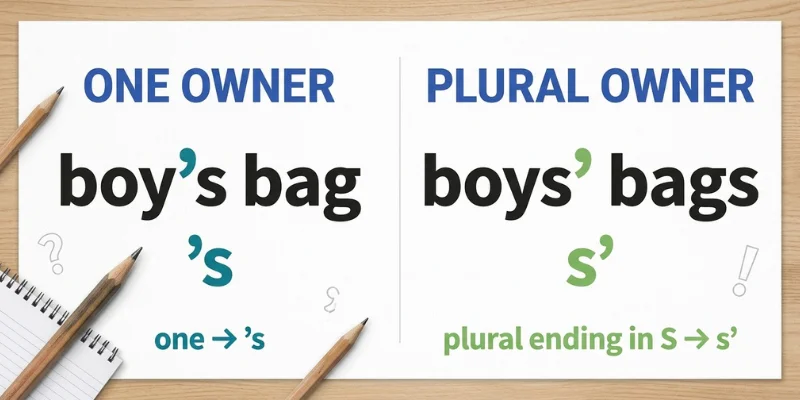
The easiest way to choose the correct apostrophe is to ask yourself: Is there one owner or more than one?
1. One owner: Use ’s
When one person, animal, or thing owns something, we usually add ’s.
Examples:
- The student’s book is new.
- The girl’s bag is blue.
- The teacher’s desk is clean.
- The dog’s tail is long.
Each example has one owner.
For example, the student’s book means the book belongs to one student.
2. More than one owner: Use s’
When the owner is plural, and the noun already ends in S, put the apostrophe after S.
Examples:
- The students’ books are new.
- The girls’ bags are blue.
- The teachers’ desks are clean.
- The dogs’ tails are long.
Here, there is more than one owner.
Compare the examples
| One owner | More than one owner |
|---|---|
| student’s book | students’ books |
| girl’s bag | girls’ bags |
| teacher’s desk | teachers’ desks |
| dog’s toy | dogs’ toys |
| friend’s phone | friends’ phones |
Easy memory trick:
- One owner → ’s
- Plural owner ending in S → s’
This is the most important rule for understanding apostrophes after S.

When Do You Use an Apostrophe After S?
Use an apostrophe after S when these three things are true:
- The noun is plural.
- The noun already ends in S.
- You want to show possession.
Look at these examples:
- The players’ uniforms are ready.
- My parents’ car is outside.
- The workers’ tools are in the box.
- The birds’ nests are in the trees.
- The doctors’ offices are on the second floor.
Each apostrophe shows a connection between the owner and something related to that owner.
For example, the players’ uniforms means the uniforms belong to the players.
You do not need to add another S after the apostrophe.
Incorrect: The players’s uniforms are ready.
Correct: The players’ uniforms are ready.
What If a Plural Word Does Not End in S?
Some plural nouns do not end in S. These words have special plural forms.
Common examples include:
- child → children
- man → men
- woman → women
- person → people
- mouse → mice
When these plural nouns show possession, add ’s.
Examples:
- The children’s toys are on the floor.
- The men’s shoes are near the door.
- The women’s team won the match.
- The people’s opinions matter.
- The mice’s nests were found in the old building.
Notice the difference:
| Plural noun | Possessive form | Example |
|---|---|---|
| students | students’ | The students’ bags |
| teachers | teachers’ | The teachers’ room |
| children | children’s | The children’s toys |
| men | men’s | The men’s shoes |
| women | women’s | The women’s team |
Remember:
- Plural ending in S → s’
- Plural not ending in S → ’s
This simple rule will help you choose the correct form in many sentences.
Singular Nouns and Names Ending in S
A word ending in S is not always plural. Some singular nouns also end in S.
Examples include:
- class
- bus
- boss
- dress
- glass
When these singular nouns show possession, the usual form is ’s.
Examples:
- The class’s teacher is helpful.
- The bus’s engine is noisy.
- The boss’s office is large.
- The dress’s color is beautiful.
For example, the class’s teacher refers to one class.
Now compare it with a plural form:
- The class’s door is open. — One class.
- The classes’ doors are open. — More than one class.
Here are more examples:
| Singular | Plural possessive |
|---|---|
| class’s room | classes’ rooms |
| boss’s office | bosses’ offices |
| bus’s engine | buses’ engines |
| dress’s color | dresses’ colors |
What about names ending in S?
For a singular name ending in S, many modern style guides recommend adding ’s.
Examples:
- James’s book is on the table.
- Chris’s car is new.
- Lucas’s phone is missing.
- Charles’s house is beautiful.
Some style guides allow or prefer the apostrophe alone, as in James’ book. Both forms are used in English.
For general writing, James’s is a clear choice. If your school, teacher, or workplace follows a particular style guide, use its preferred form.
Apostrophes in Family Names
Family names can be confusing because you must know whether you mean one person, the whole family, or something the family owns.
Let’s use the family name, Smith.
Smith
Use Smith when talking about one person.
Example:
Mr. Smith is our new teacher.
Smith’s
Use Smith’s when something belongs to one person named Smith.
Example:
Mr. Smith’s car is parked outside.
The car belongs to one person.
Smiths
Use Smiths when talking about more than one person with that family name.
Example:
The Smiths are coming to dinner.
There is no apostrophe because the word is simply plural.
Smiths’
Use Smiths’ when something belongs to the Smith family.
Example:
The Smiths’ house is near the school.
The house belongs to the family.
Quick comparison
| Form | Meaning |
|---|---|
| Smith | One person |
| Smith’s | Something belongs to one Smith |
| Smiths | More than one Smith or the family |
| Smiths’ | Something belongs to the Smith family |
What about the Jones family?
The same idea works with Jones.
- Mr. Jones — one person.
- Mr. Jones’s car — the car belongs to one person.
- The Joneses — the Jones family.
- The Joneses’ house — the house belongs to the family.
Notice that the plural of Jones is Joneses, not Jones’s.
Follow these steps:
Jones → Joneses → Joneses’
First, make the name plural. Then add an apostrophe to show possession.
This rule also helps with many other family names.

Apostrophes With Names Ending in X or Z
Some names end in X or Z. These names follow the same basic possessive rule.
Names ending in X
For one person, usually add ’s.
Examples:
- Max’s bike
- Alex’s phone
- Felix’s book
Example sentence:
Max’s bike is red.
If you mean more than one person named Alex, the plural is usually Alexes.
For possession, write Alexes’.
Example:
The Alexes’ teacher is very kind.
Names ending in Z
For one person, usually add ’s.
Examples:
- Liz’s bag
- Cruz’s car
- Fritz’s dog
Example sentence:
Cruz’s car is parked outside.
For more than one person named Cruz, the plural is usually Cruzes. To show possession, write Cruzes’.
The main rule remains the same:
- One person → ’s
- Plural name ending in S → s’
When Should You NOT Use an Apostrophe?
Apostrophes are not used to make ordinary nouns plural.
For example, if you have more than one book, write books, not book’s.
Correct and incorrect examples
| Incorrect | Correct |
|---|---|
| Apple’s for sale | Apples for sale |
| Three book’s | Three books |
| Five student’s | Five students |
| Two car’s | Two cars |
| Many teacher’s | Many teachers |
Look at these two sentences:
I have three books. ✓
This sentence tells us that there is more than one book.
The book’s cover is blue. ✓
Here, the apostrophe shows possession. The cover belongs to one book.
The difference is simple: books is a normal plural, while book’s can show possession.
What about decades?
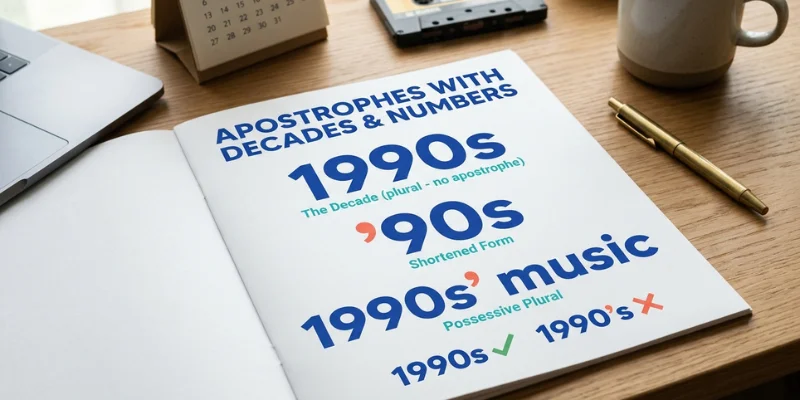
Do not use an apostrophe just to write a decade.
Correct:
- the 1980s
- the 1990s
- the 2000s
- the 2020s
Incorrect:
- the 1980’s
- the 1990’s
- the 2000’s
Example:
My parents grew up in the 1980s.
When you shorten a decade, however, an apostrophe shows the missing numbers.
For example:
- 1990s — the full form
- ’90s — the shortened form
The apostrophe in ’90s replaces the missing numbers 19.
Related Rules: Possessive Pronouns, Its vs. It’s, and Time Expressions
These rules are not all examples of apostrophes after S, but they help you avoid common punctuation mistakes.
1. Possessive pronouns do not need apostrophes
Possessive pronouns already show ownership. Do not add an apostrophe to them.
Incorrect:
- your’s
- her’s
- our’s
- their’s
Correct:
- yours
- hers
- ours
- theirs
Examples:
This bag is hers.
That house is theirs.
The word its also shows possession and does not need an apostrophe.
2. Its vs. It’s
These two words look similar but have different meanings.
Its shows possession.
Example:
The cat cleaned its paws.
The paws belong to the cat.
It’s is short for it is or it has.
Examples:
- It’s cold today. — It is cold today.
- It’s been a long day. — It has been a long day.
Here is an easy test: try replacing it’s with it is or it has. If the sentence makes sense, it’s may be correct.
For more examples of commonly confused words, read our guide to words often confused in English.
3. Apostrophes in time expressions
Time expressions can also use possessive apostrophes.
For one unit of time, use ’s:
- one day’s work
- one week’s holiday
- one month’s rent
- one year’s experience
Example:
I finished one week’s work today.
For a plural time expression ending in S, put the apostrophe after S:
- two days’ work
- three weeks’ holiday
- two months’ rent
- five years’ experience
Example:
She has five years’ experience.
The same pattern applies:
- One → ’s
- More than one ending in S → s’
Common Apostrophe Mistakes
Let’s look at a few mistakes and learn how to fix them.
Mistake 1: Adding an apostrophe to a normal plural
Incorrect: The student’s are waiting.
Correct: The students are waiting.
Use students when you mean more than one student. There is no possession in this sentence.
Mistake 2: Adding an extra S to a plural possessive
Incorrect: The students’s books are here.
Correct: The students’ books are here.
The word students already ends in S, so add only an apostrophe.
Mistake 3: Forgetting the apostrophe
Incorrect: The teachers room is upstairs.
Correct: The teachers’ room is upstairs.
The apostrophe shows that the room belongs to the teachers.
Mistake 4: Confusing Smiths and Smith’s
Incorrect: The Smith’s are coming to dinner.
Correct: The Smiths are coming to dinner.
Use Smiths when talking about the family. Use Smith’s when something belongs to one person named Smith.
Mistake 5: Writing 1990’s for a decade
Incorrect: She was born in the 1990’s.
Correct: She was born in the 1990s.
You do not need an apostrophe to make a decade plural.
Mistake 6: Adding apostrophes to possessive pronouns
Incorrect: The blue bag is her’s.
Correct: The blue bag is hers.
Words such as hers, yours, and theirs do not need apostrophes.
A Simple Three-Question Apostrophe Test
When you are unsure about an apostrophe, ask yourself these three questions.
Question 1: Am I only making a word plural?
If yes, do not use an apostrophe.
- Three books ✓
- Three book’s ✗
Question 2: Is one person, animal, or thing the owner?
If yes, usually use ’s.
- The girl’s bag
- The dog’s food
- James’s phone
Question 3: Is the owner plural and does the noun already end in S?
If yes, put the apostrophe after S.
- The girls’ bags
- The dogs’ food
- The students’ books
This quick test will help you choose the correct form in many everyday sentences.
For more help with clear writing, read our guide on how to improve English writing skills.
Apostrophe Before S or After S? Quick Comparison Table
Use this table whenever you need a quick reminder.
| Situation | Correct form | Example |
|---|---|---|
| One owner | ’s | The student’s book |
| Singular noun ending in S | Usually ’s | The boss’s office |
| Singular name ending in S | Often ’s | James’s book |
| Plural noun ending in S | s’ | The students’ books |
| Plural noun not ending in S | ’s | The children’s toys |
| Ordinary plural | No apostrophe | Five books |
| Full decade | No apostrophe | The 1990s |
| Shortened decade | Apostrophe for missing digits | The ’90s |
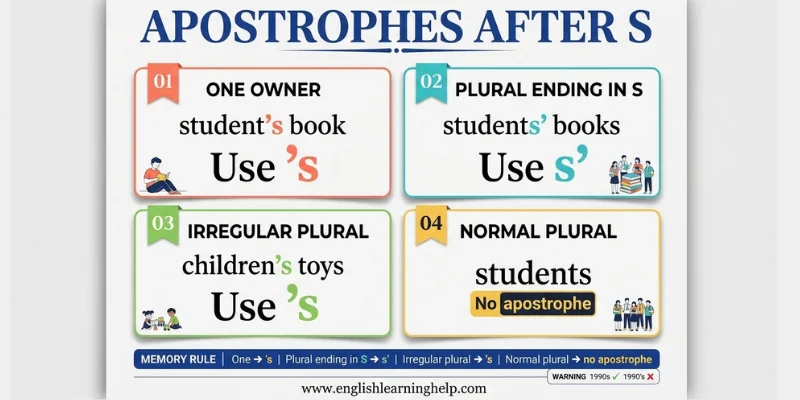
Four rules to remember
- One owner → ’s: the student’s book
- Plural owner ending in S → s’: the students’ books
- Plural not ending in S → ’s: the children’s toys
- Normal plural → no apostrophe: five books
Apostrophes After S: Practice Worksheet
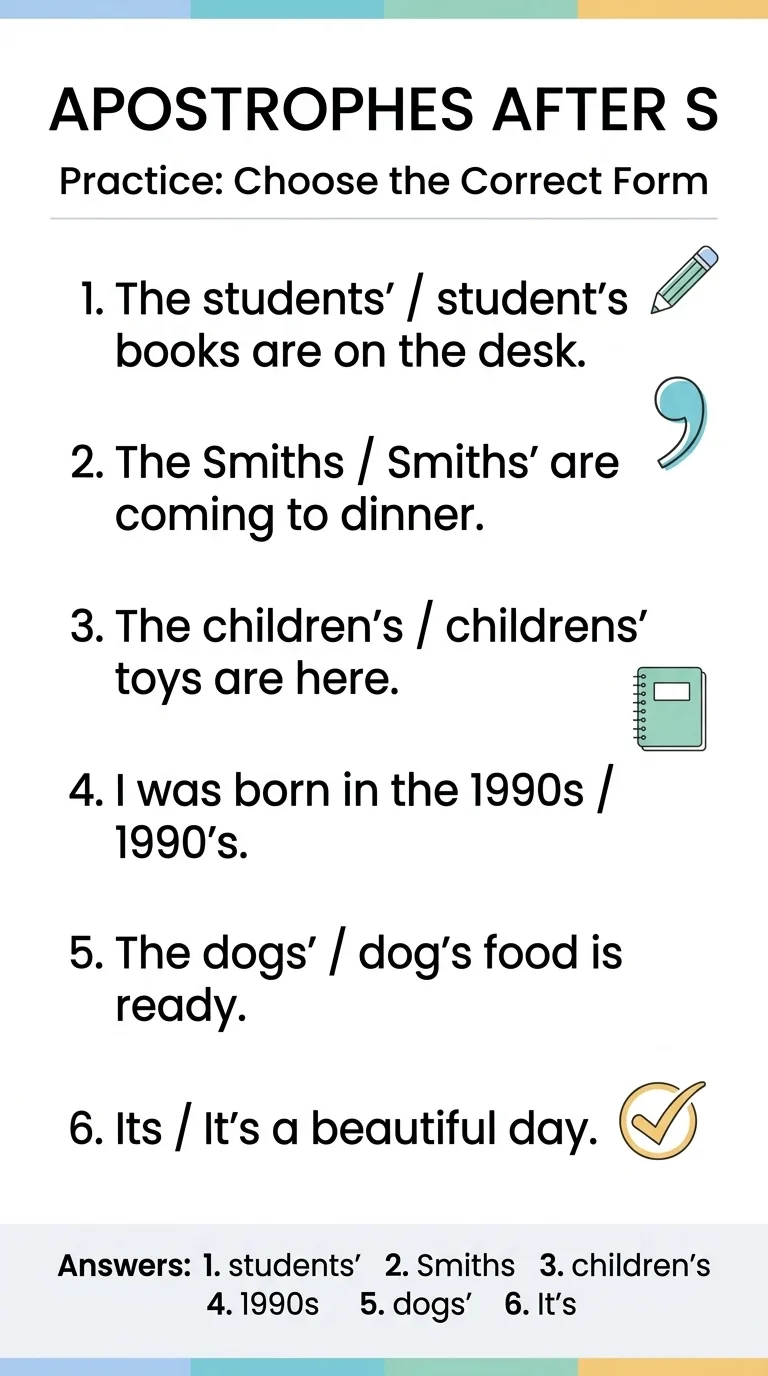
Now it is time to test what you have learned. Choose the correct answer for each question before checking the answer key.
Choose the correct form
1. The (student’s / students’) books are on the desk.
There are many students.
2. The (girl’s / girls’) bags are outside.
There are several girls.
3. The (children’s / childrens’) toys are everywhere.
4. I was born in the (1990s / 1990’s).
5. The (Smiths / Smiths’) are coming to dinner.
You mean the family.
6. The (Smiths / Smiths’) house is very large.
The house belongs to the family.
7. (Its / It’s) a beautiful day.
8. The dog hurt (its / it’s) leg.
9. The (teacher’s / teachers’) room is upstairs.
There are several teachers.
10. (James’s / James’) book is on the table.
Choose the common modern form.
Answers and explanations
- Students’ — The plural noun ends in S, so the apostrophe goes after S.
- Girls’ — Several girls own the bags.
- Children’s — Children is a plural noun that does not end in S.
- 1990s — Do not use an apostrophe to make a decade plural.
- Smiths — This means the Smith family. It does not show possession.
- Smiths’ — The house belongs to the Smith family.
- It’s — It means it is a beautiful day.
- Its — The word shows possession because the leg belongs to the dog.
- Teachers’ — The room belongs to several teachers.
- James’s — This is a common modern form for a singular name ending in S. Some style guides also allow James’.
If you made a mistake, read the matching rule again and try the question one more time. Practice helps these patterns become easier to remember.
Conclusion
Apostrophes after S are easier to understand when you first check whether the owner is singular or plural. Use ’s for one owner, s’ for a plural owner whose noun already ends in S, and ’s for irregular plurals such as children’s.
Also remember that ordinary plurals such as books and decades such as 1990s do not need apostrophes. With a little practice, you will find it easier to spot these mistakes and write clear English sentences.
Keep practising, use the examples in your own sentences, and visit EnglishLearningHelp.com for more simple English grammar lessons.
| Solve our quick Grammar Practice Test and view your score immediately. |
|---|
FAQ’s
Put an apostrophe after S when a plural noun that already ends in S shows possession. For example, students’ books means the books belong to the students. You do not add another S after the apostrophe.
Student’s means something belongs to one student, as in the student’s book. Students’ means something belongs to more than one student, as in the students’ books. The number of owners changes where the apostrophe goes.
Both forms are used in English because style guides differ. James’s is a common modern form, while some guides prefer or allow James’. Follow the rules required by your school, teacher, or workplace.
Use Smiths when you mean more than one person with that family name, as in the Smiths are visiting. Use Smith’s when something belongs to one person named Smith, as in Mr. Smith’s car. For something belonging to the whole family, write the Smiths’ house.
Irregular plural nouns that do not end in S usually take ’s to show possession. Examples include children’s toys, men’s shoes, and women’s clothes. The apostrophe comes before the S because these plural nouns do not already end in S.
No. Ordinary plural nouns do not need apostrophes. Write books, cars, and students when you simply mean more than one. Use an apostrophe only when it has a purpose, such as showing possession or missing letters in a contraction.
Write 1990s when you mean the decade. Do not use an apostrophe to make the number plural. You can write ’90s when shortening the decade because the apostrophe shows that the first two digits have been left out.
No. Possessive pronouns such as yours, hers, ours, theirs, and its do not need apostrophes. For example, write This book is hers, not This book is her’s. Remember that it’s means it is or it has, while its shows possession.



- Be Respectful
- Stay Relevant
- Stay Positive
- True Feedback
- Encourage Discussion
- Avoid Spamming
- No Fake News
- Don't Copy-Paste
- No Personal Attacks
- Be Respectful
- Stay Relevant
- Stay Positive
- True Feedback
- Encourage Discussion
- Avoid Spamming
- No Fake News
- Don't Copy-Paste
- No Personal Attacks
