30 Common Grammar Mistakes in English (And How to Fix Them)
Published: 10 Oct 2026
Have you ever written an English sentence that looked correct but still felt wrong? You are not alone. Many English learners make small grammar mistakes every day. Some happen because two words look alike. Others happen because we forget a rule or use the wrong verb.
The good news is that you do not need to learn every grammar rule at once. You can improve your English by learning one mistake at a time.
In this guide, you will learn 30 common grammar mistakes in English. Each mistake includes a wrong example, a correct sentence, and a simple explanation. You will also find useful tips and a practice quiz at the end.
Let’s get started!
What Are Common English Grammar Mistakes?
Common English grammar mistakes are errors people often make when they speak or write English. They can involve verbs, nouns, prepositions, word choice, sentence order, or punctuation.
For example:
- Incorrect: She go to school every day.
- Correct: She goes to school every day.
The second sentence is correct because we add -s to the verb when we talk about one person in the present simple tense.
Learning these errors can help you write clear sentences, speak with more confidence, and understand English more easily.
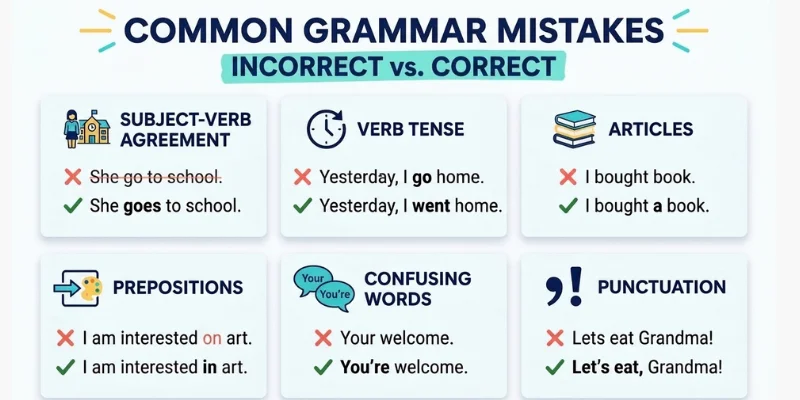
1. Common Verb and Tense Mistakes
Verbs tell us what someone does or what happens. A small verb mistake can change the meaning of a sentence or make it sound incorrect.
1. Subject–Verb Agreement
The subject and verb must agree. With he, she, or it in the present simple tense, we usually add -s or -es to the verb.
Incorrect: He play football every Sunday.
Correct: He plays football every Sunday.
More examples:
- Incorrect: My sister like music.
- Correct: My sister likes music.
- Incorrect: They plays cricket.
- Correct: They play cricket.
Easy tip: Use plays with he, she, and it. Use play with I, you, we, and they.
2. Using the Wrong Verb Tense
Verb tenses tell us when an action happens. Use the tense that matches the time.
Incorrect: Yesterday, I go to the market.
Correct: Yesterday, I went to the market.
The word yesterday tells us that the action happened in the past. So, we use went, not go.
More examples:
- Incorrect: She eat breakfast an hour ago.
- Correct: She ate breakfast an hour ago.
- Incorrect: We will went tomorrow.
- Correct: We will go tomorrow.
Easy tip: Learn common past forms, such as go → went, eat → ate, and see → saw.
3. Confusing Do, Does, and Did
We use do, does, and did to make many questions and negative sentences.
Incorrect: Does he likes tea?
Correct: Does he like tea?
After does, use the base form of the verb. Do not add -s to the main verb.
More examples:
- Incorrect: She don’t eat meat.
- Correct: She doesn’t eat meat.
- Incorrect: Did you went home?
- Correct: Did you go home?
Easy tip: After do, does, or did, use the base form of the main verb.
4. Confusing Has, Have, and Had
These words can show possession or help form verb tenses.
Incorrect: She have a new bag.
Correct: She has a new bag.
Use has with he, she, and it in the present tense. Use have with I, you, we, and they. Use had for possession in the past.
More examples:
- Incorrect: They has two cats.
- Correct: They have two cats.
- Incorrect: He have finished his work.
- Correct: He has finished his work.
Easy tip: Remember this pattern: I have, she has, they have, and we had yesterday.
5. Confusing Present Simple and Present Continuous
The present simple describes habits and facts. The present continuous describes actions happening now or around the present time.
Incorrect: I am go to school every day.
Correct: I go to school every day.
The sentence describes a daily habit, so we use the present simple.
Compare these examples:
- Habit: She reads every evening.
- Happening now: She is reading now.
- Habit: They play football on Fridays.
- Happening now: They are playing football.
Easy tip: Use the present simple for habits. Use am/is/are + verb-ing for actions in progress.
6. Confusing Since and For
Both words can describe time, but they have different uses.
Use since for the starting point of an action. Use “for” for the length of time.
Incorrect: I have lived here since five years.
Correct: I have lived here for five years.
More examples:
- I have known her since 2022.
- He has worked here for six months.
- We have been friends since childhood.
Easy tip: Since Monday tells you when something started. For three days tells you how long it has lasted.
For more examples, read our guide to Since vs. For.

2. Common Noun, Article, and Determiner Mistakes
Nouns name people, places, things, and ideas. Articles and determiners help us talk about nouns clearly.
7. Using A, An, and The Incorrectly
We often use a or an when we talk about one non-specific thing. We use the when the reader or listener knows which thing we mean.
Incorrect: I saw elephant at the zoo.
Correct: I saw an elephant at the zoo.
The noun elephant needs an article here. We use an because elephant begins with a vowel sound.
More examples:
- Incorrect: She is an teacher.
- Correct: She is a teacher.
- Incorrect: Sun is very bright today.
- Correct: The sun is very bright today.
Easy tip: Choose a or an by the first sound of the next word. Use the when you mean a specific thing.
8. Confusing Countable and Uncountable Nouns
Countable nouns have singular and plural forms. Uncountable nouns usually do not have a normal plural form when we talk about them in general.
Incorrect: I need some informations.
Correct: I need some information.
In standard English, information is uncountable. We do not usually add -s to it.
More examples:
- Incorrect: She gave me many advices.
- Correct: She gave me a lot of advice.
- Incorrect: I bought three furnitures.
- Correct: I bought three pieces of furniture.
Easy tip: Learn whether a noun is countable or uncountable. Common uncountable nouns include information, advice, furniture, and equipment.
9. Confusing Much and Many
Use many with countable plural nouns. Use much with uncountable nouns.
Incorrect: How much books do you have?
Correct: How many books do you have?
Books is a countable plural noun, so we use many.
More examples:
- How much water do you drink?
- How many students are in your class?
- We don’t have much time.
- She has many friends.
Easy tip: If you can count the items one by one, use many. If you cannot count the noun directly, much may be the right choice.
Read our Much vs. Many guide for more practice.
10. Confusing Few, A Few, Little, and A Little
These words help us talk about small amounts.
Use few and a few with countable plural nouns. Use little and a little with uncountable nouns.
Incorrect: I have a little friends at school.
Correct: I have a few friends at school.
Friends is a countable plural noun, so a few is correct.
Compare these examples:
- I have few friends here. (Almost none; a negative idea.)
- I have a few friends here. (Some friends; a positive idea.)
- We have little time left. (Almost no time.)
- We have a little time left. (Some time remains.)
Easy tip: Few goes with countable nouns. Little goes with uncountable nouns.
Learn more in our guides to Few vs. A Few and Little vs. A Little.
11. Using Incorrect Plural Nouns
Most English nouns form their plural by adding -s or -es. However, some nouns have special plural forms.
Incorrect: The childs are playing outside.
Correct: The children are playing outside.
Child has an irregular plural form: children.
More examples:
- Incorrect: I have two foots.
- Correct: I have two feet.
- Incorrect: We saw three mouses.
- Correct: We saw three mice.
- Incorrect: She bought two boxs.
- Correct: She bought two boxes.
Easy tip: Learn irregular plurals as you meet them. Common examples include child → children, foot → feet, and mouse → mice.
3. Common Preposition Mistakes
Prepositions show relationships between words. They can tell us where something is, when it happens, or how things connect.
12. Confusing In, On, and At
We use in, on, and at in different ways. The correct choice depends on the meaning and context.
Incorrect: My birthday is in Monday.
Correct: My birthday is on Monday.
We use on with days of the week.
More examples:
- I live in Lahore.
- The book is on the table.
- We will meet at 5 p.m.
- She is at school.
Easy tip: Use in for many larger places and periods, on for surfaces and days, and at for specific points or locations. There are exceptions, so learn common phrases too.
Explore our guides to In vs. On and Prepositions of Time.
13. Using the Wrong Preposition After a Word
Some verbs and adjectives often go with particular prepositions. Using the wrong one can make a sentence sound unnatural.
Incorrect: She is good in English.
Correct: She is good at English.
Here, good at is the usual expression.
More examples:
- Incorrect: I am interested on science.
- Correct: I am interested in science.
- Incorrect: He depends of his parents.
- Correct: He depends on his parents.
- Incorrect: She is afraid from dogs.
- Correct: She is afraid of dogs.
Easy tip: Learn words and their common prepositions together. For example, learn interested in, not just interested.
14. Adding Unnecessary Prepositions
Sometimes learners add a preposition when English does not need one.
Incorrect: We discussed about the problem.
Correct: We discussed the problem.
The verb discuss takes an object directly. It does not need about in this sentence.
More examples:
- Less natural in this context: She entered into the room.
- More natural: She entered the room.
- Incorrect: He reached to the station.
- Correct: He reached the station.
Easy tip: Check the verb before adding a preposition. Some verbs need one, but others do not.
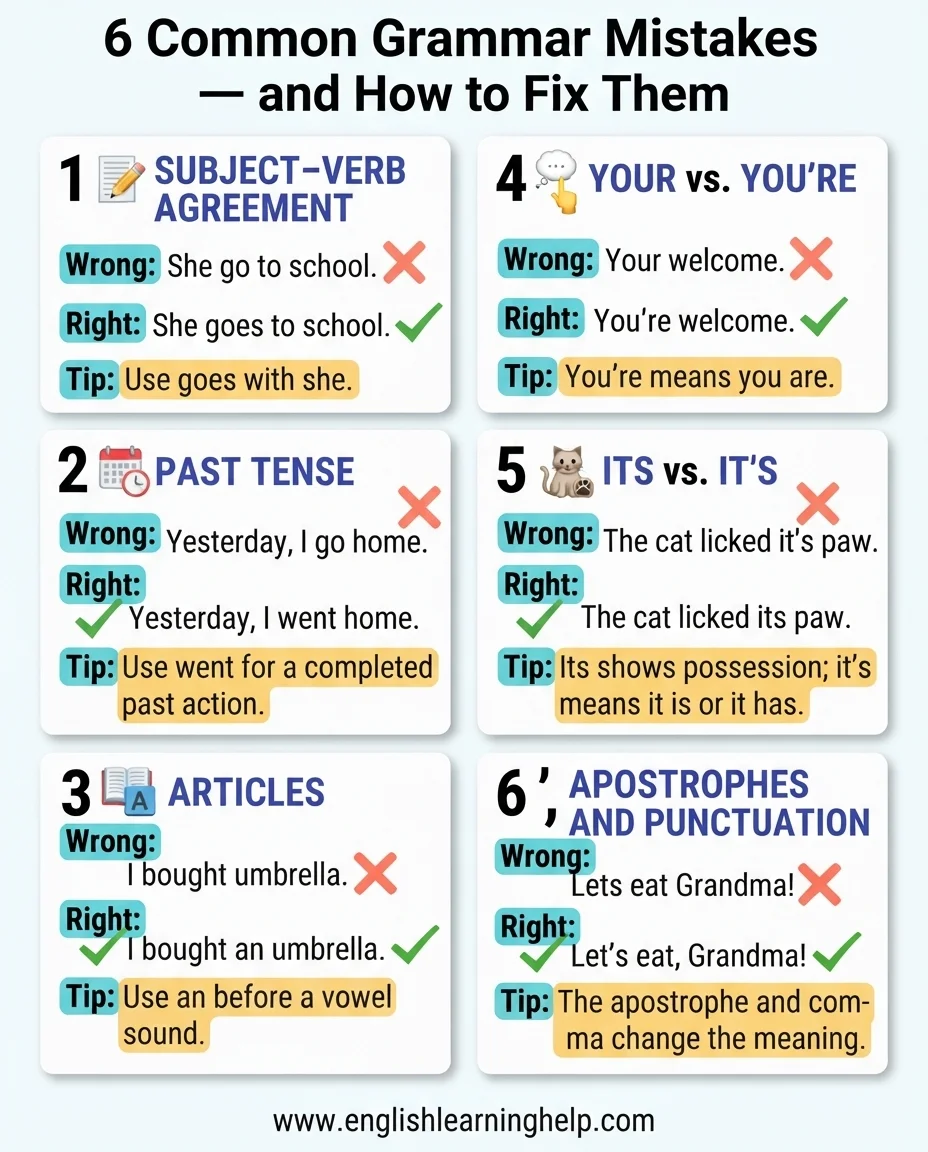
4. Commonly Confused English Words
Some English words sound alike or look similar. Their meanings may be very different. These mistakes can appear in both schoolwork and everyday messages.
15. Your vs. You’re
These words sound alike, but they have different meanings.
- Your shows ownership.
- You’re means you are.
Incorrect: Your going to enjoy this book.
Correct: You’re going to enjoy this book.
More examples:
- Is this your pencil?
- You’re very kind.
- Please bring your notebook.
Easy tip: Replace you’re with you are. If the sentence still makes sense, you’re is correct.
16. Their vs. There vs. They’re
These three words sound alike, but each has a different job.
- Their shows ownership.
- There can refer to a place.
- They’re means they are.
Incorrect: Their going to the park.
Correct: They’re going to the park.
More examples:
- Their house is large.
- Put the bag over there.
- They’re waiting for the bus.
Easy tip: If you mean they are, write they’re. If you mean something belongs to them, use their.
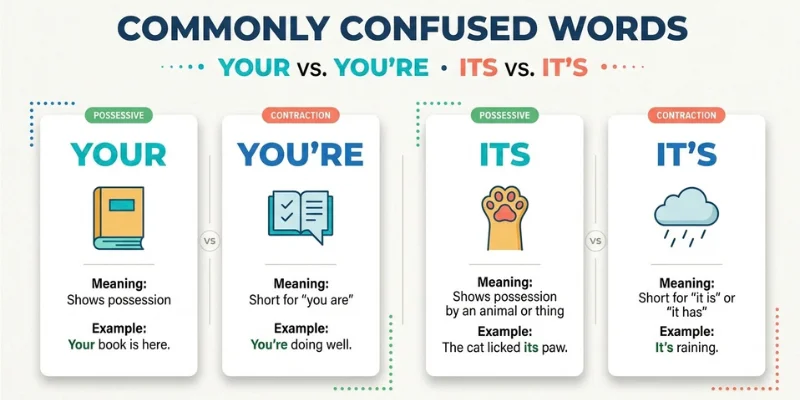
17. Its vs. It’s
This mistake is common because the apostrophe rule can feel confusing.
- Its shows ownership.
- It’s means it is or it has.
Incorrect: The cat licked it’s paw.
Correct: The cat licked its paw.
More examples:
- It’s a sunny day. (It is a sunny day.)
- The dog wagged its tail.
- It’s been a long day. (It has been a long day.)
Easy tip: Try replacing it’s with it is or it has. If neither meaning fits, you may need its.
18. Then vs. Than
Use then to talk about time, order, or what happens next. Use than to compare things.
Incorrect: My brother is taller then me.
Correct: My brother is taller than me.
More examples:
- Finish your homework, then play.
- This bag is cheaper than that one.
- We ate dinner and then watched a film.
Easy tip: Than is used for comparisons. Then often tells you what happens next.
19. Affect vs. Effect
These words are easy to mix up. In many everyday sentences, affect is a verb and effect is a noun.
Incorrect: The rain had a bad affect on our trip.
Correct: The rain had a bad effect on our trip.
More examples:
- Lack of sleep can affect your mood.
- The new rule had a positive effect.
- Loud noise affects my concentration.
Easy tip: If you need an action word, affect is often correct. If you need a noun for a result, use effect.
20. Lose vs. Loose
These words look similar but have different meanings.
- Lose means to misplace something or fail to win.
- Loose means not tight.
Incorrect: Don’t loose your keys.
Correct: Don’t lose your keys.
More examples:
- Our team might lose the match.
- This shirt is too loose.
- I don’t want to lose my phone.
Easy tip: Lose has one “o” in the middle. Loose has two. Think of the extra “o” in loose as extra room.
21. Everyday vs. Every Day
These words are related, but they do not work the same way.
- Everyday is an adjective. It means ordinary or usual.
- Every day means each day.
Incorrect: I practise English everyday.
Correct: I practise English every day.
More examples:
- These are my everyday shoes.
- She reads every day.
- We use everyday words in simple conversations.
Easy tip: If you mean each day, use two words: every day.
5. Common Sentence Structure and Pronoun Mistakes
A correct sentence needs the right word order and enough information to express a complete thought. Pronouns must also match the people or things they refer to.
22. Using the Wrong Word Order
English usually follows a subject–verb–object pattern.
Incorrect: She English speaks every day.
Correct: She speaks English every day.
The subject is she. The verb is speaks. The object is English.
More examples:
- Incorrect: I every morning drink milk.
- Correct: I drink milk every morning.
- Incorrect: Always he is late.
- Correct: He is always late.
Easy tip: Start with the person or thing doing the action. Then add the verb and the rest of the sentence.
23. Writing Sentence Fragments
A sentence fragment is an incomplete sentence. It may be missing a subject, a verb, or a complete thought.
Incorrect: Because I was tired.
Correct: I went to bed early because I was tired.
The first example leaves the reader waiting for more information.
More examples:
- Incorrect: When the teacher arrived.
- Correct: We started the lesson when the teacher arrived.
- Incorrect: My best friend from school.
- Correct: My best friend from school lives nearby.
Easy tip: Check that your sentence expresses a complete thought. A group of words is not always a complete sentence.
24. Joining Sentences Incorrectly
A run-on sentence happens when two complete sentences are joined without the correct punctuation or linking words.
Incorrect: I was hungry I made a sandwich.
Correct: I was hungry, so I made a sandwich.
You can also use a full stop to separate the ideas.
Correct: I was hungry. I made a sandwich.
More examples:
- Incorrect: It was raining we stayed inside.
- Correct: It was raining, so we stayed inside.
Easy tip: When you have two complete thoughts, join them with suitable punctuation or a linking word.
25. Confusing Subject and Object Pronouns
Use subject pronouns such as I, he, she, and they for the person doing the action. Use object pronouns such as me, him, her, and them for the person receiving the action.
Incorrect in standard written English: Me and Ali went to school.
Correct: Ali and I went to school.
More examples:
- Incorrect: The teacher helped she.
- Correct: The teacher helped her.
- Incorrect: He gave the books to we.
- Correct: He gave the books to us.
Easy tip: Ask who does the action. Use a subject pronoun for that person. If someone receives the action, use an object pronoun.
| Take our Free Grammar Test here to evaluate your English Grammar skills. |
|---|

6. Common Punctuation and Word-Form Mistakes
Punctuation helps readers understand your meaning. The form of a word also matters. These small details can make your writing much clearer.
26. Using Apostrophes Incorrectly
Apostrophes can show ownership or missing letters in contractions. They do not usually make a noun plural.
Incorrect: The girls bag is red.
Correct: The girl’s bag is red.
The apostrophe shows that the bag belongs to one girl.
Compare these examples:
- One boy’s bag = the bag of one boy.
- Two boys’ bags = bags belonging to two boys.
- Three girls = a normal plural, with no apostrophe.
Easy tip: Use an apostrophe for possession or contractions, not just to make a word plural.
Read our full guide to Apostrophes for more examples.
27. Missing or Misusing Commas
Commas separate parts of a sentence and make lists easier to read. A missing comma can sometimes confuse the reader.
Incorrect: Before we left we locked the door.
Correct: Before we left, we locked the door.
The comma helps separate the opening part from the main sentence.
More examples:
- Incorrect: I bought apples bananas and oranges.
- Correct: I bought apples, bananas, and oranges.
- Incorrect: No I don’t need help.
- Correct: No, I don’t need help.
Easy tip: Use commas to separate items in a list and after many introductory phrases. Do not add commas randomly.
28. Confusing Adjectives and Adverbs
Adjectives describe nouns. Adverbs often describe verbs and tell us how an action happens.
Incorrect: She sings beautiful.
Correct: She sings beautifully.
Beautiful describes a noun, while beautifully describes how she sings.
More examples:
- Incorrect: He runs quick.
- Correct: He runs quickly.
- Incorrect: She is a beautifully singer.
- Correct: She is a beautiful singer.
Easy tip: Ask what the word describes. If it describes a noun, you may need an adjective. If it describes an action, you may need an adverb.
29. Using Double Negatives
A double negative uses two negative words in a way that creates a nonstandard negative sentence in standard English.
Incorrect in standard English: I don’t have nothing.
Correct: I don’t have anything.
Another correct option is: I have nothing.
More examples:
- Incorrect in standard English: She didn’t see nobody.
- Correct: She didn’t see anybody.
- Incorrect in standard English: We don’t need no help.
- Correct: We don’t need any help.
Easy tip: In standard English, use one negative structure. For example, say I know nothing or I don’t know anything.
Note that some dialects use double negatives as a normal feature. The examples above follow standard English for school and formal writing.
30. Making Incorrect Comparisons
Comparative words help us compare two people or things. Do not use two comparative forms together.
Incorrect: This book is more easier than that one.
Correct: This book is easier than that one.
The word easier already shows a comparison. We do not need more.
More examples:
- Incorrect: My bag is more heavier than yours.
- Correct: My bag is heavier than yours.
- Incorrect: She is the most tallest girl in the class.
- Correct: She is the tallest girl in the class.
Easy tip: Use -er with many short adjectives, such as tall → taller. Use more with many longer adjectives, such as beautiful → more beautiful. Do not use both forms together.
How to Avoid Common Grammar Mistakes
You do not have to fix every mistake in one day. Small steps can make a big difference.
1. Read Your Sentences Again
After writing, read each sentence slowly. Check whether the words make sense together. Look for missing words and incorrect verb forms.
2. Learn One Rule at a Time
Do not try to memorize every grammar rule at once. Start with a rule you often get wrong. Practise it until you feel more confident.
3. Write Short Sentences
Short sentences are easier to check. For example:
- I wake up early.
- I eat breakfast.
- I go to school.
Once you can write simple sentences correctly, you can join ideas and write longer ones.
4. Keep a List of Your Mistakes
Write down the errors you often make. Add the correct version next to each error.
For example:
- Wrong: She don’t like tea.
- Right: She doesn’t like tea.
Review your list every few days. This helps you remember the correct forms.
5. Read English Every Day
Read short stories, simple articles, and English lessons. Notice how writers use verbs, prepositions, and punctuation. Try writing your own sentences with the same patterns.
6. Practise Writing Without Grammar Mistakes
Choose a simple topic, such as your family, school, or daily routine. Write five to ten sentences. Then check your verbs, nouns, prepositions, and punctuation.
You can also use a grammar checker to find possible errors. However, do not accept every suggestion without thinking. Learn why a correction makes sense.
For more help, visit our guide to Improve English Writing Skills.
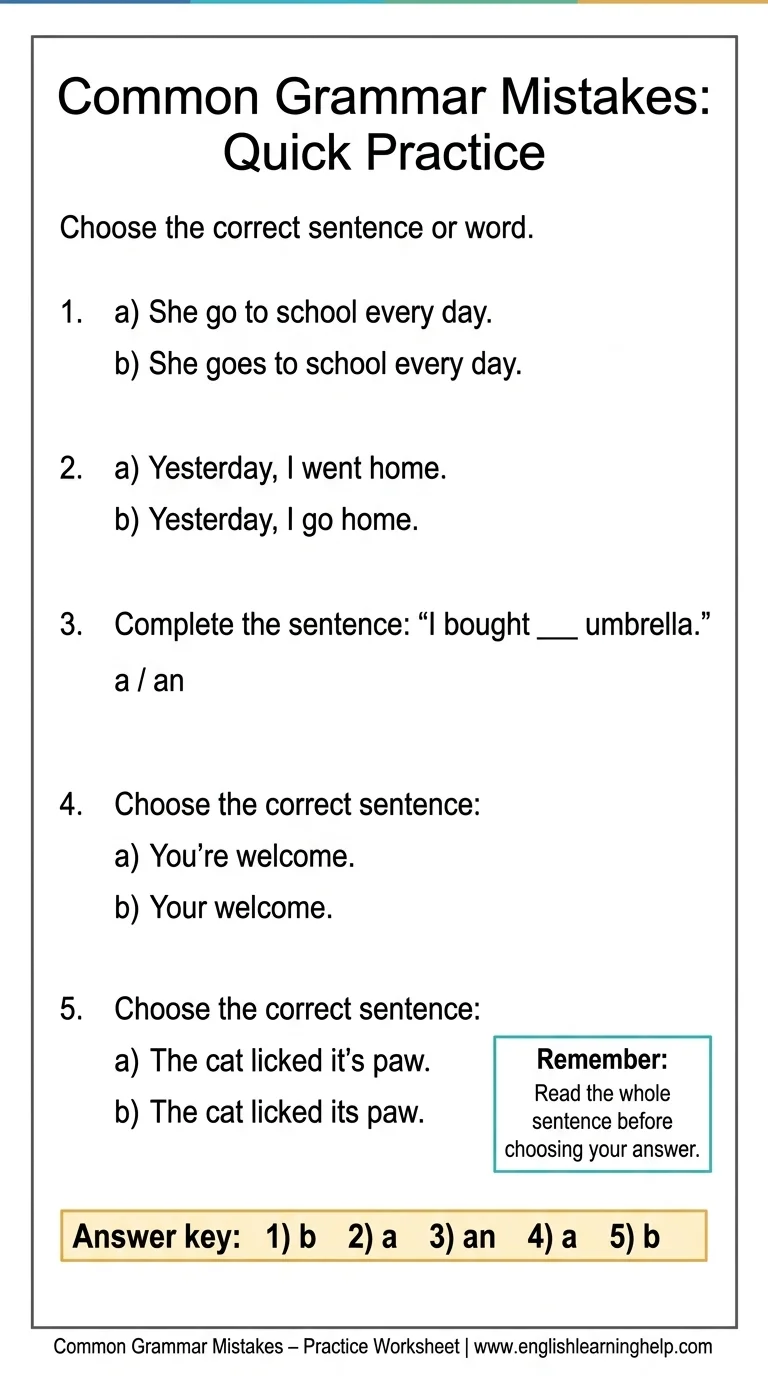
Practice Quiz: Can You Find the Grammar Mistakes?
Test what you have learned. Choose the correct answer for each question. Ready to test your skills? Access the Free Grammar Test here.
1. She ___ to school every day.
- A. go
- B. goes
- C. going
2. I have lived here ___ five years.
- A. since
- B. for
- C. at
3. How ___ books do you have?
- A. much
- B. many
- C. little
4. ___ going to visit us tomorrow.
- A. Your
- B. You’re
- C. Yours
5. The cat cleaned ___ paws.
- A. it’s
- B. its
- C. it
6. My brother is taller ___ me.
- A. then
- B. than
- C. that
7. We discussed ___ the problem.
- A. about
- B. on
- C. no preposition is needed
8. I don’t have ___ to say.
- A. nothing
- B. anything
- C. nobody
9. This question is ___ than the last one.
- A. more easier
- B. easiest
- C. easier
10. The ___ bags are near the door. The bags belong to two boys.
- A. boy’s
- B. boys
- C. boys’
Answers and Explanations
- B — goes. Use goes with she in the present simple.
- B — for. Use for to show a length of time.
- B — many. Books is a countable plural noun.
- B — You’re. It means you are.
- B — its. It shows ownership. It’s means it is or it has.
- B — than. Use than to compare people or things.
- C — no preposition is needed. We say discuss the problem.
- B — anything. This is the standard form with don’t.
- C — easier. Do not use more with easier.
- C — boys’. The plural noun boys already ends in s, so the apostrophe goes after the s to show ownership.
If you got some answers wrong, do not worry. Review those sections and try the quiz again later.
Conclusion
Everyone makes grammar mistakes while learning English. What matters is how you learn from them. Start with the rules that give you the most trouble, practise with simple sentences, and check your work regularly.
You do not need perfect English to make progress. You need patience, practice, and a willingness to learn. Keep working on one mistake at a time, and you will build stronger English skills.
Keep learning with EnglishLearningHelp.com, and practise a little every day!
Common mistakes include incorrect verb forms, wrong prepositions, missing articles, and confusing words such as your and you’re. Sentence structure and punctuation can also cause problems. Learning these errors can help you write and speak more clearly.
Many learners struggle with subject–verb agreement, verb tenses, articles, prepositions, and plural nouns. They may also confuse their, there, and they’re, or use much and many incorrectly. The exact list can vary by learner and language background.
Start with basic rules and practise them in short sentences. Read English every day and check your writing for repeated mistakes. Keep a list of your errors and review the correct forms often.
Learners may use the rules of their first language when speaking English. They may also forget irregular forms or confuse similar-sounding words. Regular practice and clear examples can help them improve over time.
Read your work slowly and check one type of error at a time. Look at verbs, articles, prepositions, and punctuation. A grammar checker can help, but you should also understand why each correction is made.
A grammar mistake happens when you use words or arrange them incorrectly in a sentence. For example, She go to school has a grammar mistake. A spelling mistake happens when you write a word incorrectly, such as frend instead of friend.



- Be Respectful
- Stay Relevant
- Stay Positive
- True Feedback
- Encourage Discussion
- Avoid Spamming
- No Fake News
- Don't Copy-Paste
- No Personal Attacks
- Be Respectful
- Stay Relevant
- Stay Positive
- True Feedback
- Encourage Discussion
- Avoid Spamming
- No Fake News
- Don't Copy-Paste
- No Personal Attacks
