English Grammar Basics: A Simple Guide for Beginners
Published: 12 Oct 2026
Learning English becomes easier when you understand the basic grammar rules. Grammar helps you put words together, make clear sentences, and share your ideas correctly.
The good news is that English grammar becomes easier when you learn it step by step. You do not need to memorize every rule in one day. Start with simple examples, practice regularly, and learn from your mistakes.
This guide explains English Grammar Basics in simple words. You will learn parts of speech, sentence structure, basic tenses, common grammar rules, and easy exercises to practise what you learn.
What Are English Grammar Basics?
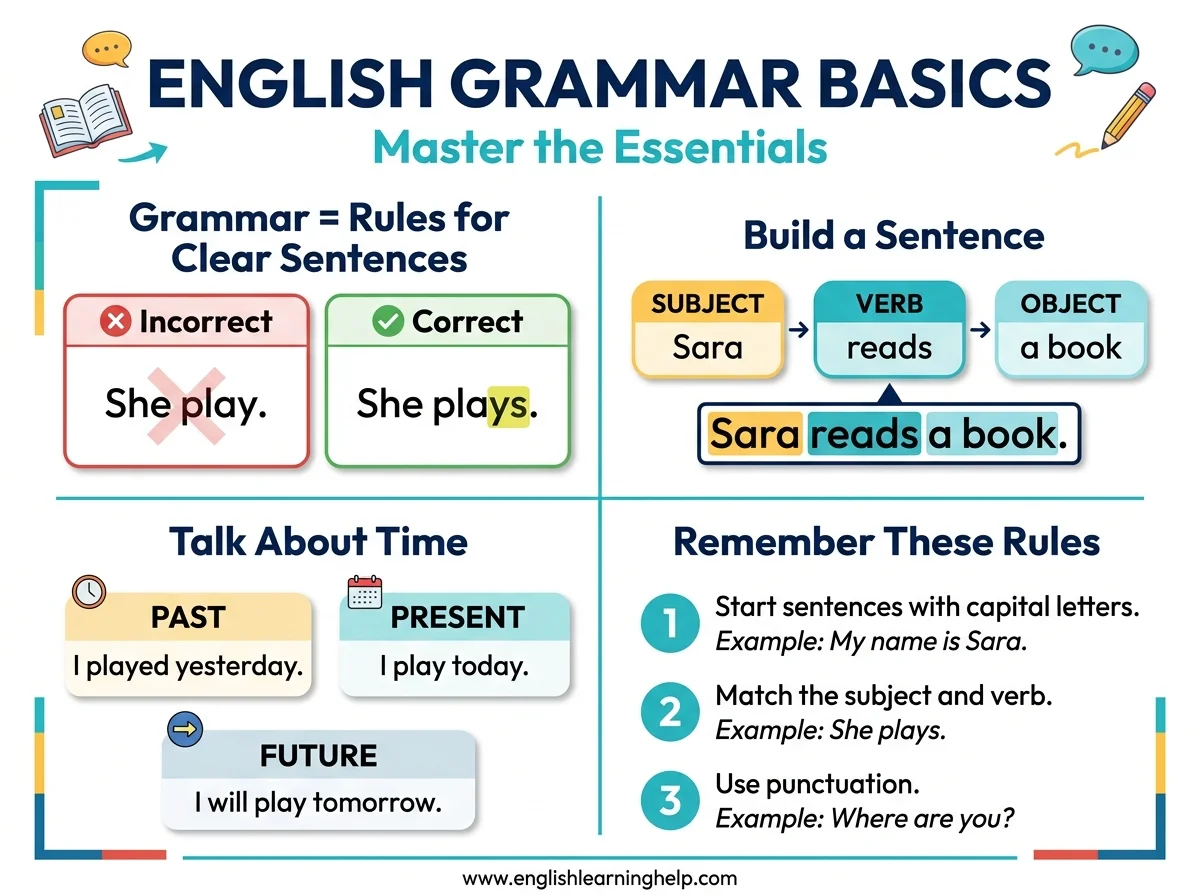
English grammar is a set of rules that helps us use words to make clear sentences. It shows us how to arrange words and express our ideas correctly.
Look at these examples:
- Incorrect: She play cricket.
- Correct: She plays cricket.
In the simple present tense, we usually add -s or -es to the main verb when the subject is he, she, or it.
Here is another example:
- Incorrect: I happy.
- Correct: I am happy.
The second sentence needs the verb “am” to make a complete sentence.
Grammar helps you speak, read, and write English more clearly. Learning the basic rules gives you a strong starting point.
Basic English Grammar Rules
Let’s begin with some important rules that every beginner should know.
1. Start Sentences with Capital Letters
Start every sentence with a capital letter. Also, use capital letters for people’s names, place names, countries, and the word “I.”
Examples:
- My brother likes football.
- Sara lives in Lahore.
- I am learning English.
Incorrect: my friend is kind.
Correct: My friend is kind.
2. Use the Correct Word Order
A common English sentence follows this pattern:
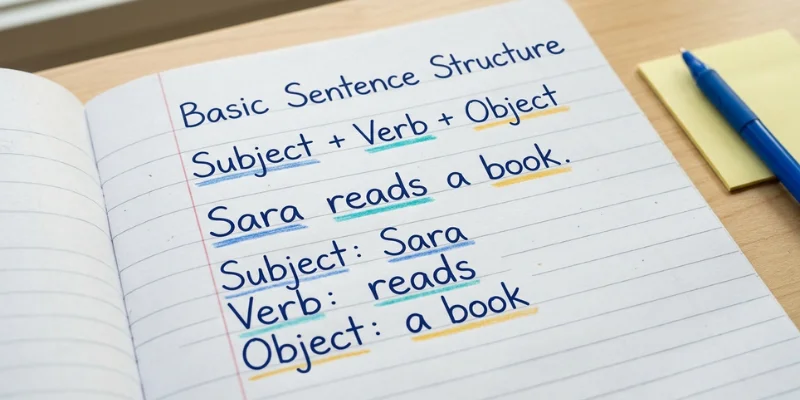
Subject + Verb + Object
- Ali eats an apple.
- Sara reads a book.
- The boy kicks the ball.
The subject tells us who or what the sentence is about. The verb tells us about an action or state. The object receives the action when the sentence has one.
For example, in “Sara reads a book”:
- Subject: Sara
- Verb: reads
- Object: a book
Not every sentence needs an object. For example, “Birds fly” is a complete sentence.
You can learn more by practicing these simple English sentences for daily use.
3. Match the Subject and Verb
The subject and verb must agree. In the simple present tense, we usually add -s or -es to the verb when the subject is he, she, or it.
| Subject | Correct sentence |
| I | I play football. |
| You | You play football. |
| He | He plays football. |
| She | She plays football. |
| They | They play football. |
Remember these examples:
- Incorrect: He like tea.
- Correct: He likes tea.
- Incorrect: They goes to school.
- Correct: They go to school.
The verb also changes with “be”:
- I am happy.
- She is happy.
- They are happy.
4. Understand Singular and Plural Nouns
A singular noun names one person, place, animal, or thing. A plural noun names more than one.
Examples:
- one book → two books
- one box → two boxes
- one child → two children
- one person → two people
Many nouns form their plural by adding -s or -es, but some have irregular forms.
English also uses different words to talk about amounts. Learn when to use much vs many and some vs any.
5. Use A, An, and The Correctly
These words come before nouns.
Use a before a word that begins with a consonant sound:
- a book
- a teacher
- a car
Use an before a word that begins with a vowel sound:
- an apple
- an egg
- an umbrella
- an hour
In “an hour,” the letter h is silent, so the word begins with a vowel sound.
Use the when you mean a particular person or thing:
- I saw a dog. The dog was brown.
- Please close the door.
The Eight Main Parts of Speech
Parts of speech show us how words work in sentences. English grammar traditionally teaches eight main parts of speech.
| Part of speech | Meaning | Example |
| Noun | Names a person, place, animal, or thing | teacher, school, cat |
| Pronoun | Takes the place of a noun | he, she, they |
| Verb | Shows an action or state | run, eat, is |
| Adjective | Describes a noun | tall, happy, blue |
| Adverb | Gives more information about a verb or another word | slowly, very |
| Preposition | Shows a relationship, often of place or time | in, on, at |
| Conjunction | Joins words or ideas | and, but, because |
| Interjection | Expresses a sudden feeling | Wow! Oh! |
“You may also see a, an, and the called articles. Many modern grammar books group them under determiners.”
Look at this sentence:
Wow! Sara quickly put the red book on the table.
- Wow: interjection
- Sara: noun
- quickly: adverb
- put: verb
- the: article (determiner)
- red: adjective
- book: noun
- on: preposition
- the: article (determiner)
- table: noun
You do not need to memorize every part of speech at once. Learn a few each day and find examples in the sentences you read.

Basic English Sentence Structure
A complete sentence usually expresses a complete thought. Many simple sentences have a subject and a verb.
Examples:
- Birds fly.
- The baby sleeps.
- My mother cooks dinner.
You can add more information to a sentence:
- Birds fly in the sky.
- The baby sleeps in her room.
- My mother cooks dinner every evening.
English sentences can serve different purposes.
Statements give information.
- I like English.
Questions ask for information.
- Do you like English?
Commands tell someone to do something.
- Open your book.
Exclamations show strong feelings.
- What a beautiful day!
As you improve, you can join ideas to make longer sentences.
- Simple: I was tired.
- Simple: I went to bed early.
- Combined: I was tired, so I went to bed early.
The word “so” connects the two ideas and shows their relationship.
Learn the Basic English Tenses
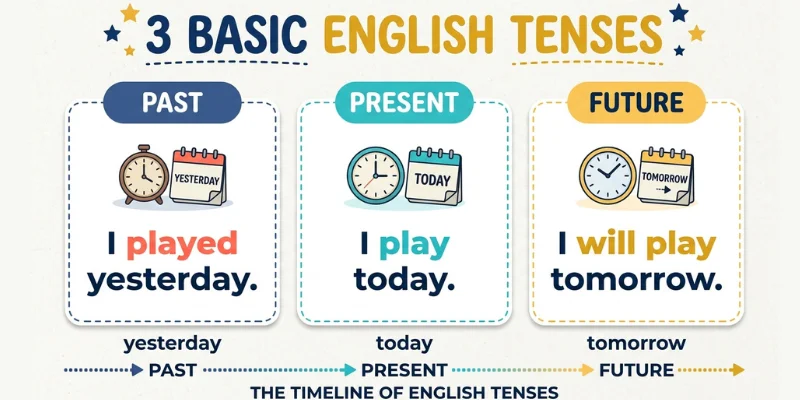
Tenses help us show when an action happens. Start with the simple present, simple past, and basic future forms.
1. Simple Present Tense
Use the simple present for habits, routines, and facts.
Examples:
- I go to school every day.
- She drinks milk in the morning.
- The sun rises in the east.
Remember that we usually add -s or -es to the verb with he, she, and it.
- I play cricket.
- He plays cricket.
2. Simple Past Tense
Use the simple past for actions that happened and ended in the past.
Examples:
- I visited my uncle yesterday.
- She played tennis last Sunday.
- We watched a movie last night.
Many verbs add -ed in the past tense:
- play → played
- walk → walked
Some verbs change their form:
- go → went
- eat → ate
- see → saw
3. Basic Future Forms
Use future forms to talk about things that have not happened yet.
Examples:
- I will call you tomorrow.
- She is going to visit her friend.
- We will study tonight.
We often use will for predictions or decisions made at the moment. We often use going to for plans or intentions. The correct choice depends on the situation.
Read our guide to will vs going to for more examples.
Practice tip: Write three sentences about your daily routine, three about yesterday, and three about your plans for tomorrow.
How to Make Questions and Negative Sentences
Questions ask for information. Negative sentences show that something isn’t true or doesn’t happen.
Making Questions
Use do or does to make many simple present questions.
- You like tea. → Do you like tea?
- She plays tennis. → Does she play tennis?
Use did for simple past questions.
- They watched the film. → Did they watch the film?
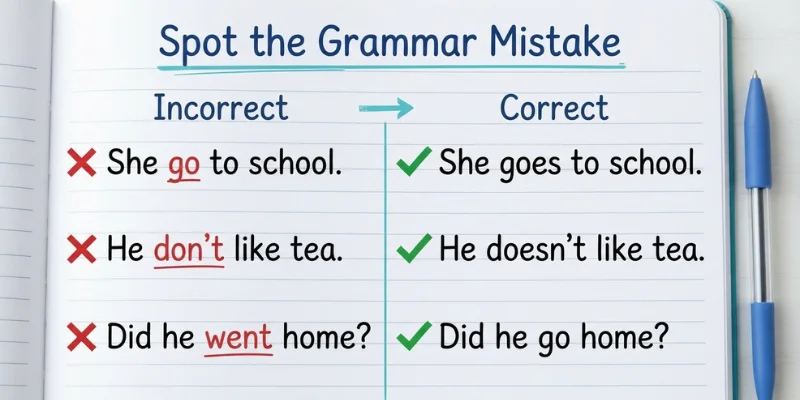
- He went home. → Did he go home?
After “does” or “did,” use the base form of the main verb.
- Incorrect: Does she likes tea?
- Correct: Does she like tea?
- Incorrect: Did he went home?
- Correct: Did he go home?
“With the verb be, change the word order: She is happy. → Is she happy? They were late. → Were they late?”
Making Negative Sentences
Use do not or does not for many simple present negative sentences.
- I do not like coffee.
- He does not play cricket.
Use did not for simple past negative sentences.
- She did not call me.
- We did not watch TV.
In everyday English, people often use shorter forms:
- do not → don’t
- does not → doesn’t
- did not → didn’t
Remember that “be” works differently:
- She is happy. → She is not happy.
- They were late. → They were not late.
Learn Prepositions of Time and Place
Prepositions are small words that show relationships between people, places, things, or times.
Prepositions of Place
- The keys are on the table.
- The children are in the classroom.
- I am at the bus stop.
Prepositions of Time
- I wake up at 7 a.m.
- My birthday is in July.
- We have a test on Monday.
These words can be confusing because we do not use them in the same way in every situation. Read our guides to at vs in and prepositions of time to learn more.
| Test Your Grammar Skill Now |
|---|
Use Punctuation Correctly
Punctuation helps readers understand your meaning. Without it, a sentence may become confusing.
| Mark | Name | Example |
| . | Full stop | I like English. |
| ? | Question mark | Where are you? |
| ! | Exclamation mark | What a surprise! |
| , | Comma | I bought apples, bananas, and oranges. |
| ‘ | Apostrophe | Sara’s book is new. |
An apostrophe can show possession or missing letters.
- Sara’s bag means the bag belongs to Sara.
- Don’t is a short form of “do not.”
A comma can also change the meaning of a sentence:
- Let’s eat, kids!
- Let’s eat kids!
The first sentence speaks to the kids. The second sentence has a very different meaning because it has no comma.
Read our guide to apostrophes for more examples.
Common English Grammar Mistakes to Avoid
Beginners often make mistakes while learning new rules. Look at these examples and notice how the correct sentences change.
| Incorrect | Correct |
| She go to school. | She goes to school. |
| I am agree. | I agree. |
| He don’t like tea. | He doesn’t like tea. |
| They was happy. | They were happy. |
| I have a apple. | I have an apple. |
| Did she went home? | Did she go home? |
When you write a sentence, check three things:
- Does the subject match the verb?
- Have you used the correct verb form?
- Does the sentence have the words it needs to express a complete thought?
For more examples, read our guide to common grammar mistakes.
How to Learn English Grammar Step by Step
You do not need to study grammar for hours every day. A short daily routine can help you make steady progress.
Step 1: Learn one rule. Start with a small topic, such as nouns or the simple present tense.
Step 2: Read examples. Find three to five sentences that use the rule.
Step 3: Write your own sentences. Write three sentences about your family, school, or daily life.
Step 4: Speak aloud. Read your sentences aloud to practice using English.
Step 5: Correct your mistakes. Write the correct forms in a notebook and review them later.
Step 6: Build your vocabulary. Learn new words and use them in your sentences. Our guide to English vocabulary development can help you get started.
Step 7: Practice regularly. Ten to fifteen minutes a day is a useful starting point. As you improve, you can study for longer.
If you want to use grammar in everyday conversations, read our guide on how to learn spoken English.
Practice Exercises
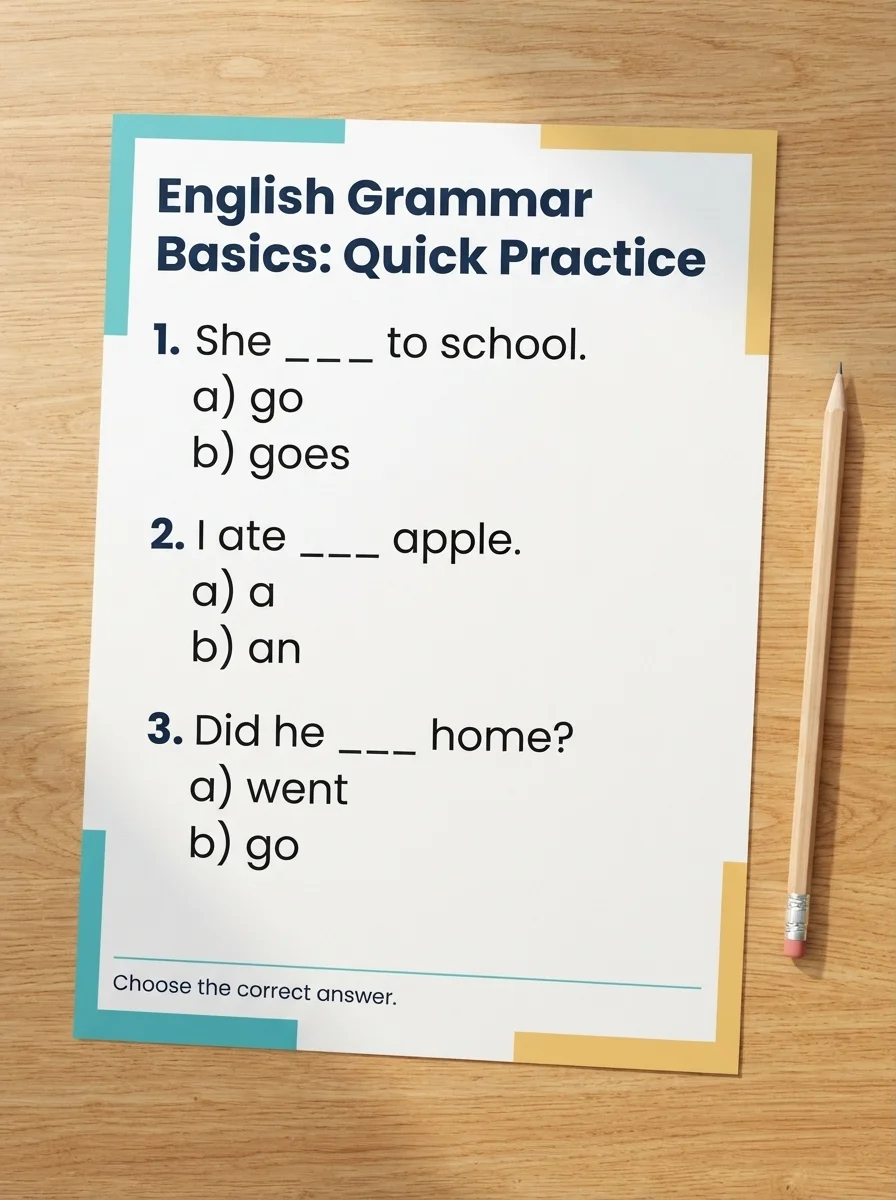
Test what you have learned. Choose the correct answer for each question. We also invite you to take our Free Grammar Test available on the website.
1. She ___ to school every day.
- a) go
- b) goes
- c) going
2. I ate ___ apple.
- a) a
- b) an
- c) the
3. They ___ happy yesterday.
- a) was
- b) were
- c) is
4. ___ you like English?
- a) Do
- b) Does
- c) Did
5. The book is ___ the table.
- a) on
- b) quickly
- c) happy
6. Did he ___ home yesterday?
- a) went
- b) goes
- c) go
Answers and Explanations
- b) goes — We use “goes” with “she” in the simple present tense.
- b) an — “Apple” begins with a vowel sound.
- b) were — We use “were” with “they” in the past tense.
- a) Do — We use “do” to make this simple present question.
- a) on — “On” tells us where the book is.
- c) go — Use the base form of the verb after “did.”
If you get an answer wrong, review the rule and try again. Every mistake gives you a chance to learn.
Conclusion
English grammar becomes easier when you learn one rule at a time. Start with sentence structure, parts of speech, and basic tenses. Then practice questions, prepositions, and punctuation.
Do not worry if you make mistakes. Correct them, try again, and use what you learn in daily conversations. A little practice each day can help you become a more confident English learner.
Ready to improve your English? Visit EnglishLearningHelp.com and keep learning one step at a time.
FAQ’s
Basic rules include using capital letters, arranging words in the right order, matching subjects and verbs, and choosing the correct verb tense. You should also learn articles, prepositions, and punctuation. Practice each rule with short sentences before moving to harder topics.
Start with nouns, pronouns, verbs, and simple sentence structure. Then learn basic tenses and common grammar rules. Read easy examples, write your own sentences, and practice a little every day. Review your mistakes instead of trying to memorize every rule at once.
Begin with the simple present, simple past, and basic future forms. These help you talk about daily habits, past events, and future plans. Once you understand them, move on to continuous and perfect forms.
Yes. Speaking gives you a chance to use grammar in real situations. Start with short sentences about your family, school, work, or daily routine. Listen to correct examples and review your mistakes. Reading and writing can also help you build stronger grammar skills.
The time depends on your current level and how often you practice. You may understand some basic rules within a few weeks, but using them correctly takes more practice. Set small goals, review what you learn, and focus on steady progress rather than speed.





- Be Respectful
- Stay Relevant
- Stay Positive
- True Feedback
- Encourage Discussion
- Avoid Spamming
- No Fake News
- Don't Copy-Paste
- No Personal Attacks
- Be Respectful
- Stay Relevant
- Stay Positive
- True Feedback
- Encourage Discussion
- Avoid Spamming
- No Fake News
- Don't Copy-Paste
- No Personal Attacks
