How Many Words Are in English? Dictionary Counts vs the Words You Actually Need
Published: 17 Oct 2026
English has words for almost everything, from everyday activities to complex scientific ideas. New words appear, old words change their meanings, and people borrow words from other languages. So, how many words are in English?
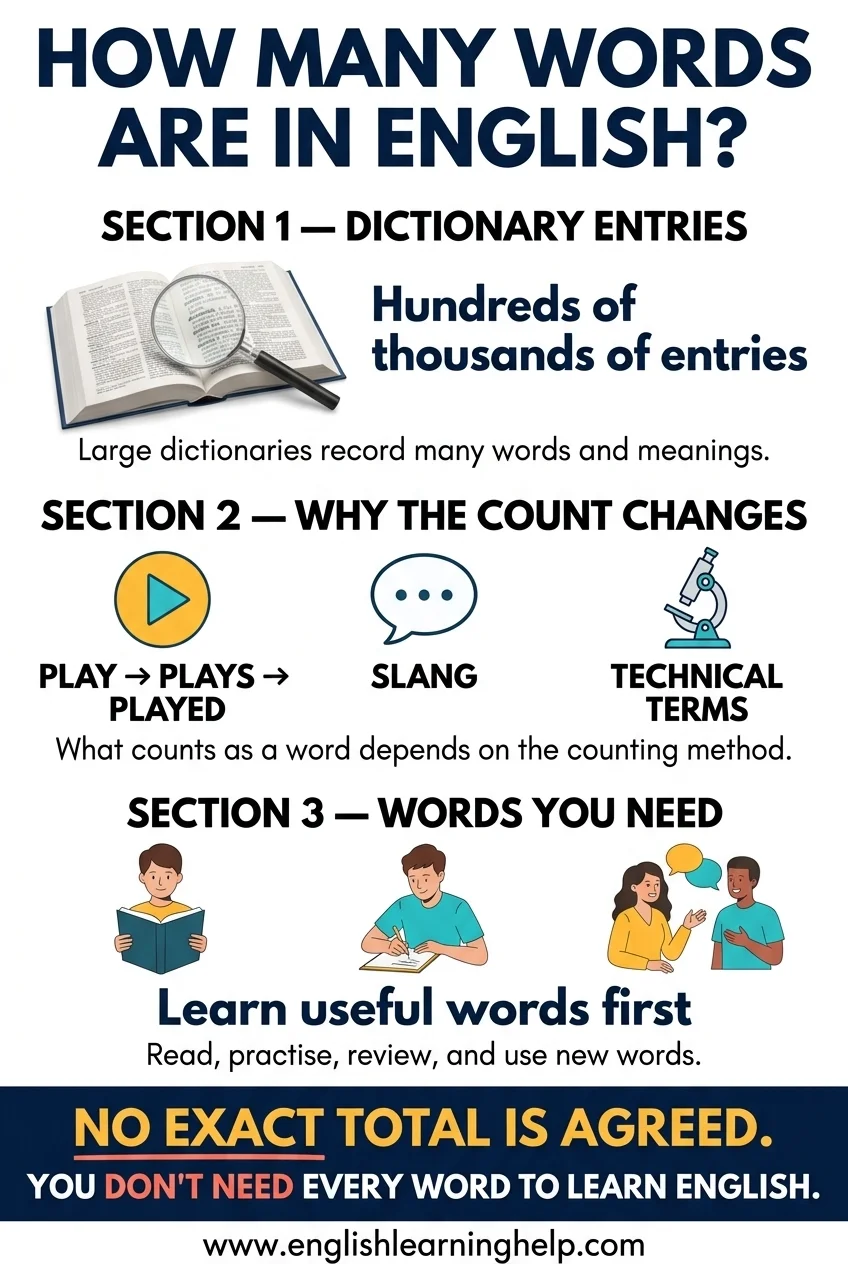
The honest answer is that nobody knows the exact total. Dictionaries contain hundreds of thousands of entries, but they do not include every word people use. The total also depends on what we count as a word.
But here is the more useful question: how many English words do you need to learn to speak, read, and write with confidence?
Let’s look at dictionary counts, vocabulary estimates, and practical ways to build your English vocabulary.
How Many Words Are in English Dictionaries?
Large English dictionaries contain hundreds of thousands of entries. However, each dictionary follows its own rules. Some include older words, regional expressions, and technical terms. Others focus more on words used in modern English.
A dictionary’s entry count can help us understand the size of its collection. It does not tell us the exact number of words in the entire English language.
The Oxford English Dictionary
The Oxford English Dictionary (OED) is one of the best-known historical dictionaries of English. It contains more than 500,000 entries and millions of quotations showing how English words have been used over time.
The OED does more than explain what words mean today. It also records their history and tracks changes in their meanings and use.
For example, a word may have had one meaning hundreds of years ago and a different meaning today. Historical quotations help show how that change happened.
The dictionary also continues to grow. Its editors add new words, phrases, and meanings and revise existing entries every quarter.
This is one reason we cannot treat a dictionary’s current entry count as a final count of all English words. The language continues to develop, and the dictionary continues to record those changes.
Merriam-Webster and Other Dictionaries
Merriam-Webster also explains why English has no exact word count. One problem is deciding what counts as a separate word.
For example, should drive, drives, and drove count as three words or different forms of one word? What about a word that has several unrelated meanings? Should a scientific term used by only a small group of experts count in the same way as a common word such as house?
Different dictionaries may answer these questions differently.
They may also include different types of vocabulary. A historical dictionary, a learner’s dictionary, and a technical dictionary serve different purposes.
That is why their word counts can vary. A larger number does not automatically mean that one dictionary is better than another. It may simply cover a wider range of English.

Why Is There No Exact Word Count for English?
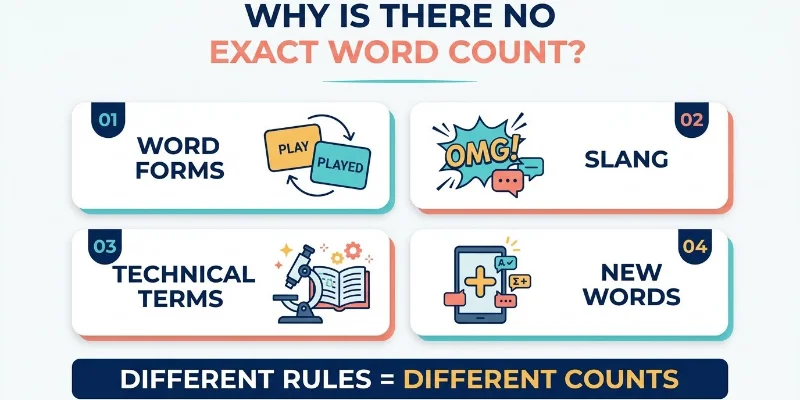
English does not have a fixed list of words that everyone agrees to count. Several factors make the task difficult.
Word Forms, Lemmas, and Word Families
One major problem is deciding whether different forms of a word should count separately.
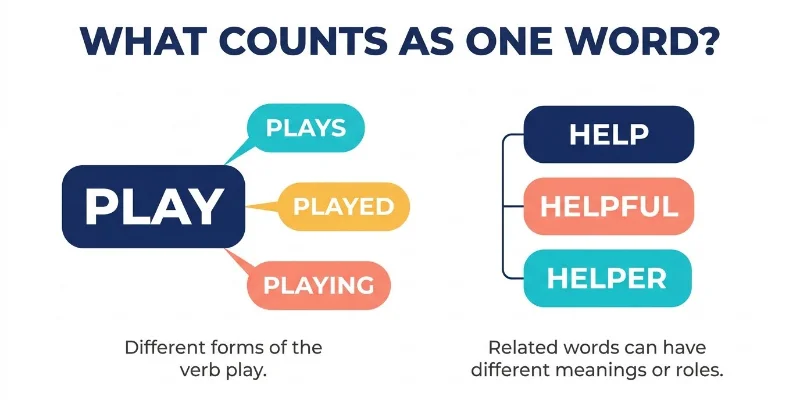
Consider the verb play:
- Play
- Plays
- Played
- Playing
These are four written forms of the same verb. If we count every form separately, the total increases. If we group them under the basic form play, the total becomes smaller.
Linguists often use the term lemma for a basic dictionary form of a word. For example, play, plays, and played can belong to the same lemma.
A word family is a broader group of related words. For example:
- Help
- Helpful
- Helpless
- Helper
- Helpfully
These words share a base, but they do not all have the same meaning or grammatical role.
There is no single counting method that everyone uses for every purpose. A dictionary may list several related forms under one entry, while a vocabulary study may group them together or count them differently.
This simple difference can change the final number by a great deal.
Slang, Technical Terms, and New Words
Another challenge is deciding which words belong in the count.
Think about the English words people use in daily life. Some are common everywhere, while others appear only in certain places, professions, or groups.
English includes:
- Slang: Informal words and expressions used in casual conversations.
- Regional words: Terms that are common in particular places.
- Technical terms: Words used in fields such as medicine, science, law, and engineering.
- New words: Terms that become popular as technology and culture change.
- Old words: Words that people no longer use often but that still appear in historical texts.
English also borrows words from other languages. Some borrowed words become a regular part of English, while others remain uncommon or are used only in special situations.
Should we count every scientific term, local expression, and newly created word? Should we include words that appeared centuries ago but are rarely used today?
Different counting methods produce different answers. That is why a single, exact total remains out of reach.
Why Does English Have Such a Large Vocabulary?
English has developed over many centuries. During that time, it has changed through migration, trade, cultural contact, education, science, and technology.
English has also borrowed words from many languages. French and Latin have had a major influence on English vocabulary. Words from Old Norse, Greek, Arabic, and many other languages have also become part of English.
Sometimes, English adopts a word from another language. At other times, people create new words by joining existing words, changing their forms, or giving familiar words new meanings.
Technology adds to this process. Words related to computers, social media, and digital communication have become common in modern life.
However, a large vocabulary does not mean that every English speaker knows or uses every word. Most people rely on a much smaller group of words in everyday conversations.
If you want to understand how English developed over time, read our guide to the history of the English language.
How Many Words Does a Native English Speaker Know?
There is no single vocabulary size for every native English speaker. Age, education, reading habits, personal interests, and life experiences can all affect how many words someone knows.
A research study published in Frontiers in Psychology estimated that an average 20-year-old native speaker of American English knew about 42,000 lemmas. The researchers also estimated knowledge of thousands of common multiword expressions.
These figures need some context. The study used a particular method to estimate vocabulary knowledge. It did not count every possible English word, and its results should not be treated as a universal number for all native speakers.
Knowing a word can also mean different things.
You may recognize a word when you read it but struggle to explain it. You may understand a word when someone speaks but rarely use it yourself. Or you may know its meaning and use it naturally in conversation.
These are different levels of word knowledge.
For example, you might understand the word enormous when reading a story but usually say very big when speaking. Both expressions communicate a similar idea, but your ability to recognize a word is not always the same as your ability to use it.
This is why vocabulary size alone does not tell the whole story. The way you understand and use words matters, too.
How Many Words Do You Need to Learn English?
You do not need to learn every word in an English dictionary to become a confident English user.
Your goal should be to learn words that help you understand others and express your own ideas. The right vocabulary depends on what you want to do with English.
For example, a student may need words for school subjects and assignments. Someone preparing for a job interview may need vocabulary for work, skills, and professional communication. A beginner may want to focus on shopping, travel, family, and daily routines.
Instead of chasing a huge number, build your vocabulary step by step.
Start With Common English Words
Begin with words you are likely to hear, read, and use often. These include everyday nouns, verbs, adjectives, and useful expressions.
For example:
| Word | Meaning | Example |
| Need | To require something | I need some water. |
| Choose | To pick one thing | Choose your favorite book. |
| Explain | To make something clear | Please explain this rule. |
| Improve | To make something better | I want to improve my English. |
| Enough | As much as needed | We have enough time. |
Do not learn a word only by memorizing its meaning. Learn how it works in a sentence.
For example, remember improve in a sentence such as, “I want to improve my writing.” This gives you a clearer idea of how to use the word naturally.
You should also learn common phrases. Expressions such as How are you?, Could you help me?, and I agree with you can be more useful in everyday conversation than rare dictionary words.
As your skills grow, add vocabulary related to your studies, work, hobbies, and other interests.
Build Vocabulary Through Reading and Practice
Reading is a useful way to discover new words in context. You can learn from short stories, news articles, simple books, blogs, and other material that matches your English level.
When you find an unfamiliar word, do not stop to look up every single one. First, try to understand the main idea. Then choose a few useful words to study.
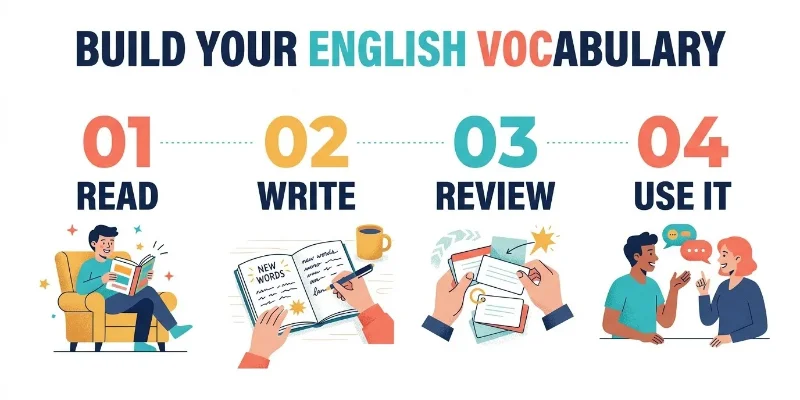
Follow these simple steps:
- Choose a short text. Read something you can mostly understand.
- Pick useful new words. Focus on words you may use again.
- Check the meaning. Use a reliable dictionary and read the example sentences.
- Write your own sentences. Connect each new word to your daily life.
- Review the words. Return to them after a day, a few days, and a week.
- Use them in real situations. Speak, write messages, or keep a short English journal.
For example, if you learn the word confident, you could write, “I feel more confident when I practice English.”
This helps you move beyond simply recognizing a word. You begin learning how to use it.
For more ideas, explore our guide to English vocabulary development. You can also practice useful expressions with our guide to simple English sentences for daily use.
Remember, you do not have to learn dozens of words every day. A few useful words that you understand and use well can be more valuable than a long list you quickly forget.
You can also take our English Grammar Test to practice your grammar skills and check your understanding of English.

English Compared With Other Languages
People often ask whether English has more words than languages such as French, Spanish, Arabic, or Chinese. A simple ranking is difficult to make fairly.
Languages have different writing systems, word-building rules, and dictionary traditions. Some dictionaries count certain word forms separately, while others group them under a single entry. Some also include more technical or historical terms than others.
For these reasons, comparing two dictionary counts does not automatically tell us which language has the larger vocabulary.
Languages also express ideas in different ways. One language may use a single word where another uses a phrase. Both can communicate the same idea without using the same number of words.
The more useful lesson is that every language has a rich vocabulary suited to its speakers and their needs. If you are learning English, focus on the words that help you communicate rather than trying to prove that one language has more words than another.
What Is the Longest Word in English?
One famous long English word is pneumonoultramicroscopicsilicovolcanoconiosis. It has 45 letters and is used for a lung disease associated with inhaling very fine silica dust.
However, calling it the single longest word in English can be misleading. The answer depends on what we count as a word. Some extremely long chemical names can be much longer, but they are not usually treated as ordinary vocabulary.
For everyday English learners, knowing this word is not a priority. It is an interesting example of how long a word can become, but common words and useful expressions will help you communicate far more often.
Conclusion
So, how many words are in English? There is no exact number that everyone agrees on. Dictionary counts give us a useful picture of the language, but they cannot include every word, form, expression, and technical term.
The more important question is how many words you need for your own goals. You do not have to memorize an entire dictionary to improve your English. Start with common vocabulary, read regularly, practice in sentences, and review what you learn.
Every useful word you learn gives you another way to understand people and express yourself. Keep practicing, stay curious, and build your English one word at a time.
| Now that you know the facts, check your skills using our Free English MCQs Test. |
|---|
FAQ’s
There is no exact, universally agreed total. The answer depends on how we count word forms, technical terms, slang, old words, and new words. Large dictionaries contain hundreds of thousands of entries, but they do not include every word that exists or is used in English.
No. The Oxford English Dictionary is a major historical record of English, with more than 500,000 entries. It documents words and their development over time, but no dictionary can capture every word, expression, name, or new term used by every English-speaking community.
English has developed over many centuries and borrowed vocabulary from numerous languages. Trade, migration, cultural contact, science, and technology have all contributed to its growth. People also create new words and give existing words new meanings, so the vocabulary keeps changing.
There is no fixed number for all native speakers. One research study estimated that an average 20-year-old native speaker of American English knew about 42,000 lemmas. This is an estimate based on a specific research method, not a universal total for every English speaker.
There is no single target that works for everyone. Beginners should start with common words and phrases used in everyday situations. Learn vocabulary for greetings, family, food, shopping, travel, and daily routines first. Then add words that match your personal goals and practice using them in sentences.
Yes. Fluent communication does not require knowing every word in the language. It requires understanding useful vocabulary, forming clear sentences, listening carefully, and expressing ideas naturally. You can also explain an unfamiliar idea in simpler words when you do not know the exact term.
Yes. New words and meanings appear as society, culture, and technology change. Some become widely used and enter dictionaries, while others remain limited to certain groups or situations. Dictionaries regularly review and update their entries, but a word’s appearance in a dictionary does not mean everyone uses or knows it.





- Be Respectful
- Stay Relevant
- Stay Positive
- True Feedback
- Encourage Discussion
- Avoid Spamming
- No Fake News
- Don't Copy-Paste
- No Personal Attacks
- Be Respectful
- Stay Relevant
- Stay Positive
- True Feedback
- Encourage Discussion
- Avoid Spamming
- No Fake News
- Don't Copy-Paste
- No Personal Attacks
