Much vs More: Simple Grammar Rules with Examples for English Learners
Published: 14 Sep 2026
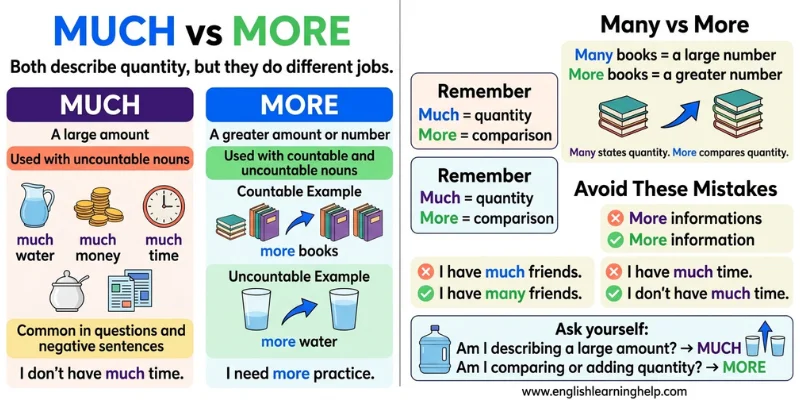
Have you ever wondered why we say “much money” but “more apples”?
Much and more both belong to a small group of words called quantifiers, words that describe amount or quantity without giving an exact number. These two short words, much and more, look simple but confuse many English learners. The much vs more confusion usually comes from one small detail that most people never get properly explained. Both words talk about quantity, but their usage depends on the noun type and the type of comparison you are making.
This confusion sits right next to a related one that trips up just as many learners: the difference between much and many. Once you understand both pairs together, quantity words in English stop feeling random.
In this easy guide, you will learn when to use much and when to use more, through simple rules, real-life examples, a quick comparison table, and practice exercises. By the end, you will never get confused again.
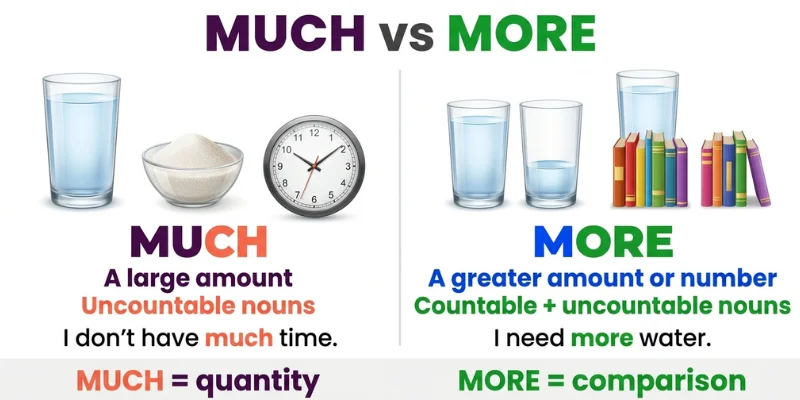
Main Rule: When to Use Much and More
| Word | Use With | Meaning | Example |
| Much | Uncountable nouns | A large amount (not countable) | I don’t have much money. |
| More | Both countable and uncountable nouns | A greater amount or number (comparison) | I have more money than before. |
Remember:
Much = quantity (used mostly in negatives and questions) More = comparison (used for both countable and uncountable nouns)
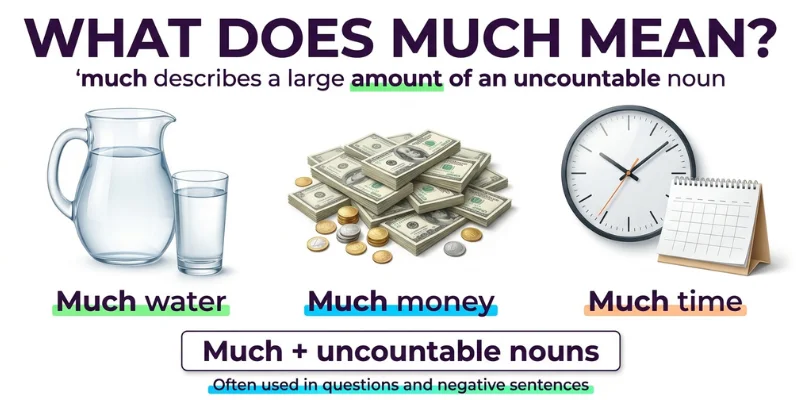
What Does Much Mean?
Much describes a large amount of something. It is used only with uncountable nouns, things you cannot count one by one, like water, time, money, or information.
Examples:
- I don’t have much time to finish this task.
- She didn’t spend much money on clothes.
- How much water do you drink every day?
Quick Tip: Use much mostly in negative sentences and questions.
Wrong: I have much time. Correct: I don’t have much time. Correct: Do you have much homework?
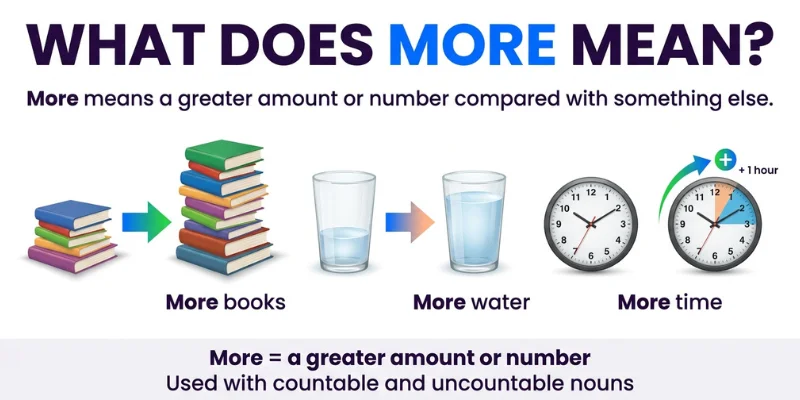
What Does More Mean?
If you are looking for a clear definition of more, here it is: more means a greater amount or number compared to something else. It is the comparative form of both many and much, which is exactly why it can be used with both countable and uncountable nouns.
Examples:
- I have more books than you. (countable)
- She needs more water to fill the tank. (uncountable)
- We should spend more time studying.
Quick Tip: More is used when comparing quantities. It shows an increase or a difference between two amounts
Many vs More: What Is the Real Difference?
This is where a lot of learners get stuck. Many and more both work with countable nouns, so it is easy to mix them up.
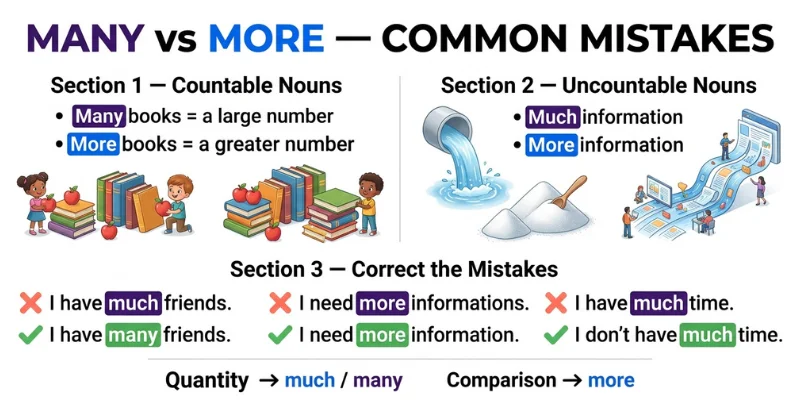
The difference comes down to comparison. Many simply states a large number on its own, with no comparison involved: “I have many friends.” More always compares one amount to another, even if the second amount is only implied: “I have more friends than I used to.”
Side by side:
- Many books = a large number of books (no comparison)
- More books = a greater number of books than before, or than someone else
The same logic applies to much vs more. Much states a large amount on its own. More compares that amount to something else. Once you see it this way, the choice between much, many, and more becomes about one simple question: am I stating a quantity, or comparing one?
In years of teaching English grammar, this exact question is the one habit that fixes the confusion fastest. Students who pause and ask themselves whether they are stating an amount or comparing two amounts almost always pick the right quantifier without needing to memorize a rule at all.
Quick Comparison Table: Much vs More
| Comparison Point | Much | More |
| Meaning | A large amount | A greater amount or number |
| Used With | Uncountable nouns | Both countable and uncountable nouns |
| Type | Quantity | Comparison |
| Common Usage | Negatives, questions | Positive sentences, comparisons |
| Example | I don’t have much sugar. | I need more sugar for tea. |
Common Mistakes to Avoid
Wrong: I have much friends. Correct: I have many friends. (Friends are countable, so use many instead of much.)
Wrong: I need more informations. Correct: I need more information. (Information is uncountable and has no plural form.)
Wrong: She didn’t eat more food. Correct: She didn’t eat much food. (Much fits better in negative sentences describing quantity.)
Pro Tip: If you are talking about quantity on its own, use much. If you are comparing or describing an increase, use more.
This same pattern connects closely to how English vocabulary grows over time. Small quantifier words like much, many, and more are exactly the kind of detail that separates learners who sound natural from learners who sound like they are translating word by word.
Real-Life Examples
There isn’t much traffic today; we’ll arrive early.
You need more sleep to stay healthy.
How much sugar do you take in tea?
I feel more confident after daily English practice.
These examples show that both much and more help describe how much or how great something is, just in different ways. Much states an amount. More compares it to something else.
Practice Exercises
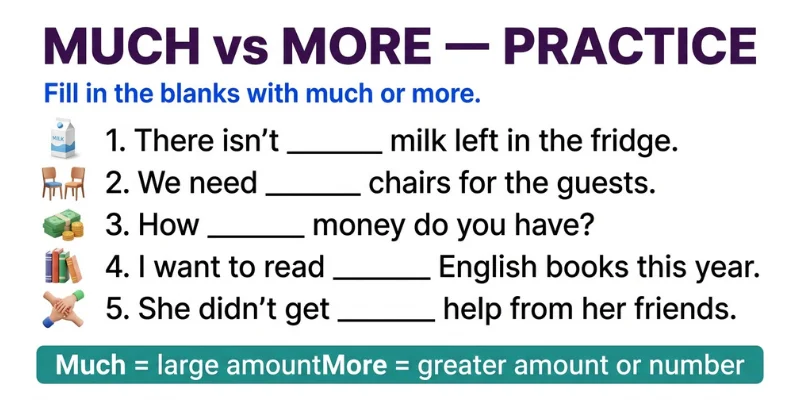
Fill in the blanks with much or more:
- There isn’t ___ milk left in the fridge.
- We need ___ chairs for the guests.
- How ___ money do you have?
- I want to read ___ English books this year.
- She didn’t get ___ help from her friends.
Answers: 1. much, 2. more, 3. much, 4. more, 5. much
Once these rules feel comfortable, applying them inside real writing is the fastest way to make the habit permanent. Practicing through English writing exercises that use quantifiers like much, many, and more in real sentences helps the rule move from memory into natural, automatic use.
Conclusion
Understanding much vs more comes down to one simple question: are you stating a quantity, or comparing one?
Much describes a large amount of something uncountable, most often in negative sentences or questions. More compares amounts and works with both countable and uncountable nouns, whether that is more books or more sugar.
Try writing a few sentences using much, like “I don’t have much time today,” and a few using more, like “I need more practice to improve my English.” Read them aloud and notice how naturally the difference starts to click.
Small, consistent practice like this is really what makes grammar rules stick for good.
No. Much is used only with uncountable nouns like water, money, and time. For countable nouns, use many instead, such as many apples, not much apples.
Yes. That is exactly why more is so flexible. You can say more apples (countable) or more water (uncountable). Either way, it simply means a greater amount.
In natural English, much can sound too formal or stiff in positive statements. Instead of saying “I have much money,” most people say “I have a lot of money.”
Much describes a large quantity of something on its own. More describes an increased or greater quantity compared to something else, since it is used for comparison.
Many states a large number without comparing it to anything. More always involves comparison, showing that one amount is greater than another. Both can be used with countable nouns, but only more implies a comparison.
Think about what you are describing. Use much when talking about a quantity on its own, like much time or much water. Use more when comparing, showing that something increases or is greater than before, like more time or more water than yesterday.



- Be Respectful
- Stay Relevant
- Stay Positive
- True Feedback
- Encourage Discussion
- Avoid Spamming
- No Fake News
- Don't Copy-Paste
- No Personal Attacks
- Be Respectful
- Stay Relevant
- Stay Positive
- True Feedback
- Encourage Discussion
- Avoid Spamming
- No Fake News
- Don't Copy-Paste
- No Personal Attacks
