Few vs A Few: Simple Grammar Guide with Examples for English Learners
Published: 26 Jul 2026
Do you ever get confused between “few” and “a few”?
You’re not alone. This is one of the most common grammar doubts English learners face. In fact, in years of teaching English grammar, this is one of the questions students ask most often, right alongside prepositions and tenses.
The good news is that this guide will make the difference between few and a few crystal clear with:
Easy explanations, real-life examples, a detailed comparison table, practice exercises with answers
By the end, you will never confuse “few” and “a few” again.
If grammar comparisons like this one help you, understanding what the English language is and how it developed gives you an even bigger picture of why these small word differences matter so much in communication.
Main Rule
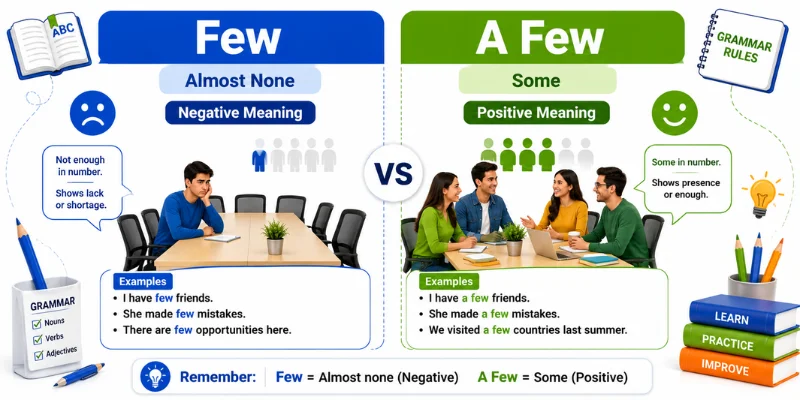
Both “few” and “a few” mean a small number, but the feeling behind them is different:
- Few = almost none (negative meaning)
- A few = some (positive meaning)
Think of it like this:
“Few” sounds disappointing. “A few” sounds hopeful.
Quick Comparison Table
| Comparison Point | “Few” | “A Few” | Meaning Difference | Example |
|---|---|---|---|---|
| Meaning | Almost none | Some | Negative vs Positive | Few people attended. / A few people attended. |
| Tone | Negative | Positive | Few = almost nothing | A few = at least some |
| Use | To show lack | To show presence | Few = not enough | A few = enough for purpose |
| Context | Disappointment | Satisfaction | Few students passed. | A few students passed. |
| Article used | No article | Has “a” | Different grammar use | Few chairs are broken. / A few chairs are new. |
What Does “Few” Mean?
Few means almost none or very little. It carries a negative meaning and shows that something is not enough or very small in number.
It is used with countable nouns.
Examples:
- I have few friends. (almost none, maybe 1 or 2, negative feeling)
- She made few mistakes. (not many, but the tone still feels negative)
- There are few opportunities in this area. (not enough opportunities)
Quick Tip: “Few” means not many. It shows a lack or shortage.
What Does A Few Mean?
A few means some, a small number but enough. This carries a positive meaning and shows presence instead of absence.
It is also used with countable nouns.
Examples:
- I have a few friends. (some friends, enough to be happy)
- She made a few mistakes. (some mistakes, but not too many)
- We visited a few countries last summer. (a small number, but enough)
Quick Tip: “A few” means some. It is positive in meaning.
This same logic connects to how you build English vocabulary over time. Small, meaningful differences like this one are exactly the kind of detail that separates learners who sound natural from learners who sound like they are translating word by word.
Common Mistakes to Avoid
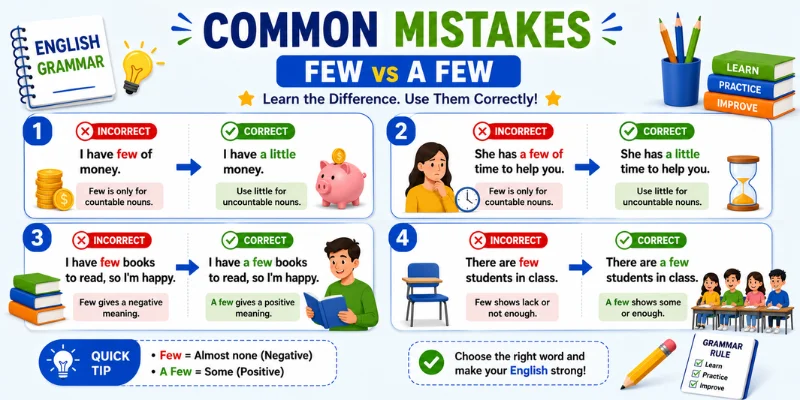
Wrong: I have few of money. Correct: I have a little money. (Few is only for countable nouns. Use little for uncountable ones.)
Wrong: She has a few of time to help you. Correct: She has a little time to help you.
Wrong: I have few books to read, so I’m happy. Correct: I have a few books to read, so I’m happy.
Remember:
- Few = negative (not enough)
- A few = positive (some or enough)
Practice Sentences
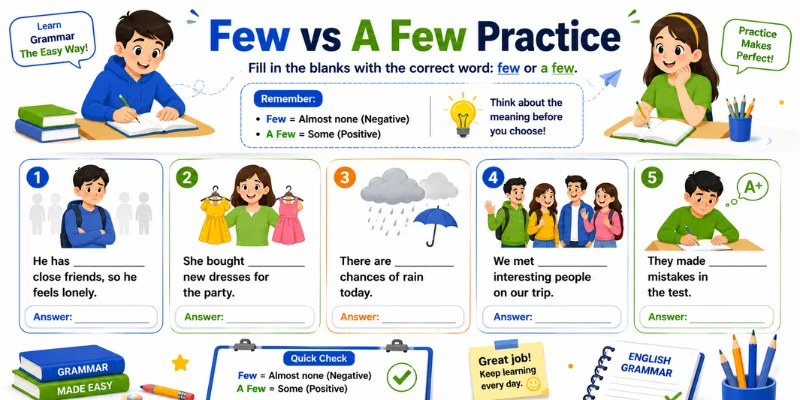
Fill in the blanks with “few” or “a few”:
- He has ___ close friends, so he feels lonely.
- She bought ___ new dresses for the party.
- There are ___ chances of rain today.
- We met ___ interesting people on our trip.
- They made ___ mistakes in the test.
Answers: 1. few, 2. a few, 3. few, 4. a few, 5. a few
Real-Life Examples
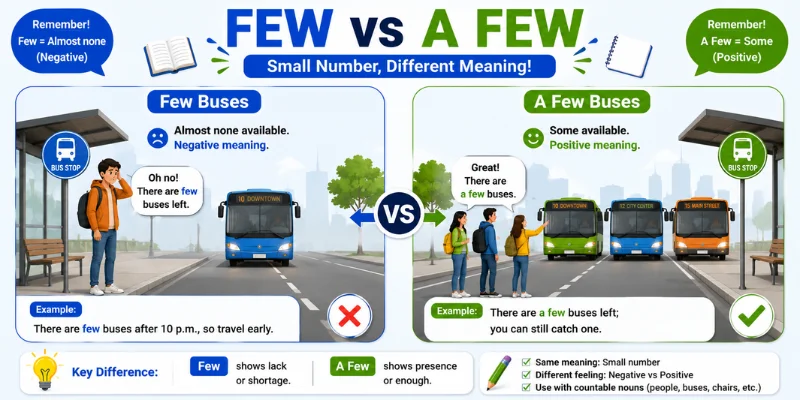
“There are few buses after 10 p.m., so travel early.”
“There are a few buses left; you can still catch one.”
Notice the difference:
“Few” sounds like a warning (almost none). “A few” sounds hopeful (some available).
Grammar rules like this one become second nature once you practice them inside real sentences instead of just memorizing definitions. Strong English writing skills come from exactly this kind of habit: noticing small differences and testing them in your own writing.
Conclusion
Few means almost none, giving a negative sense, while a few means some, giving a positive sense. Both are used with countable nouns.
Try this quick practice. Write three sentences using “few,” for example with friends, books, or cars. Then write three sentences using “a few,” like ideas, pencils, or days.
Read them aloud and ask yourself: does the sentence sound positive or negative? This simple check helps your brain notice the difference naturally.
Daily practice will make these rules second nature. Soon, you will use “few” and “a few” correctly without even thinking about it.
“Few” and “a few” are only used with countable nouns like books, cars, or people. For uncountable nouns such as water or money, we use “little” and “a little” instead. Always check if the noun can be counted before choosing.
“Few” gives a negative feeling, meaning almost none or not enough. “A few” gives a positive feeling, meaning some or enough to be useful. The meaning is small, but the feeling is very different.
Yes, “very few” is correct and common. It makes the idea stronger. For example, “Very few students passed the test” means almost none passed. It shows a stronger sense of lack compared to just “few.”
Both mean more than one but less than many. “A few” usually means a smaller number, like 3 to 4, while “some” can mean more, like 10 or more. For example, “a few apples” is less than “some apples.”
Yes, “few” can start a sentence. It often makes the sentence sound stronger or more dramatic. For example: “Few people know this secret.” This means almost nobody knows.






- Be Respectful
- Stay Relevant
- Stay Positive
- True Feedback
- Encourage Discussion
- Avoid Spamming
- No Fake News
- Don't Copy-Paste
- No Personal Attacks
- Be Respectful
- Stay Relevant
- Stay Positive
- True Feedback
- Encourage Discussion
- Avoid Spamming
- No Fake News
- Don't Copy-Paste
- No Personal Attacks
