History of the English Language: The Story Behind the Words You Use Every Day
Published: 6 Jul 2026
You are learning English right now.
But did you ever stop and ask — where did English actually come from? What is the history of the English language?
Why does the word “knife” have a K that nobody says? Why do we use words like “purchase” and “buy” that mean the same thing? Why are some grammar rules so confusing?
These are real questions. And they all have one answer.
English has a long story. A very long one. And once you know even a small part of that story, everything starts making more sense. The spelling, the grammar, the weird rules — they all have a reason.
This article tells you that story. In simple words. Step by step.
And if you are just starting your English journey, it helps to first understand what the English language is and how it works today. That makes this history even easier to follow.
English Did Not Start in England
Here is the first surprise.
English did not come from England. The people who created it came from other countries.
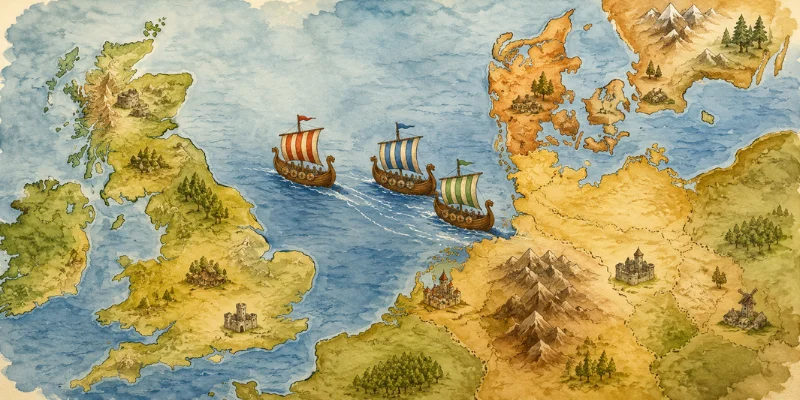
Around 450 AD, three groups of people crossed the sea and came to live in Britain. They came from what we now call Germany and Denmark. The three groups were called the Angles, the Saxons, and the Jutes.
Each group spoke its own language. But they all lived together in the same land. So their languages slowly mixed. Day by day, year by year, the mixing happened.
That mixed language became the very first English. People today call it Old English.
Here is a fun fact. The word “English” comes from the word “Angles.” So in a way, we are all speaking “Anglish.”
Old English (450 to 1100 AD)
Old English does not look like the English you are reading right now.
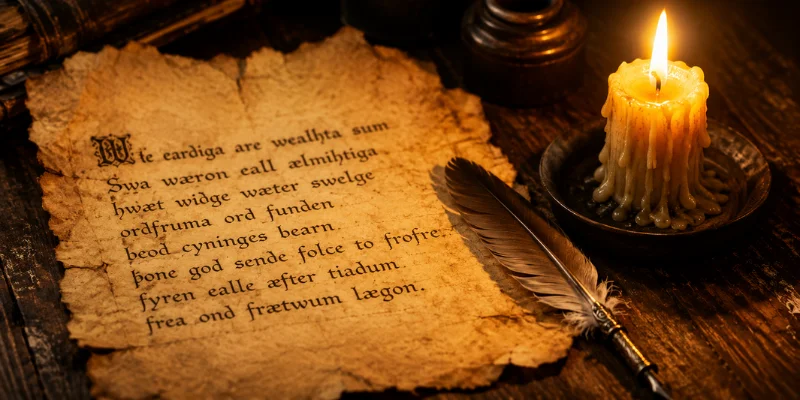
Look at this line from an old poem written over 1,000 years ago:
“Hwæt! We Gardena in geardagum…”
Can you understand it? No? That is totally normal. Even people who have spoken English their whole life cannot read this without help.
But here is something interesting. Some words from Old English are still with us today. Words like eat, drink, sleep, fire, water, mother, father, child — these come from Old English. They are over 1,000 years old. And we still use them every single day.
The most famous Old English story is a poem called Beowulf. It is about a brave man who fights a terrible monster. It is a great story. But you need a translation to read it today.
Think of it this way. Old English is like your great-great-great-great-grandfather’s way of talking. He is your family. But his words sound very different from yours.
Here is a good tip for learners. Many of the basic English words come from this old time. When you focus on English vocabulary development, start with simple everyday words. They are the oldest and most important part of the language.
Middle English (1100 to 1500 AD)
In 1066, something happened that changed English forever.
A man named William the Conqueror came from France with his army. He fought the English king. He won. And suddenly, France was in charge of England.
The French rulers spoke French. So French became the language of kings, courts, and rich people. English was the language that normal people spoke at home.
For hundreds of years, both languages lived side by side. And slowly, they mixed. French words enter English every day.
That is why English today has two words for almost everything. One simple word and one fancy word:
| Simple Word | Fancy Word |
| Ask | Inquire |
| Help | Assist |
| Buy | Purchase |
| Start | Commence |
| Wish | Desire |
The simple word almost always comes from Old English. The fancy word came from French.
This is also why English has so many ways to say the same thing. For example, when you look at synonyms of happy in English, you find words like glad, joyful, cheerful, elated, delighted. Each one came from a different language at a different time. They all mean happy — but they each feel a little different.
A famous writer named Geoffrey Chaucer lived during this time. He wrote a book called The Canterbury Tales in Middle English. You can actually read parts of it today. It is not easy. But you can understand it. That shows how much English was changing and growing.
Early Modern English (1500 to 1700 AD)
Before the 1500s, people made books by hand. One person. One pen. One page at a time. It took months to finish one book. Very few people could afford to buy one. Very few people knew how to read.
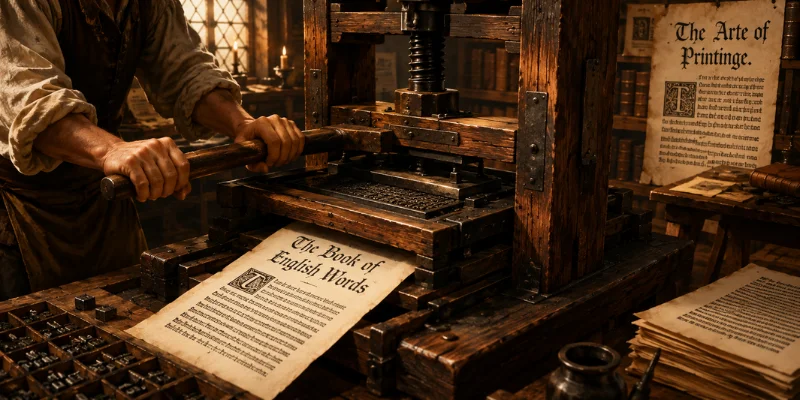
Then, in 1476, a man named William Caxton brought the printing press to England.
Everything changed.
Now people can print hundreds of books fast. Books got cheaper. More people bought them. More people read them. And when everyone read the same printed words, spelling slowly became the same everywhere.
Before the printing press, one word had many different spellings, and nobody cared. After the printing press, everyone agreed on one correct spelling.
This is also the time of William Shakespeare. He lived from 1564 to 1616. He wrote plays and poems that people still read and watch today. But he did something else too. He invented new words.
Here are some words Shakespeare created:
- Lonely
- Bedroom
- Generous
- Fashionable
- Gossip
- Swagger
- Rant
Yes. Shakespeare invented swagger. The next time you hear someone use that word, remember it is over 400 years old.
Shakespeare also created phrases that we still use:
- “Break the ice”
- “All that glitters is not gold”
- “The world is my oyster”
These phrases come from plays written hundreds of years ago. But they still feel natural and normal today.
If you want to write well in English, remember this lesson from the printing press era. Clear writing uses the right word in the right place. Weak or unnecessary words make writing harder to read. You can check out this helpful guide on words to avoid in writing to clean up your own writing.
Modern English (1700 to Today)
By the 1700s, English grammar had become more stable. Spelling became more fixed. And for the first time, people made dictionaries.
In 1755, Samuel Johnson published the first big English dictionary. For the first time, people had one place to check spellings and meanings. That was a big deal.
Then the world started changing very fast.
Factories opened. New machines appeared. Scientists discovered new things. All of these needed new words. English added them all.
Then Britain built an empire across many countries — in Asia, Africa, and the Americas. English traveled to all those places. In every new country, English mixed a little with local languages and kept growing.
Then came the 1900s. Hollywood movies spread American English all over the world. Then the internet made English the main language of global communication.
Today, about 1.5 billion people speak English. Only around 400 million grew up with it as their first language. The rest — more than one billion people — learned it later in life.
So if you are learning English right now, you are part of the biggest group of English speakers on the planet. You are not alone. Not even close.
Why Some Grammar Rules Feel Strange
Many English grammar rules seem confusing at first. But history explains them.
Take the difference between since vs for. Many learners find this tricky.
We say:
- “I have studied for three hours.” (for = a period of time)
- “I have studied since morning.” (since = a starting point)
Why two different words? English built this rule slowly over hundreds of years. It helps people say exactly when something started or how long it lasted. Once you understand the difference, it stays in your head.
The same idea works for much vs many. We say much water, but many bottles. We say much time but many hours. English uses much for things you cannot count and many for things you can count.
This rule did not come from nowhere. It developed over centuries to make communication clearer and more exact.
These rules are not random. They all came from real needs that real people had at different points in history.
Why English Has Silent Letters
Almost every English learner asks this question at some point.
Why is the K silent in knife? Why is the W silent in write? Why is the B silent in lamb?
The answer is simple. Those letters were not silent in the past. People actually said them out loud.
In Old English, people said k-nife. They said w-rite. They said lam-b. The sounds were real.
But over time, speaking changed. People stopped saying those sounds. The pronunciation got easier and shorter. But nobody changed the spelling. The old letters just stayed there.
So today, we have letters that do nothing. They just sit in the world as a reminder of how people used to speak hundreds of years ago. You can think of them as small pieces of history hiding inside everyday words.
Once you know this, strange spellings become less annoying. They are not there to confuse you. They are just very old.
English Is Still Growing
Here is something many people do not think about.
English is not finished. It is still growing right now.
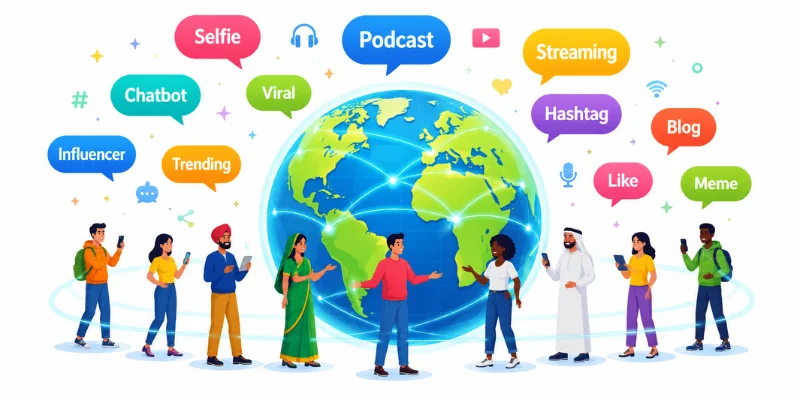
Every year, new words enter the language. Some recent ones:
- Selfie
- Podcast
- Binge-watch
- Ghosting
- Deepfake
None of these words existed 30 years ago. Today, everyone uses them.
And in 10 years, English will have new words that do not exist yet.
This is great news for learners. It means there is no final perfect version of English that you must reach. The language keeps growing. And you can grow with it.
The best way to start is with everyday communication. Learning simple English sentences for daily use gives you real confidence fast. Simple sentences are not weak. They are often the clearest and most powerful.
As you get more comfortable, you can build up your English writing skills too. Good writing helps you in school, at work, and in life. And it gets better with practice.
Surprising Facts About English History
Here are a few things that most people never hear about English history.
The word “girl” once meant any young child — boys and girls both. It only started meaning a female child much later.
The word “nice” used to mean foolish or silly. Over many centuries, it slowly changed to mean kind and pleasant.
The word “meat” once meant all food, not just animal flesh. So when old books say “meat and drink,” they mean food and drink.
And the biggest surprise of all: English almost died. After William the Conqueror took over England in 1066, French became the dominant language. For a long time, it looked like English might just disappear. But ordinary people kept speaking it at home every day. And it survived.
Conclusion
I want to tell you something honest before you go.
English is hard sometimes. The spelling does not always make sense. The grammar rules feel strange. And there are so many words that mean almost the same thing.
I know that feeling. Most English learners know that feeling. But here is what I want you to take away from this article.
English is not a perfect, finished thing that was handed down from the sky. It was built by real people. People who were confused, who made mistakes, who borrowed words from their neighbors, who changed things when the old way stopped working.
Old English tribes mixed their languages because they had to. Medieval people borrowed French words because life forced them to. Shakespeare made up new words because the old ones were not enough.
Every messy, confusing part of English has a story behind it. A human story.
And you are now part of that story too.
Every new word you learn. Every sentence you read. Every conversation you try — you are doing exactly what people have done for 1,500 years. You are learning, adapting, and growing with this language.
So do not feel bad when English is hard. It has always been a work in progress. And so are you. That is perfectly fine.
Keep going. You are doing better than you think.
English began in England around 450 AD when Germanic tribes came from Europe. Their languages mixed and slowly formed Old English. Over time, English kept changing as it absorbed words from other languages and spread around the world.
Languages grow and adapt as people travel and mix cultures. English borrowed from Latin, French, and many other languages. New words and rules came from trade, travel, and books. These changes helped English grow and reach more people. That’s why it sounds and looks so different today.
Old English was spoken a long time ago and sounds very different from English today. Modern English is what we speak and write now. The words, grammar, and pronunciation have changed a lot over time. Old English had many strange letters and grammar rules. Modern English is simpler and easier to understand.
Around the 1500s, during the Early Modern English period. Printing helped fix spelling and grammar. People began speaking in a clearer, more modern way. Writers like Shakespeare also shaped how English was spoken.
The French changed English in many ways. When the Normans invaded England in 1066, they brought French words and customs. English adopted thousands of French terms for food, law, and government. That’s why we use words like “court” and “judge.” Words like “beauty,” “castle,” and “dinner” came from French and entered English.
English is used all over the world because it spread when Britain traded and ruled in many countries. Later, America helped it grow through movies, science, and technology. Now, people use English as a bridge to talk, learn, and work with others across the world.
Today, there are many types of English around the world. The main ones are British English, American English, and Australian English. Each has its own accent, spelling, and a few different words. But they all share the same roots.
Yes, English is still changing every day. New slang, online words, and cultural trends keep shaping it. The way people speak and write also changes over time, with technology and culture. That’s what makes English alive and exciting.
Learning about the history of English helps you see how the language started and changed over time. You’ll notice patterns, word origins, and grammar rules more easily. Knowing its history can also make learning English easier and more interesting.
A lot of people think English has always sounded the way it does now, but that’s not true. Old English was so different that most of us wouldn’t understand a single line of it. Over time, the language changed as people from other places mixed their words and ideas, and that’s how we got the English we use today.






- Be Respectful
- Stay Relevant
- Stay Positive
- True Feedback
- Encourage Discussion
- Avoid Spamming
- No Fake News
- Don't Copy-Paste
- No Personal Attacks
- Be Respectful
- Stay Relevant
- Stay Positive
- True Feedback
- Encourage Discussion
- Avoid Spamming
- No Fake News
- Don't Copy-Paste
- No Personal Attacks
