English Communication Skills: How to Speak Clearly and Confidently in Real Life
Published: 24 Jul 2026
Most English learners face the same problem.
They study grammar for months. They memorize vocabulary lists. They read textbooks from cover to cover. But when the moment comes actually to speak English in real life, something goes wrong. The words disappear. The sentences get stuck. And the confidence they built in the classroom falls apart the moment a real conversation starts.
If this sounds familiar, you are not alone. And you are not the problem.
The real problem is that most people learn English but never practice English communication skills. And those are two very different things.
In this guide, you will learn exactly what English communication skills are, why they matter more than grammar alone, and how to build them step by step starting from today.
What Are English Communication Skills?
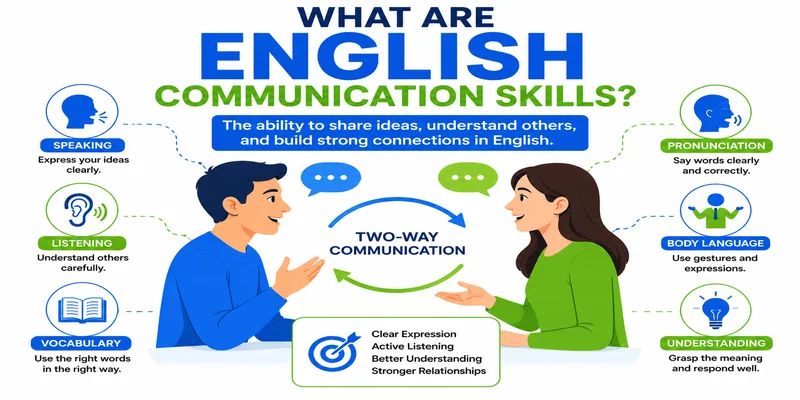
English communication skills are the ability to share your thoughts, ideas, and feelings clearly in English. In real situations. With real people.
This is not about memorizing rules. It is about using English in a way that actually works when you need it most.
A student who scores 90 percent on a grammar test but cannot hold a five-minute conversation in English has good grammar knowledge but weak communication skills. A professional who can write a perfect email but freezes during a meeting has the same gap.
Communication includes several things working together at the same time. It includes speaking and listening. It includes the words you choose and the way you say them. It includes your tone, your confidence, and your ability to understand what the other person actually means.
Understanding what is the English language and how it works gives you the foundation you need before building these skills on top of it.
Why Are English Communication Skills Important?
Think about every important moment in your life where English was involved.
A job interview. A presentation at school. A conversation with someone from another country. An email to a client. A phone call you were nervous to make.
In all of these moments, grammar was not what mattered most. Communication did.
Strong English communication skills help you in ways that go far beyond the classroom. They help you get better jobs because you can express yourself clearly in interviews and meetings. They help you perform better in school because you can ask questions, participate in discussions, and explain your ideas confidently. They help you connect with people from different countries because you can hold a real conversation, not just exchange memorized phrases.
There is also something that does not get talked about enough. Good communication makes you feel different. When you can say what you mean in English without struggling, something shifts inside you. You feel more confident. More capable. More ready for situations that used to feel scary.
The importance of the English language in today’s world makes these skills not just useful but necessary for anyone who wants to grow personally or professionally.
How to Improve English Speaking Skills
Speaking is the skill most learners want to improve first. And it is also the one they practice the least.
The reason is simple. Speaking feels risky. You might make a mistake. Someone might not understand you. You might forget a word at the worst possible moment. So instead of speaking, many learners keep studying. They tell themselves they will start speaking when their English is good enough.
That day never comes. Because speaking is how your English gets good enough.
Here is the truth about speaking. Clarity matters more than perfection. Saying “I need help with this, please” in simple words is far better than staying silent because you cannot remember the perfect sentence. Native speakers do not expect perfection from learners. They expect effort and clarity.
Start with simple English sentences for daily use and practice saying them out loud every single day. Describe what you are doing around the house. Talk to yourself in English while cooking, walking, or getting ready in the morning. It feels strange at first. It works every time.
One more thing. Speed does not mean fluency. Many learners rush because they think speaking fast makes them sound better. It does the opposite. Slow down. Let your words land. People understand you better, and you sound more confident, not less.
Why Listening Is Half of Communication
Most people think of communication as talking. But listening is just as important. Maybe more.
In real English conversations, the person who listens well is always the person who responds well. If you miss what someone said, your reply will not make sense. If you are so focused on what you are going to say next that you stop listening to what is being said now, the whole conversation falls apart.
Many learners struggle with listening because they try to understand every single word. When they hit a word they do not know, they get stuck on it. And while they are stuck, the conversation keeps moving, and they miss the next three sentences.
The fix is to listen for meaning, not words. Focus on the overall idea. What is this person trying to tell me? What is the main point? You do not need to understand every word to understand the message.
Practice with real English content. Podcasts, YouTube videos, short conversations, news clips. Do not turn on subtitles for the first listen. Just listen. Then listen again. Your ears adjust faster than you think.
How to Build Vocabulary for Better Communication
Words are the building blocks of communication. The more words you know and can use naturally, the more clearly and confidently you communicate.
But there is a right way and a wrong way to build vocabulary.
The wrong way is to memorize long word lists. Fifty words on Monday, all forgotten by Wednesday. This method feels productive but produces almost no real results because those words never connect to anything in your actual life.
The right way is to learn words in context. When you read a sentence and understand what a word means from the situation around it, that word sticks. When you use a new word in your own sentence the same day you learned it, it sticks even more.
Focus on learning phrases and word groups instead of single words. “Get in touch” is more useful than “contact” alone. “I was wondering if” is more useful than “wonder” by itself. Phrases are how real English actually works in conversation.
English vocabulary development does not happen overnight. But with the right approach, it builds steadily, and the results show up in your actual conversations much faster than you expect.
Does Grammar Matter for Communication?
Yes. But not the way most people think.
You do not need perfect grammar to communicate effectively in English. What you need is clear enough grammar that your message makes sense to the person you are talking to.
Simple grammar mistakes happen to everyone, including native speakers. The ones that actually hurt communication are the ones that change the meaning of what you are saying or make your sentence impossible to understand.
For example, mixing up tenses can sometimes confuse the timeline of what you are describing. Understanding the difference between since vs for helps you talk about time accurately. Knowing when to use much vs many helps you describe quantities correctly. These are not just grammar rules. They are tools for clearer communication.
The goal is not to speak like a textbook. The goal is to speak clearly enough that the person in front of you understands exactly what you mean. Build your grammar gradually. Focus on the rules that come up most often in daily conversation. And do not let fear of mistakes stop you from speaking at all.
English Communication Skills for Students
For students, communication skills show up in every part of academic life.
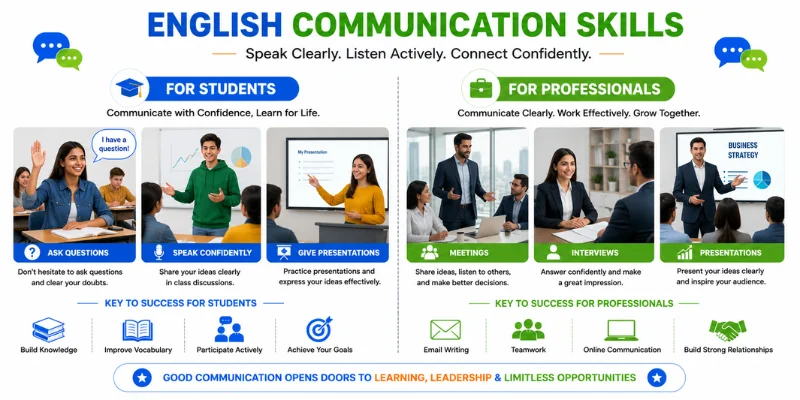
Asking a question in class takes confidence. Answering a question in front of the whole room takes more. Giving a presentation takes even more. Group discussions, oral exams, debates, and project explanations all require you to communicate clearly under pressure.
The students who do well in these situations are usually not the ones with the best grammar. They are the ones who practice speaking regularly, who are comfortable with not being perfect, and who have learned how to organize their thoughts before they speak.
One simple habit makes a huge difference. Before you speak in an important situation, take two seconds to think about what your main point is. One clear main idea, delivered simply, is always more effective than three half-formed ideas delivered nervously.
Good English writing skills also support academic communication because they help you organize your thinking. When you can write clearly, you tend to speak more clearly too.
English Communication Skills for Professionals
In the workplace, how you communicate often matters as much as what you actually know.
A brilliant idea explained poorly gets ignored. A simple idea explained clearly gets heard. This is the reality of professional life, and English communication skills sit right at the center of it.
Meetings require active listening and clear responses. Emails need to be polite, direct, and easy to understand. Presentations need structure and confidence. Client conversations need professionalism and clarity.
The good news is that professional English communication does not require a huge vocabulary or complex sentences. It requires the opposite. Clear, simple, well-organized English is what professionals in every field actually use.
If you work in or want to work in a field where English matters, the single most valuable thing you can do is practice speaking in professional situations. Role-play a job interview with a friend. Practice giving a short presentation to yourself in the mirror. Write an email and then read it out loud to check if it sounds natural.
Common Problems That Hold Learners Back
After working with English learners at different levels, the same problems come up again and again. Knowing them helps you avoid them.
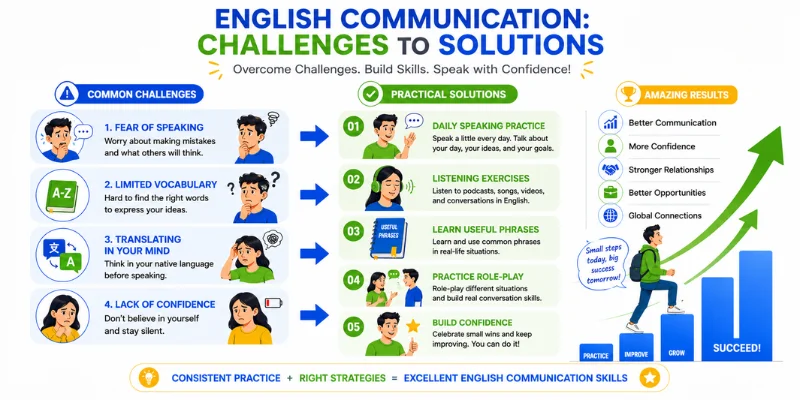
Fear of making mistakes. This is the biggest one. Mistakes are not failures. They are information. Every mistake tells you something specific that you can fix. The learners who improve fastest are the ones who speak despite the fear, not the ones who wait until the fear is gone.
Thinking in your first language first. When you think in Urdu or Arabic or Hindi and then translate into English in your head before speaking, two things happen. Your speech gets slow and unnatural. And the translated sentence often sounds strange because languages do not translate directly. The goal is to start thinking in English, even in small pieces. It takes time, but it changes everything.
Studying without practicing. Reading about how to swim does not teach you to swim. Reading about English communication does not give you English communication skills. At some point, you have to get in the water. Practice is where the real learning happens.
Trying to be perfect. Perfection is not the goal. Communication is. The moment you accept that your English does not need to be perfect for it to be effective, speaking becomes much less stressful.
Simple Daily Habits That Actually Work
Big improvements in communication skills come from small habits done consistently. Not from marathon study sessions done once a month.
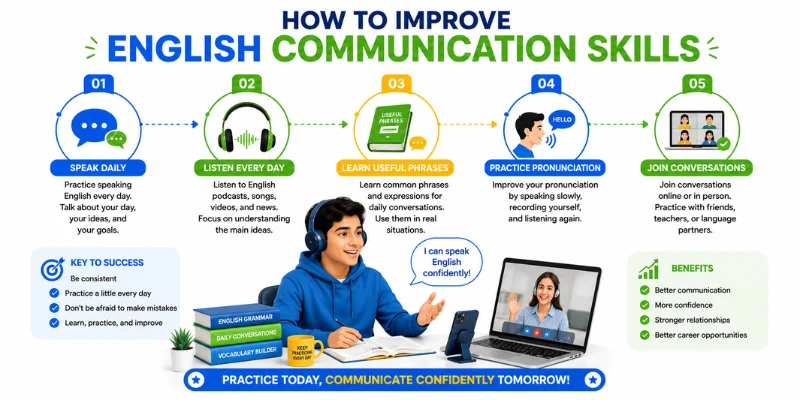
Speak English for five minutes every morning before you do anything else. Describe what you see around you. Talk about what you are going to do today. Say it out loud, not in your head.
Listen to one short piece of English audio every day. A podcast episode, a YouTube video, a news clip. Something at a level that challenges you slightly but does not overwhelm you.
Learn three new phrases every day, not three new words. Use each phrase in a sentence before the day ends. Write it down. Say it out loud.
Find one person to practice English conversation with, even if it is online. Even if they are also a learner. Real conversation practice, however imperfect, teaches you things that no textbook ever will.
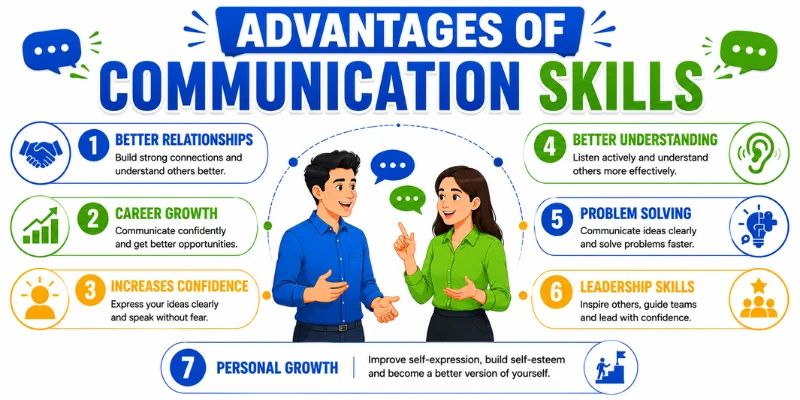
Conclusion
Learning English is one thing. Using it confidently in real life is another.
English communication skills are what close that gap. They take what you have studied and turn it into something you can actually use when it matters, in conversations, interviews, classrooms, and workplaces.
You do not need to be perfect. You need to be clear. You need to practice. And you need to keep going even when it feels uncomfortable, because that discomfort is exactly where the growth happens.
Start with one small thing today. Speak one sentence out loud in English. Then another tomorrow. Build from there.
The gap between knowing English and speaking English closes one conversation at a time.
English communication skills are the ability to share ideas, thoughts, and feelings clearly in English in real situations. They include speaking, listening, choosing the right words, and using the right tone. These skills help you communicate effectively in daily life, school, and work.
Spoken English focuses mainly on pronunciation and speaking words correctly. English communication skills are broader. They include listening actively, understanding meaning, responding appropriately, and using tone and body language effectively. Communication is about exchanging meaning, not just producing words.
Yes, absolutely. Beginners can and do improve with regular daily practice. The key is to start simple. Use short sentences. Focus on being understood rather than being perfect. Confidence and clarity both grow with practice.
This depends on how consistently you practice. Most learners notice real improvement within four to six weeks of daily practice. Significant confidence and fluency usually develop over three to six months. The timeline is different for everyone, but consistent daily practice always produces results.
Speak English out loud every day, even if it is just to yourself. Listen to real English conversations regularly. Learn new phrases and use them the same day. Find opportunities to have real conversations in English whenever possible. Small daily practice beats occasional long sessions every time.
Because most English education focuses on grammar rules and vocabulary memorization rather than actual communication practice. Knowing English and using English are two different skills. Communication gets better through practice in real or realistic situations, not through more studying alone.






- Be Respectful
- Stay Relevant
- Stay Positive
- True Feedback
- Encourage Discussion
- Avoid Spamming
- No Fake News
- Don't Copy-Paste
- No Personal Attacks
- Be Respectful
- Stay Relevant
- Stay Positive
- True Feedback
- Encourage Discussion
- Avoid Spamming
- No Fake News
- Don't Copy-Paste
- No Personal Attacks
