General English: A Complete Guide to Meaning, Skills, and Everyday Use
Published: 31 May 2026
Imagine you are talking to someone in English and stopping because you cannot find simple, everyday words. Many learners feel this way. They learn grammar, read rules, and remember vocabulary, but they still struggle to use English in real conversations. This makes daily communication hard at home, school, work, or even while traveling.
General English can solve this problem. It helps you speak, read, write, and understand English clearly and simply. You learn words you can use every day, short sentence patterns, and easy phrases for real situations. With time and practice, you start to speak with confidence.
Here is a small example to show the difference.
Casual English: “Hey, what’s up?”
General English: “Hello, how are you?”
This guide will help you understand General English and improve your skills in a step-by-step manner. It will give you clear tips, simple examples, and easy-to-follow methods that you can implement daily.
What Is General English?
General English is the basic form of English that people use in everyday life. It helps you speak, read, write, and understand simple and clear language. It focuses on common vocabulary, basic grammar rules, and daily communication skills.
It covers basic grammar, common vocabulary, and the main skills you need: reading, writing, listening, and speaking. You use it at home, in school, at work, while traveling, and in daily conversations.
Example
I need help with this form. Can you explain it to me?
Quick Checklist: Do You Need General English?
You need General English if:
- You struggle to speak in simple English.
- You know grammar, but cannot use it in real life.
- You want to improve your speaking, writing, or listening skills.
- You want more confidence in everyday conversations.
- You want clearer communication in school, at work, or in your daily life.
General English vs Other Types of English
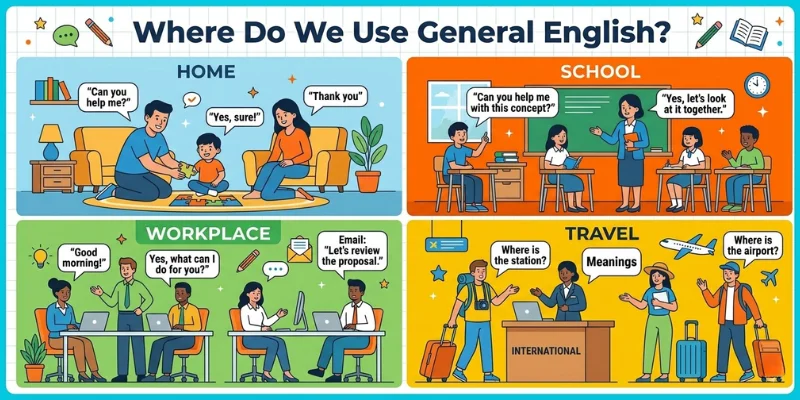
General English is simple, clear, and used in daily life. But other types of English have specific purposes. Knowing the difference helps you choose the right style in the right situation.
General English vs Business English
General English is for daily conversations, while Business English is for work, office settings, and formal tasks.
Example:
General English: “Please send the file.”
Business English: “Could you please send the document by EOD?”
Quick Comparison Table
| Type | Tone | Purpose |
| General English | Simple and friendly | Daily conversation |
| Business English | Formal and polite | Work and office communication |
General English vs Academic English
General English uses short and clear sentences. Academic English uses formal, research-based language.
Sample sentences:
General English: “This book simply explains the topic.”
Academic English: “This text provides an in-depth analysis of the subject.”
General English vs Professional English
General English sounds casual and friendly. Professional English sounds clear, polite, and suitable for the workplace.
Where we use each:
General English: home, friends, travel, simple conversations
Professional English: emails, meetings, reports, office discussions
General English vs Spoken English
Spoken English focuses on fluency and speaking skills. General English covers all skills: reading, writing, listening, and speaking.
Short example conversation:
General English:
A: “I need some help with this task.”
B: “Sure. Tell me what you need.”
Spoken English:
A: “Hey, can you help me out?”
B: “Yeah, no problem.
Why Is General English Important?
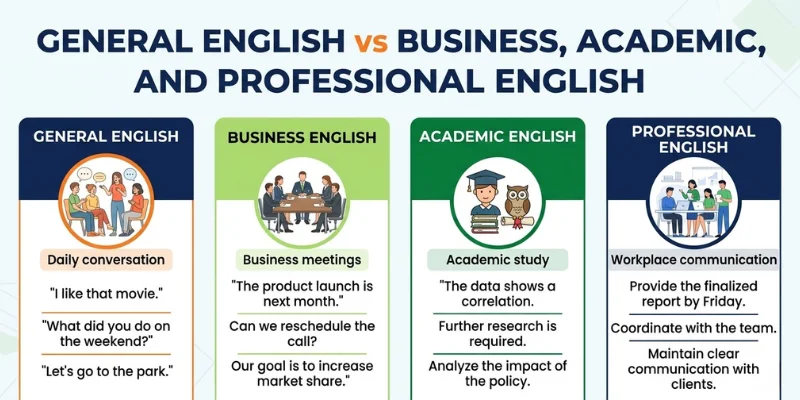
General English helps you communicate clearly in daily life. It supports simple conversations, basic reading, writing, and quick understanding. You use it at home, school, work, and while traveling. Strong General English also builds confidence and improves your chances in interviews and career tasks.
A quick scenario:
A person asks you a simple question like “Where are you going?” If you struggle to reply, communication becomes difficult. This is why learners need steady, basic English skills.
This skill makes everyday communication easier and more comfortable.
Key Features of General English
General English has simple tools that help you speak, write, and understand everyday English with ease. These features make communication clear, natural, and beginner-friendly.
Simple and Clear Vocabulary
General English uses common, easy words that help you speak without stress. These words apply to daily conversations at home, school, work, and travel.
Examples: help, share, remind, meet, plan
Words to replace difficult vocabulary:
- Utilize → use
- Commence → start
- Assist → help
- Purchase → buy
- Require → need
Basic Grammar Rules
These rules help you build short, clear sentences that make sense. You focus on simple tenses, modal verbs like can, must, should, and active voice.
Correct vs Incorrect
| Incorrect | Correct |
| I not understand. | I do not understand. |
| He go to school. | He goes to school. |
| You must to try. | You must try. |
Daily Conversation Skills
These skills help you talk politely and comfortably in everyday situations.
You learn how to:
- Greet people
- Ask simple questions
- Give short, clear answers
- Share information nicely
Practice lines:
- “Hi, how are you today?”
- “Can you help me with this?”
- “I am going to the market. Do you need anything?”
Practical Writing Skills
These skills enable you to craft concise and clear messages for school, work, or everyday tasks.
You practice:
- Short messages
- Simple emails
- Basic instructions
- Notes and reminders
Sample message:
“Hi Robin. I reached safely. Call me when you are free.”
General English in Daily Life
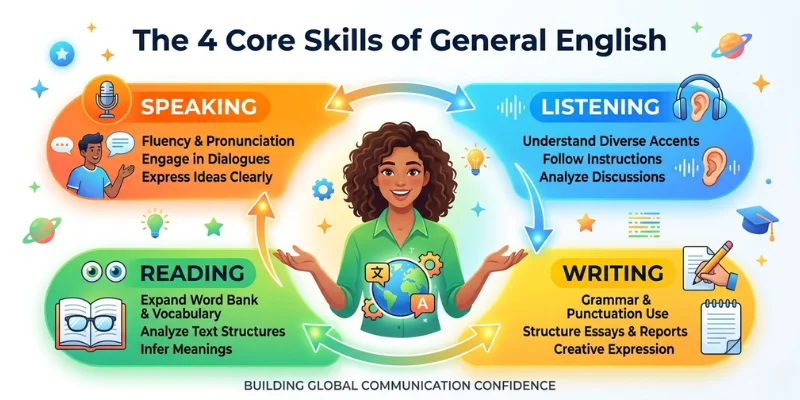
General English helps you speak and understand simple English in real situations. You use it at home, in school, at work, and while traveling. These skills make communication easy and natural.
At Home
You use General English to talk with family, ask for help, and provide brief instructions.
Example dialog:
A: “Can you pass me the salt?”
B: “Yes, here it is.”
At School or University
General English helps you speak confidently in class, understand your teachers, finish assignments, and give simple presentations.
Classroom question example:
“Can you explain this topic again?”
At Work
You use General English for emails, short instructions, meetings, and daily tasks. Clear communication helps you work more effectively with your team.
Workplace note example:
“Please check this file and send it back to me.”
While Traveling
General English helps you book tickets, ask for directions, and talk to new people. Simple phrases make your trip safe and easy.
Example dialog:
A: “Where is the bus station?”
B: “It is two minutes from here.”
Useful travel phrases:
- “How much is this?”
- “I need help.”
- “Can you show me the way?”
- “I want to book a room.”
General English Vocabulary: You Must Learn
Building a strong vocabulary helps you speak with confidence and clarity. These simple words and phrases are part of daily communication and make English easy to use in real-life situations.
Daily Use Words
These words help you talk about food, work, time, people, and places. You use them in almost every conversation.
Examples: breakfast, job, morning, friend, market.
Mini practice activity (choose the right word):
- I ate ___ before school.
- I met my ___ at the park.
- I reached the ___ late.
Conversation Phrases
These short phrases help you communicate effectively in everyday conversations.
- “How can I help you?”
Usage: You can say this when someone looks confused or needs support. - “Could you repeat that?”
Usage: Use this when you did not hear something clearly. - “I don’t understand. Please explain.”
Usage: Say this when you need a simple explanation in class or at work.
Polite Expressions
These words help you sound respectful and kind in any situation: please, sorry, thank you, and excuse me.
Common mistakes learners make:
- Saying “thanks you” instead of “thank you.”
- Forgetting “please” when asking for help.
- Using “sorry” too much, even when it is not needed.
Verb Phrases for Daily Life
These action phrases help you describe simple daily routines: wake up, get ready, go out, look for, and turn off.
Small paragraph using all verb phrases:
I wake up early in the morning. I get ready for my day and then go out for work. Sometimes I look for my keys before leaving. At night, I turn off the lights and rest.
General English Grammar Essentials
Good grammar helps you speak and write clearly. These simple rules guide your daily communication and make your English easy to understand.
Tenses You Need Daily
The simple present, simple past, and simple future help you talk about daily actions, past events, and future plans.
Quick examples:
- Present: I eat breakfast at 8.
- Past: I ate breakfast early.
- Future: I will eat later.
Timeline idea for learners:
Think of three points in a line: now, yesterday, tomorrow. Use each tense to match the time.
Modal Verbs for Polite Requests
Modal verbs help you ask softly and respectfully. Common modals include can, could, may, and should.
Strong vs polite requests:
| Type | Example |
| Strong | Can you close the door? |
| Polite | Could you please close the door? |
Sentence Structures
Short sentences help your message stay clear. Start with a subject, add a verb, and then add simple details.
Sentence-building steps:
- Choose a subject: I, you, he, she.
- Add a simple verb: eat, go, see, or need.
- Add a small detail: breakfast, school, water.
- Put them together: I need water.
Common General English Mistakes
Many learners make small mistakes that change the meaning of a sentence. Learning the basics helps you avoid these errors.
- Wrong preposition:
Incorrect: I am good in English.
Correct: I am good at English. - Overuse of slang:
Incorrect: That food was lit.
Correct: The food was delicious. - Unclear sentence:
Incorrect: Yesterday go market.
Correct: I went to the market yesterday.
Correct the following sentences:
- I will meet you at Sunday.
- She can you help me.
- I go school tomorrow.
Try to fix them using the rules above.
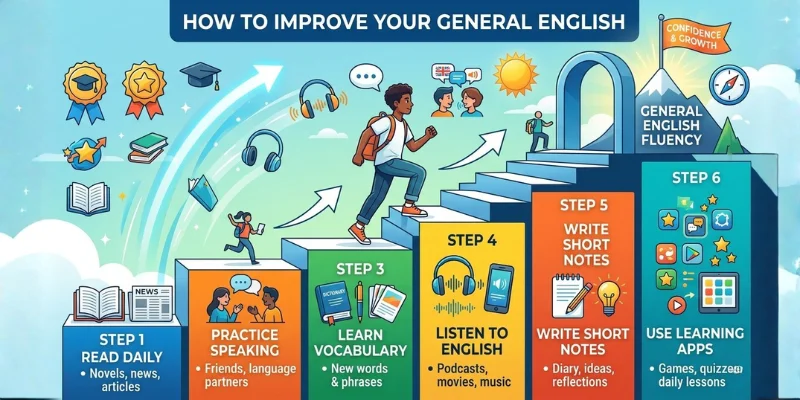
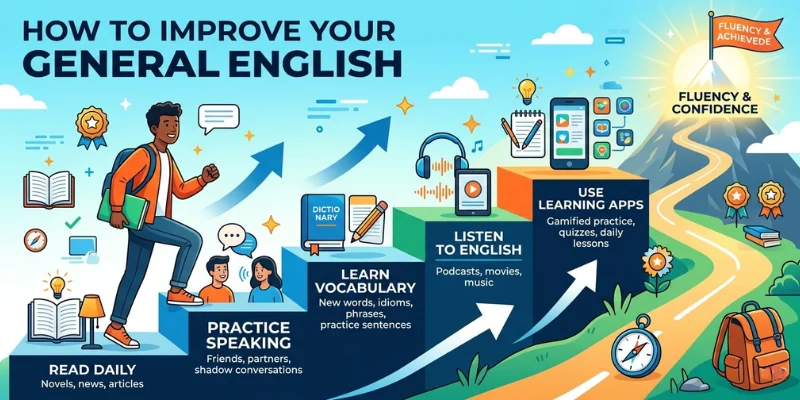
How to Improve Your General English
Improving your General English becomes easy when you follow simple habits every day. These small steps help you speak more effectively, write clearly, and understand English with confidence.
Read Simple English Content
Read short and easy English every day. Pick news, blogs, or children’s books because the language is clear and friendly.
Try these websites/apps:
- VOA Learning English
- BBC Learning English
- Storyberries
Practice Speaking Daily
Speak in English for a few minutes each day. Try speaking to a friend, speaking in front of a mirror, or use a speaking app.
Simple speaking routine:
- Say a greeting.
- Describe your day in three short lines.
- Ask yourself one question and answer it.
Build Vocabulary Slowly
Learn a few new words each day. Five to ten useful words are enough.
Sample 1-day word list:
help, give, check, plan, share
Practice each word in one sentence to remember it better.
Listen to English
Listen to short videos, podcasts, or lessons. This helps you understand natural speech and improve your pronunciation.
Listening practice questions:
- What words did you hear clearly?
- What was the topic about?
- Can you repeat one sentence?
Write Short Notes and Messages
Writing helps your grammar and clarity. Keep it short and simple.
Daily 2-minute writing exercise:
Write three lines about your day:
- What you did.
- What you liked.
- What do you plan next?
Use Free Online Resources
Many websites and apps offer free resources for learning the English language. Pick tools based on your needs.
Resource type and purpose:
| Type | Purpose |
| Dictionary app | Learn meanings and pronunciation |
| Grammar website | Practice simple rules |
| Video lessons | Improve listening |
| Speaking apps | Build confidence |
| Vocabulary apps | Learn new words |
Using these tips daily will help you grow your General English step by step.
Common Challenges in General English (With Solutions)
Many learners face the same problems when they try to use General English in daily life. Here are simple explanations and quick solutions that help you move forward with confidence.
Difficulty in speaking
Many learners feel shy or get stuck while speaking. Start with short and easy sentences.
Solution:
Say simple lines like “I need help” or “I am busy today.” Repeat them until they feel natural.
Weak vocabulary
A small word bank makes speaking and writing hard.
Solution:
Learn themed word lists such as food-related words, work-related words, and travel-related words. This helps you remember words more quickly because they belong to one group.
Grammar confusion
Confusing rules make sentences unclear.
Solution:
Focus on basic grammar first. Review simple tense rules and practice the active voice. Keep your sentences short and clear.
Fear of mistakes
Many learners stay quiet because they worry about being wrong.
Solution:
Speak without fear. Every mistake teaches you something. Practice with friends or talk to yourself for a few minutes each day.
Quick tips for confidence building
- Use simple words until you feel ready for harder ones.
- Practice for five minutes daily instead of waiting for a long study session.
- Celebrate small wins like using one new word or speaking one new sentence.
These steps help you grow your General English skills and feel confident in any conversation.
General English Examples for Beginners
Here are some simple examples to help you understand how General English works in daily life. These short samples improve your basic communication skills and build confidence.
Simple Conversation Example
Example 1
A: Hello, how are you?
B: I am fine, thank you. How are you?
Example 2
A: Where are you going?
B: I am going to the market. Do you need anything?
Simple Email Example
1) Formal Email
Hello Sir,
Please send me the updated file.
Thank you.
2)Casual Email
Hi Sara,
Can you share the notes from today’s class?
Thanks.
Short Paragraph Example
Paragraph 1
My name is Ali. I live in Lahore. I study in college. I enjoy reading simple English stories. They help me improve my skills.
Paragraph 2
I wake up early every day. I get ready and go to my classes. I talk to my friends in English to practice. This helps me learn new words.
These examples guide beginners and make General English easier to understand and use in real life.
Conclusion
So, learners, in this article, we’ve covered General English in detail. I suggest you start with small steps because simple daily practice helps you build strong English communication skills. Try reading a short text each day and speaking a few clear sentences with someone you trust. These easy habits improve your vocabulary, grammar, and confidence in English. Start today and use at least one new General English phrase in a real conversation.
General English helps you communicate in daily life. You use it at home, school, work, and while traveling. It makes simple conversations easy and clear.
Yes, it is easy to learn with small daily practice. You can start with simple words and short sentences. Regular use builds confidence fast.
It depends on how often you practice. Most learners experience good improvement within a few months. Daily reading and speaking speed up your progress.
Start with simple words and short sentences. Read easy English content and speak a little every day. Listen to short videos to learn natural communication.
General English is for everyday communication. Business English is for workplace communication, like emails and meetings. One sounds casual while the other sounds more formal.
Yes, it helps you speak clearly and answer questions with confidence. Good General English improves your first impression. It also helps you understand instructions during interviews.
The main skills are reading, writing, listening, and speaking. You also learn simple grammar and useful vocabulary. These skills help you to communicate effectively in daily life.
Students, workers, and travelers should learn General English. It is helpful for anyone who wants to enhance communication. It is a good base for all other types of English.




- Be Respectful
- Stay Relevant
- Stay Positive
- True Feedback
- Encourage Discussion
- Avoid Spamming
- No Fake News
- Don't Copy-Paste
- No Personal Attacks
- Be Respectful
- Stay Relevant
- Stay Positive
- True Feedback
- Encourage Discussion
- Avoid Spamming
- No Fake News
- Don't Copy-Paste
- No Personal Attacks
