In vs On: Complete Guide for Beginners to Advanced Learners with Real-Life Examples
Published: 15 Sep 2026
Have you ever paused mid-sentence, unsure whether to say “in the car” or “on the car”?
You are not alone. In vs on is one of the most common preposition mix-ups in English, and even fluent speakers sometimes hesitate because both are tiny words that completely change the meaning of a sentence.
Prepositions of place and time, like in and on, rarely follow one single logical rule. That is exactly why this comparison confuses even advanced learners who have already mastered more complex grammar. In this guide, you will finally learn when to use in and when to use on, with simple rules, real-life examples, and practice that helps you remember naturally.
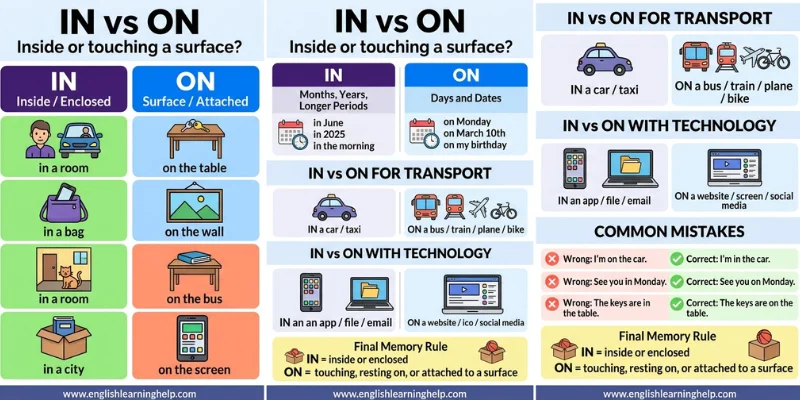
Main Rule: In Means Inside, On Means Touching the Surface
The easiest way to remember it:
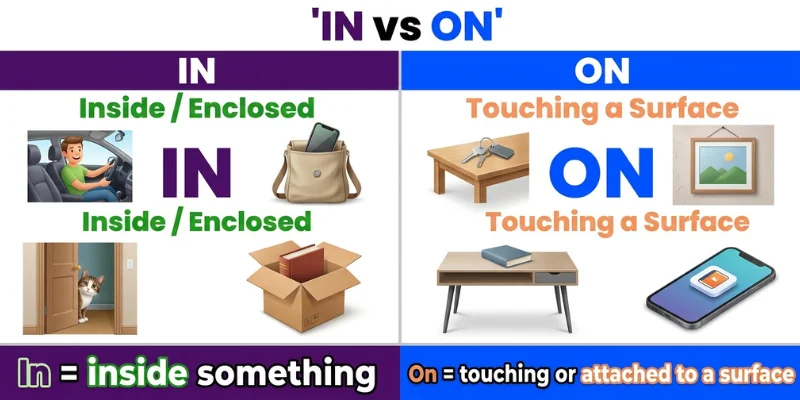
In means inside something, surrounded or enclosed. On means touching the surface of something.
Comparison Table: In vs On
| Use | In | On |
| Basic Meaning | Inside, an enclosed space | Touching, on top, or attached |
| Places | in a room, in a car, in a city | on the table, on the wall, on the bus |
| Time | in the morning, in June, in 2025 | on Monday, on my birthday, on New Year’s Day |
| Devices | in a phone (app), in a file | on TV, on the screen, on social media |
| Transport | in a car / taxi | on a bus / train / plane / bike |
| Body and Clothes | in my eyes, in my pocket | on my face, on my shirt |
When Do You Use In?
We use in when something is inside a space or surrounded by boundaries.
Examples:
- The kids are in the room.
- She lives in London.
- My phone is in my bag.
Quick Tip: If you can imagine walls or limits around it, use in.
When Do You Use On?
We use on when something is touching or resting on a surface.
Examples:
- The keys are on the table.
- There’s a picture on the wall.
- Don’t sit on the floor; it’s dirty.
Quick Tip: If you can touch the thing, or it is lying on top of something, use on.
This same instinct for small connecting words carries over into general English vocabulary building, since prepositions are exactly the kind of detail that separates learners who sound fluent from learners who sound like they are translating word by word.
How Do You Use In and On for Time?
Prepositions of time follow their own set of rules, separate from prepositions of place, but the logic is just as learnable.
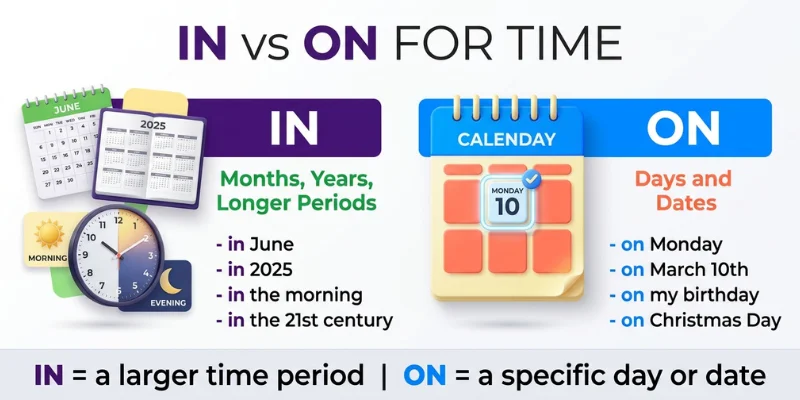
Use in for larger time periods:
- in the morning
- in June
- in 2025
- in the 21st century
Remember: in describes something that happens within a time frame.
Use on for specific days and dates:
- on Monday
- on my birthday
- on March 10th
- on Christmas Day
Quick Tip: If you can circle it on a calendar, use on. If not, use in.
This distinction sits close to another common preposition confusion, since vs for, where the challenge is choosing the right word for describing time correctly. Once you are comfortable with in vs on for time, that related rule becomes much easier to pick up too.
Which One Do You Use for Transport: In or On?
This confuses many learners.
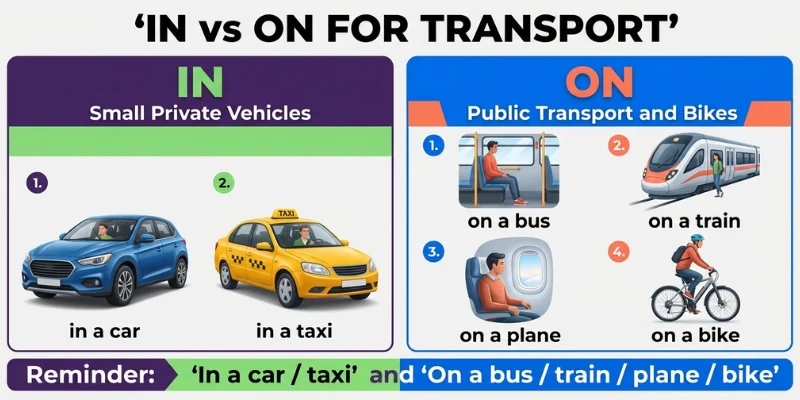
In is used for small private vehicles, ones you sit inside. On is used for large or shared transport, ones you can move around in.
Examples:
- in a car, in a taxi
- on a bus, on a plane, on a train
Quick Tip: If you can stand or walk around inside it, use on.
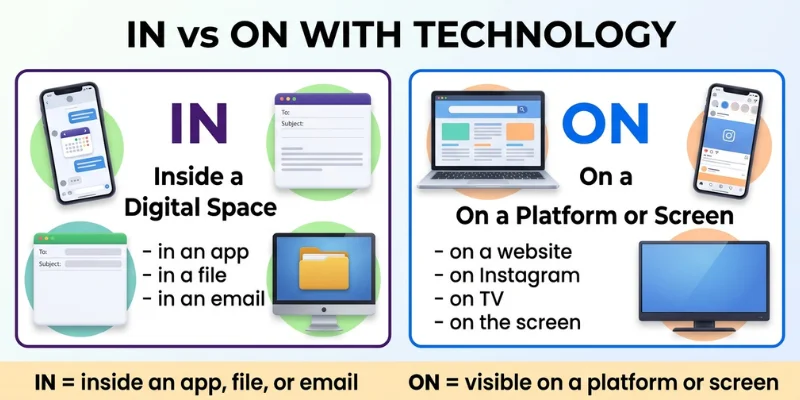
How Do In and On Work with Technology?
Modern English uses both, depending on how you picture the space.
In refers to an enclosed digital space, like a document or app. On refers to a visible platform or surface, like a website or screen.
Examples:
- I read it in an email.
- I saw it on Instagram.
Common Mistakes to Avoid
These are some of the most common preposition mistakes learners make with in and on.
Wrong: I’m on the car. Correct: I’m in the car. (You are sitting inside it.)
Wrong: There’s a crack in the table. Correct: There’s a crack on the table. (It is on the surface.)
Wrong: I’ll see you in Monday. Correct: I’ll see you on Monday.
These preposition rules become second nature through repetition rather than memorization alone. Applying them inside real English writing practice is what actually makes the difference between knowing the rule and using it correctly without thinking.
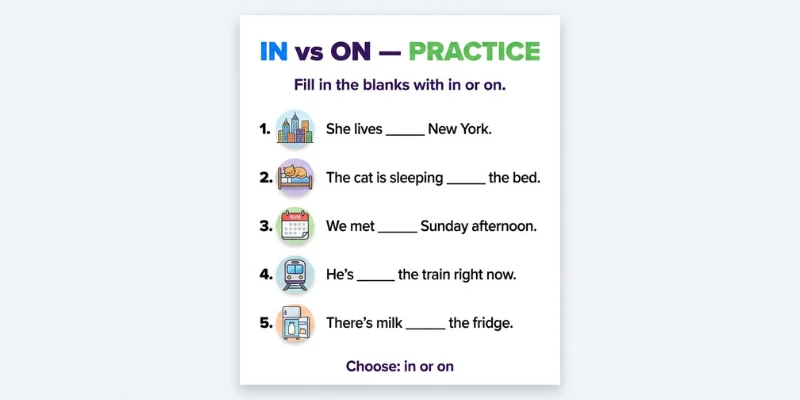
Practice Exercises
Fill in the blanks with in or on:
- She lives ___ New York.
- The cat is sleeping ___ the bed.
- We met ___ Sunday afternoon.
- He’s ___ the train right now.
- There’s milk ___ the fridge.
Answers: 1. in, 2. on, 3. on, 4. on, 5. in
Real-Life Examples You Hear Every Day
“I’m in the office right now.”
“Your book is on the shelf.”
“We’ll go on vacation in July.”
“He’s on the phone with his friend.”
“I saw that video on YouTube.”
In years of teaching English prepositions, one thing becomes clear every time. Students stop mixing up in and on the moment they start visualizing the sentence instead of translating it. Picture the object. Is it enclosed, or is it resting on a surface? That single mental image solves most mistakes instantly.
Getting comfortable with small grammar choices like this one also strengthens overall English communication skills, since prepositions show up in almost every sentence you speak or write.
Conclusion
The secret to mastering in vs on comes down to one simple habit: visualize the position before you speak.
If something is surrounded or enclosed, use in. If it is touching or resting on top of something, use on.
Take five minutes today and write three sentences using in and three using on, about your room, your day, or your phone. The more you notice these small words in real life, the faster they start to feel automatic instead of confusing.
In means being inside or within something, like a box, city, or car. On means being on the surface of something or attached to it, like a table, wall, or phone.
Yes, but only for large or public transport, like on the bus, on the train, or on a plane. For smaller, private vehicles like cars or taxis, use in instead.
Use in for months, years, and longer periods, such as in July, in 2020, or in the evening. Use on for specific days or dates, such as on Monday or on 5th May.
Yes. For example, “in an app” describes something inside the program, while “on the website” describes something on the platform’s surface. Context usually decides which one sounds natural.
Imagine a box. If you are inside it, use in. If you are touching it or standing on top of it, use on. This simple mental image helps you get it right almost every time.
Yes. English has a small group of location and time prepositions, including at, that follow their own patterns. Once in vs on feels natural, learning how at fits alongside them becomes much easier.






- Be Respectful
- Stay Relevant
- Stay Positive
- True Feedback
- Encourage Discussion
- Avoid Spamming
- No Fake News
- Don't Copy-Paste
- No Personal Attacks
- Be Respectful
- Stay Relevant
- Stay Positive
- True Feedback
- Encourage Discussion
- Avoid Spamming
- No Fake News
- Don't Copy-Paste
- No Personal Attacks
