At vs On: Master This English Preposition Rule Today with Real-Life Examples
Published: 17 Sep 2026
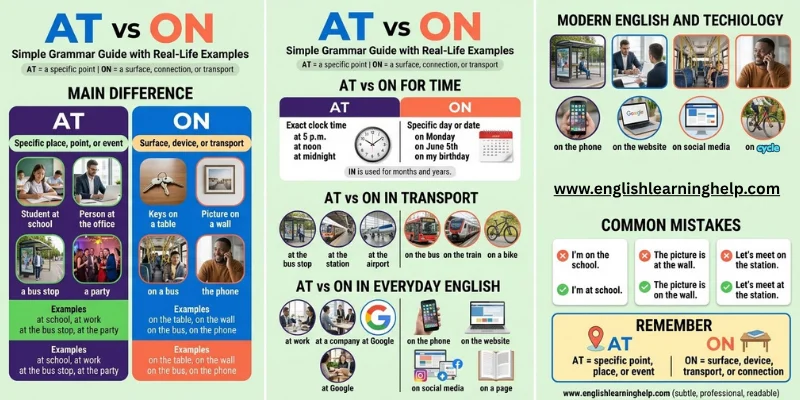
Have you ever wondered why we say “at school” but “on the bus”?
These tiny prepositions, at and on, can completely change how natural your English sounds. Many learners find at vs on confusing because both seem to describe place or location, but they focus on different ideas entirely.
Don’t worry, this guide will clear it up with easy rules, examples, and quick tricks, so you will never mix them up again. Whether you are a school student, a college learner, or preparing for an English exam, the rules below work the same way every time. By the end, you will know exactly when to use at and on like a native speaker.
This confusion connects closely with two other preposition pairs worth knowing: in vs on and at vs in. Together, these three make up almost every place-related preposition mistake English learners make.
Are At and On Prepositions?
Yes. Both at and on are prepositions, specifically prepositions of place, since they describe where something is located or positioned. English has a small set of these place-related prepositions, and at, on, and in are the three most commonly used ones.
A simple way to define at: it points to an exact location or moment, without describing the inside or the surface of anything. On, by contrast, describes something touching or resting against a surface.
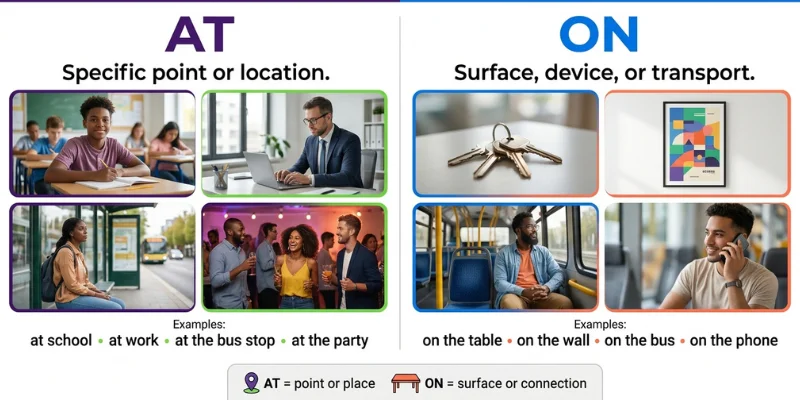
Main Difference Between At and On
| Comparison Point | At | On | Example |
| Meaning | Used for a specific point or location | Used for a surface or position on something | She’s at the door. / The book is on the table. |
| Used For | Places, events, time, or positions | Surfaces, devices, transport, streets | at home, at work / on the bus, on the wall |
| Focus | Point-based (exact location) | Surface-based (contact or position) | at the corner / on the corner |
| Feeling | Exact spot or event | Something attached or touching | at the station / on the board |
When Do You Use At?
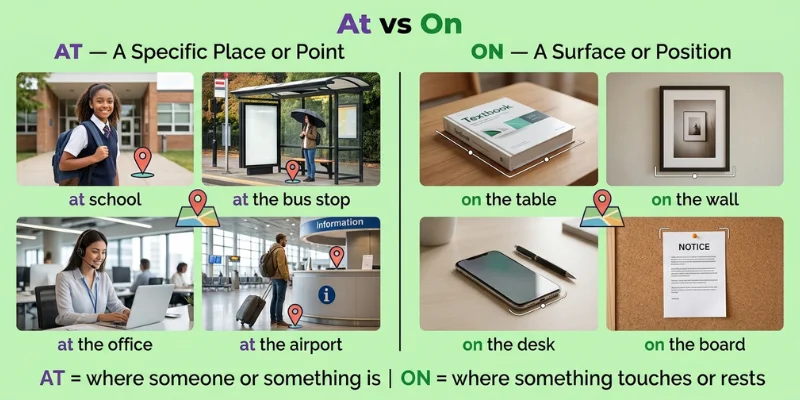
At shows a specific place, point, or event where something happens or exists.
Examples:
- I’m at the office right now.
- She’s at school until 3 p.m.
- Let’s meet at the bus stop.
- He was at the party last night.
Quick Tip: Use at when you are thinking about a point on the map, not the inside or surface of a place.
When Do You Use On?
On means something is touching, attached to, or supported by a surface. It can also describe public transport or devices.
Examples:
- The keys are on the table.
- There’s a poster on the wall.
- She’s on the phone right now.
- We met on the train to London.
Quick Tip: Use on when you imagine something touching or resting on another thing.
Recognizing this pattern is part of building stronger English vocabulary over time, since prepositions like these carry meaning that only becomes clear through repeated exposure to real sentences.
At vs On in Real-Life Situations
| Situation | Correct Sentence | Why |
| School | I’m at school. | You’re at a specific location. |
| Transport | I’m on the bus. | You’re inside a vehicle (surface idea). |
| Office | Meet me at the office. | Talking about a specific workplace. |
| Table | The book is on the table. | It’s resting on a surface. |
| Party | We danced at the party. | The event is a specific point. |
At vs On for Time and Dates
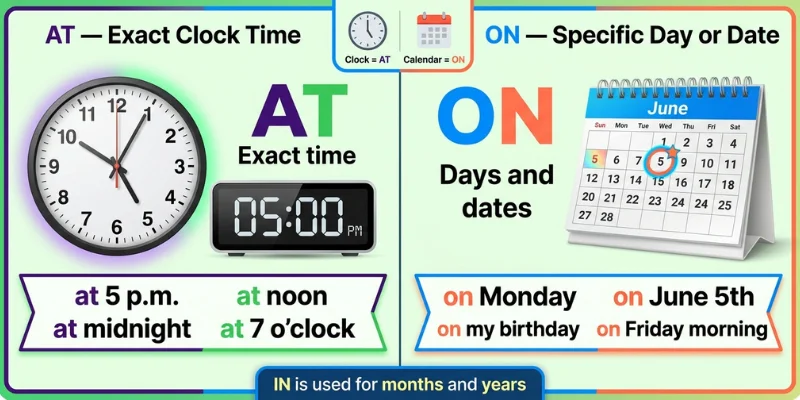
Both at and on are used for time, but in different ways depending on how specific the time is.
Use at for an exact time: at 5 p.m., at noon, at midnight.
Use on for a specific day or date: on Monday, on June 5th, on my birthday.
For longer periods like months and years, English switches to in instead, such as in June or in 2025, which is covered in more detail in our guide on in vs on.
Quick Tip: If you can point to an exact clock time, use at. If you can circle it on a calendar as a single day, use on.
At vs On in Modern, Everyday English
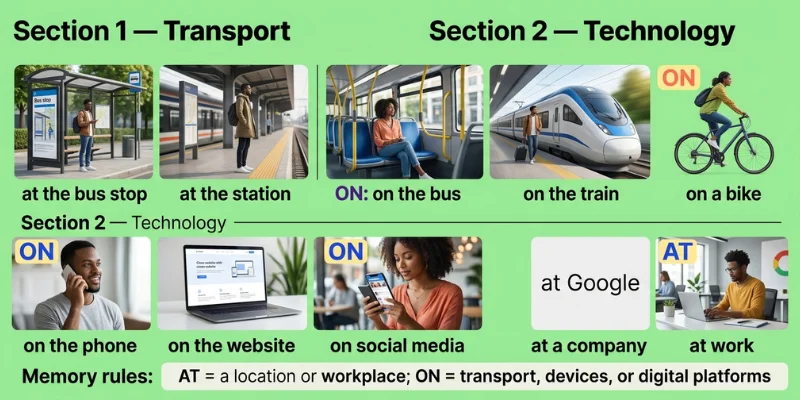
Prepositions also apply to digital spaces, and this is where many learners hesitate today.
We say “on the website,” not “at the website,” because a website is treated like a surface or platform you browse. Similarly, we say “on social media” and “on a page.”
For workplaces, we say “at a company,” such as “I work at Google,” describing it as a specific place, not a surface. This kind of workplace phrasing comes up constantly in Business English, where getting small preposition choices right shapes how professional your writing and speaking sound.
Getting comfortable with these modern examples matters just as much as the traditional ones, since so much of daily English now happens online.
Common Mistakes to Avoid
Wrong: I’m on the school.
Correct: I’m at school. (You’re not physically “on” the school. It’s a location.)
Wrong: The picture is at the wall.
Correct: The picture is on the wall. (It’s attached to a surface.)
Wrong: Let’s meet on the station.
Correct: Let’s meet at the station. (You meet at a point or place.)
Remember:
At = specific point or event. On = surface, device, or transport.
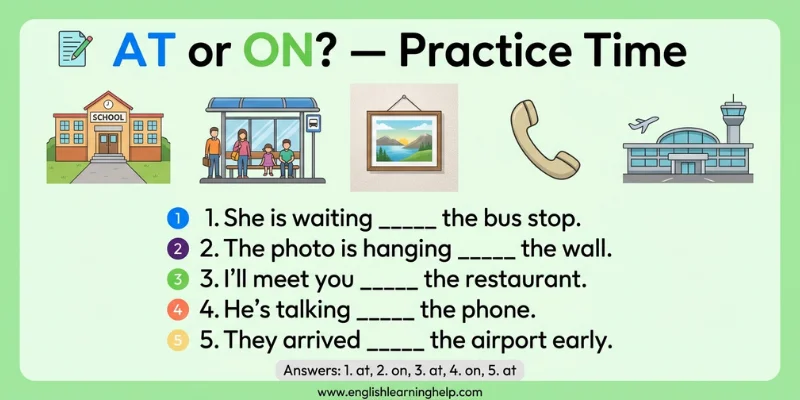
Practice Exercises
Fill in the blanks with at or on:
- She is waiting ___ the bus stop.
- The photo is hanging ___ the wall.
- I’ll meet you ___ the restaurant.
- He’s talking ___ the phone.
- They arrived ___ the airport early.
Answers: 1. at, 2. on, 3. at, 4. on, 5. at
In years of teaching this rule, the mistake that comes up most often is with transport and buildings together, like mixing up “on the bus” with “at the bus.” The trick that helps most is asking one question: am I thinking about an exact point, or something I am touching or inside of? That question solves almost every case.
Applying this rule consistently inside real conversations is what actually makes the choice automatic instead of something you have to pause and think about, and it connects directly to broader English communication skills, since small word choices like these shape how clearly you come across when speaking
In, At, or On? The Full Picture
To make it even clearer, here is how all three prepositions of place relate to each other:
In = inside a place (I’m in the room.) At = specific place or event (I’m at school.) On = surface or transport (I’m on the bus.)
This three-step picture helps you remember how each preposition describes a different type of location.
Conclusion
Once at vs on starts to make sense, using both correctly becomes second nature. When you use at, you are talking about a specific point or event, a place where something happens. When you use on, you are describing a surface or position where something is resting, attached, or happening.
The more you read, listen, and practice, the faster your brain will catch these differences naturally. Keep practicing daily, and soon you will stop thinking about the rules and start using at and on like a fluent English speaker.
Yes. Both are used for time, but differently. Use at for exact times, such as at 5 p.m. or at midnight, and on for specific days or dates, such as on Monday or on June 5th. This small change makes your sentences sound more natural.
Because “on the bus” means you are inside or traveling by it, similar to being on a surface, while “at the bus stop” means you are waiting at a fixed point or location. The choice depends on whether it is a place or a position.
Only “at home” is correct. We use it to talk about being in your personal space or location. “On home” does not work because home is not a surface. It is a state or place where you stay.
“At the table” means sitting beside or using the table, so you are near it. “On the table” means something is physically resting on top of it. The first shows position; the second shows surface.
Yes. “On top of” is a compound preposition that works similarly to on, but it emphasizes something being directly above and touching another object, such as “The remote is on top of the TV.”
Think of at as a point or event, and on as a surface or connection. Picture the action. Is it at a location, or on something? That image helps you choose instantly and correctly.






- Be Respectful
- Stay Relevant
- Stay Positive
- True Feedback
- Encourage Discussion
- Avoid Spamming
- No Fake News
- Don't Copy-Paste
- No Personal Attacks
- Be Respectful
- Stay Relevant
- Stay Positive
- True Feedback
- Encourage Discussion
- Avoid Spamming
- No Fake News
- Don't Copy-Paste
- No Personal Attacks
