Been vs Gone: Simple Grammar Guide with Clear Examples + Exercise for English Learners
Published: 18 Sep 2026
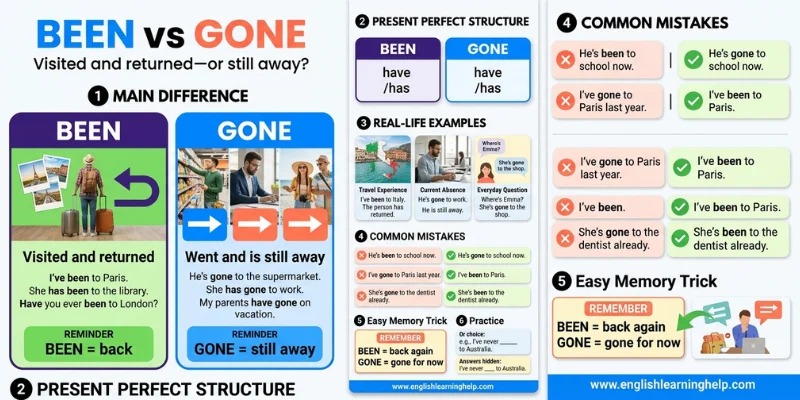
Have you ever said, “I’ve gone to Paris,” when you were actually back home?
You are not alone. Many English learners mix up been vs gone because both words seem to mean “going somewhere.” But here is the secret: these two small words can completely change the meaning of your sentence. One means you have already come back. The other means you are still away.
Both been and gone belong to the present perfect tense, formed with has or have plus a past participle. That’s why they get confused so often: they share the same grammatical structure but point to opposite situations.
This guide will make everything clear. You will learn simple grammar rules, easy examples, quick tips, and practice exercises to help you never mix them up again. By the end, you will confidently know whether someone has been somewhere or has gone and not yet returned.
What Does Been Mean?
Been is the past participle of be and is used with has or have to show that someone visited a place and returned. It focuses on the experience, not the action of going.
Structure: have/has + been + to + place
Examples:
- I have been to Paris twice. (I visited and came back.)
- She has been to the new library. (She went there and returned.)
- They’ve been to the beach this weekend. (They already came back.)
Quick Tip: Use been when the person is back from the trip.

What Does Gone Mean?
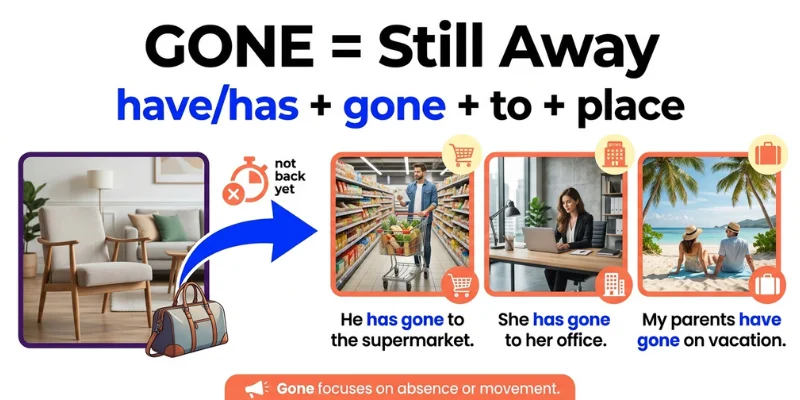
Gone is the past participle of go and is used with has or have to show that someone went somewhere but has not returned yet. It focuses on the movement or action of going, not the experience.
Structure: have/has + gone + to + place
Examples:
- He has gone to the supermarket. (He’s still there.)
- My parents have gone on vacation. (They haven’t come back yet.)
- She has gone to her office. (She’s still at work.)
Quick Tip: Use gone when the person is still away.
This kind of present perfect confusion sits right alongside another common time-related mix-up: since vs for; both grammar points rely on understanding exactly when and how an action connects to the present moment.
Comparison Table: Been vs Gone
| Word | Focus | Person’s Location | Example | Meaning |
| Been | Experience | Back from place | I’ve been to Italy. | Visited and returned. |
| Gone | Action / Absence | Still away | He’s gone to work. | Not returned yet. |

Common Mistakes (and How to Fix Them)
| Wrong | Correct | Why |
| He’s been to school now. | He’s gone to school now. | He’s still there. |
| I’ve gone to Paris last year. | I’ve been to Paris last year. | Been shows a completed visit. |
| She’s gone to the dentist already. | She’s been to the dentist already. | The visit is finished. |
Pro Tip: Been means returned. Gone means still away.
In years of teaching this rule, the fastest way students stop mixing these up is by asking one simple question before speaking: Is the person here right now, or still away? That single question solves almost every case.
Real-Life Conversation Examples
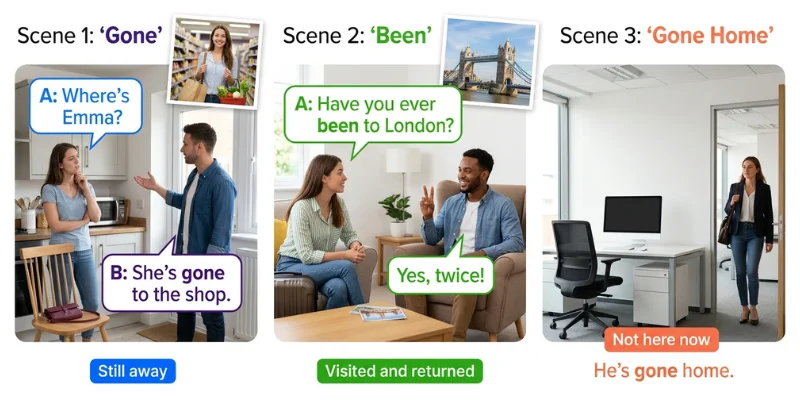
A: Where’s Emma? B: She’s gone to the shop.
A: Have you ever been to London? B: Yes, twice. It’s amazing!
A: He’s gone home early today. B: Really? I’ve been to his office. He wasn’t there.
You will hear this exact pattern constantly in movies, TV shows, and everyday English conversations, which makes it a genuinely useful piece of spoken English to master early.
Practice Exercises
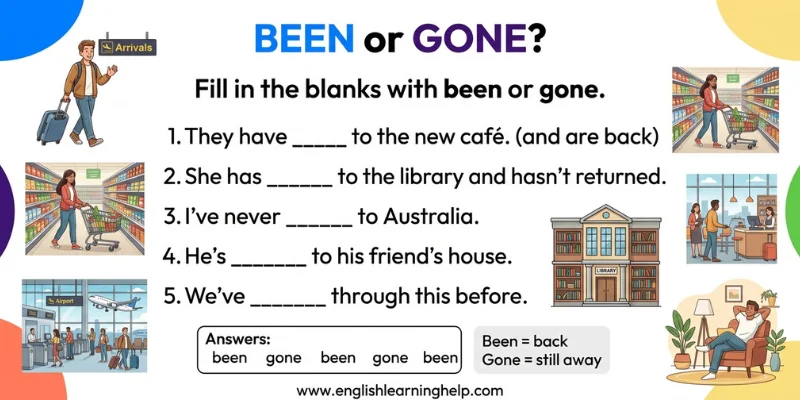
Fill in the blanks using been or gone:
- They have ___ to the new café. (and are back)
- She has ___ to the library and hasn’t returned.
- I’ve never ___ to Australia.
- He’s ___ to his friend’s house.
- We’ve ___ through this before.
Answers: 1. been, 2. gone, 3. been, 4. gone, 5. been
Easy Memory Trick
Been = “back again” (both start with B). Gone = “gone for now.”
Just ask yourself one question: is the person here, or still away? That one question will always guide you to the right choice.
Practicing this rule inside real conversations is what actually makes it automatic.
Conclusion
Understanding been vs gone is not just about memorizing a grammar rule. It is about clarity and confidence in how you describe presence and absence. When you talk about travel or daily activities, remember that been focuses on experiences you have completed, while gone highlights actions that are still in progress.
Next time someone asks, “Where’s Sarah?”, you will know exactly whether to say, “She’s gone to work” (still away) or “She’s been to work” (already back). That small detail makes your English sound noticeably more natural.
Practice using both in real situations, describing your day, your travels, or your friends’ routines. The more you use them, the more automatic they will feel.
Not exactly the same way. Been means you traveled somewhere and came back, so it focuses on your experience. Gone means you are still away or have not returned yet, so it describes the action of going rather than the completed visit.
Yes, it is perfectly correct. It means the person has already left and is not here right now. You would only say “been home” if the person had gone there earlier and already returned.
Yes. Been is perfect for talking about life experiences or completed visits. For example, “I’ve been to Italy twice” shows that you have had that experience and returned home.
Because she is still shopping and has not come back yet. Once she returns, you can say “she’s been shopping,” meaning the activity is complete.
“Has been” describes a completed visit where the person has already returned. “Has gone” describes an ongoing absence where the person has not come back yet. Both use the present perfect tense, but they describe opposite situations.
Think of it this way: been means returned; gone means still away. Picture been as a finished story and gone as one that is still happening.






- Be Respectful
- Stay Relevant
- Stay Positive
- True Feedback
- Encourage Discussion
- Avoid Spamming
- No Fake News
- Don't Copy-Paste
- No Personal Attacks
- Be Respectful
- Stay Relevant
- Stay Positive
- True Feedback
- Encourage Discussion
- Avoid Spamming
- No Fake News
- Don't Copy-Paste
- No Personal Attacks
