Prepositions of Time: Learn “In,” “On,” and “At” Like a Native Speaker
Published: 22 Sep 2026
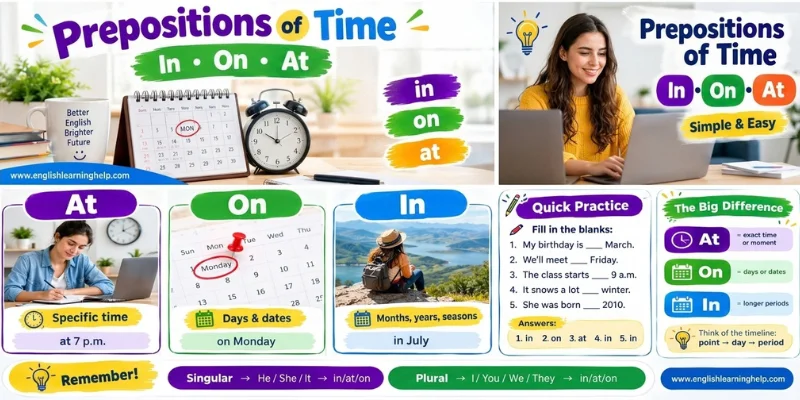
Have you ever been confused about whether to say “in Monday,” “on Monday,” or “at Monday”? Don’t worry, almost every English learner faces this problem at some point.
Prepositions of time may seem insignificant, but they make a significant difference in meaning. One wrong preposition can make your sentence sound strange, even if the rest of it is perfect.
The good news is that once you understand how in, on, and at actually work, everything starts to make sense. In this lesson, we will break them down with simple rules, examples you will never forget, and a few tips to help you sound more natural in everyday conversation.
By the end, you will not only remember the rules, but you will also feel them whenever you speak or write English. Let’s begin your quick journey to mastering prepositions of time.
What Are Prepositions of Time?
A preposition of time tells when something happens, not where, but when. They connect actions to time expressions like days, months, hours, and seasons. The three most common are in, on, and at.
Examples:
- The class starts at 9 a.m.
- We go on vacation in July.
- I’ll see you on Friday.
These may look simple, but each one has a specific job. Let’s break them down.
1. Preposition of Time: At
At is used for specific times, exact hours, moments, or points in time.
Structure: at + specific time or moment
Examples:
- The train leaves at 7:30.
- Let’s meet at noon.
- I feel tired at night.
Quick Tip: Use at when you can see the exact time on a clock.
This is the same at that governs prepositions of place, explained in more detail in our guide on at vs in, since at behaves the same way whether you are talking about a moment in time or an exact point in space.

2. Preposition of Time: On
On is used for days and dates.
Structure: on + day/date / specific day part
Examples:
- My class is on Monday.
- She was born on May 3rd.
- We met on a sunny morning.
Quick Tip: If the time expression includes a day, use on.

3. Preposition of Time: In
In is used for longer periods of time: months, years, seasons, or parts of the day.
Structure: in + month/season/year/part of the day
Examples:
- I was born in 2001.
- We travel in the summer.
- He studies in the morning.
Quick Tip: Use in for anything that is not one specific moment, more like a time frame than a single point.
The full comparison between in and on for both time and place is covered in detail in our guide on in vs on, if you want to see how the same logic extends beyond just time expressions.
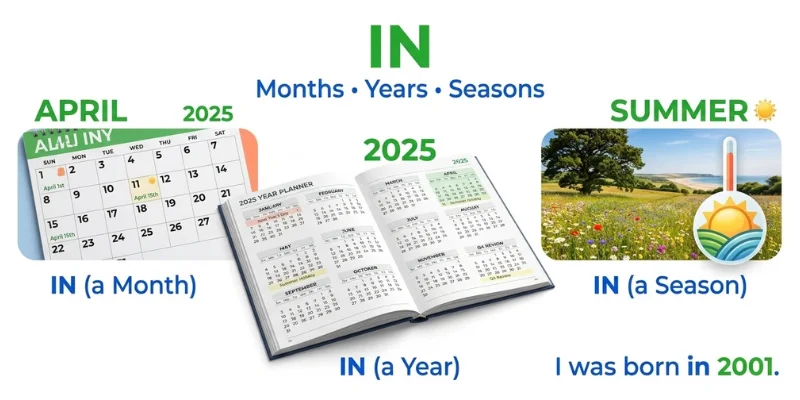
Comparison Table: In vs On vs At
| Preposition | Used For | Example |
| At | Exact time or point | at 7 p.m., at midnight |
| On | Days or dates | on Monday, on July 1st |
| In | Months, years, seasons | in April, in 2025 |
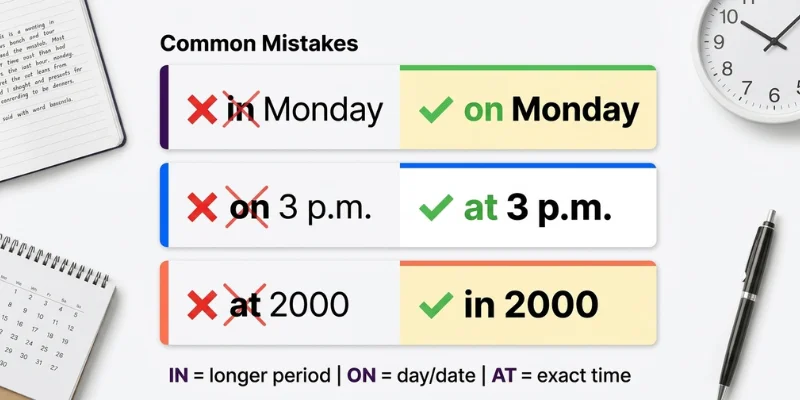
Common Mistakes Learners Make
Wrong: I’ll call you in Monday. Correct: I’ll call you on Monday.
Wrong: The meeting is on 3 p.m. Correct: The meeting is at 3 p.m.
Wrong: I was born at 2000. Correct: I was born in 2000.
Remember: in equals a big period, on equals a day, at equals an exact time.
In years of teaching this rule, the mistake that trips up even advanced learners is combining a day with a part of the day, like “Monday morning” or “Friday evening.” The fix is simple: on governs the whole phrase in these cases, so it is “on Monday morning,” not “in Monday morning.”
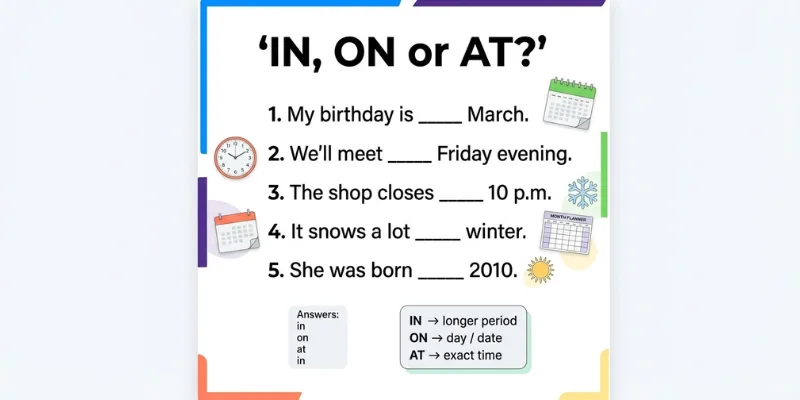
Practice Exercises
Fill in the blanks with in, on, or at:
- My birthday is ___ March.
- We’ll meet ___ Friday evening.
- The shop closes ___ 10 p.m.
- It snows a lot ___ winter.
- She was born ___ 2010.
Answers: 1. in, 2. on, 3. at, 4. in, 5. in
Applying this rule inside full sentences about your own daily routine is what genuinely makes it click. This same instinct connects to the broader preposition family covered in our guide on at vs on, which shows how these small words shift meaning across time, place, and position together.
Interesting Fact
Native speakers do not memorize prepositions; they feel them. By reading and listening daily, your brain naturally connects at with points, on with days, and in with longer periods. The more you use them, the easier they become.
Conclusion
Prepositions of time might seem like small, tricky words at first, but once the logic clicks, they become some of the easiest grammar rules to rely on.
Use in for longer periods, on for days and dates, and at for specific moments. Keep practicing with real examples from your own routine, your class schedule, your birthday, your favorite season, and the pattern will start to feel completely natural.
Yes, some special phrases do not follow the usual rules. For example, “in time” means you are early enough, and “on time” means you are right on schedule. For instance: “I arrived at the movie in time to buy popcorn, and it started on time, just as planned.”
Both phrases are correct. It depends on the region. “At the weekend” is commonly used in British English, while “on the weekend” is used in American English. The meaning is the same; both refer to time spent during the weekend.
Yes. A sentence can include both if it talks about when and where something happens. For example: “I’ll meet you at the café on Friday.” Here, “at the café” shows place, while “on Friday” shows time, and both fit naturally together.
Night is treated as a short, specific point in time, while morning, afternoon, and evening are treated as longer periods. So we say “at night” for that specific time, but “in the morning,” “in the afternoon,” or “in the evening” for the broader parts of the day.
A preposition of time shows when something happens. It connects actions to time, for example: at 7 o’clock, on Monday, in June. These small words help you express timing clearly in both conversation and writing.
Think of it like a timeline. At marks a small, precise point, on covers a medium block like a single day, and in represents a longer stretch of time like a month or year. Picturing this scale makes the choice much easier to remember naturally.
Not usually in one phrase, but they can appear in the same sentence. For example, in “on Monday morning,” on describes the day, and morning naturally fits inside that time frame. Just remember: it is never “in on Monday”; that combination is incorrect.
Yes. Words like at, in, and on work for both time and place, but the meaning changes depending on context. For instance, “at school” refers to a place, while “at 5 p.m.” refers to time. The surrounding words tell you how the preposition is being used.
A preposition of time tells when something happens, such as “in July” or “at noon.” A preposition of place tells where something happens, such as “in the kitchen” or “on the table.” Understanding both helps you speak and write more clearly.






- Be Respectful
- Stay Relevant
- Stay Positive
- True Feedback
- Encourage Discussion
- Avoid Spamming
- No Fake News
- Don't Copy-Paste
- No Personal Attacks
- Be Respectful
- Stay Relevant
- Stay Positive
- True Feedback
- Encourage Discussion
- Avoid Spamming
- No Fake News
- Don't Copy-Paste
- No Personal Attacks
