Modern English: A Complete Guide to Its Definition, History, Features, and Evolution With Examples
Published: 22 Sep 2026
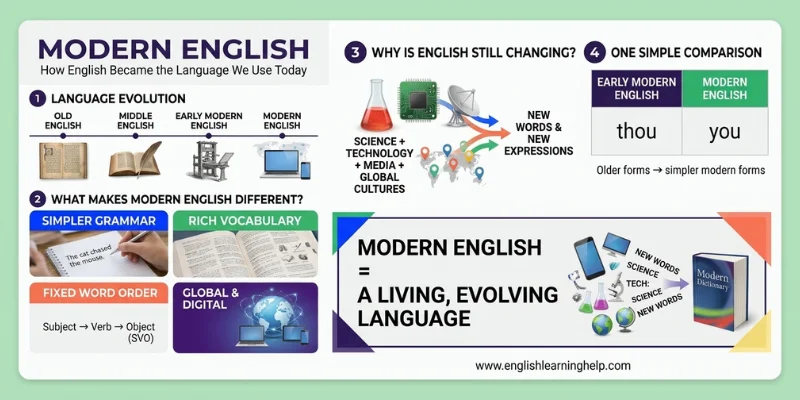
Modern English is the language we hear in schools, on the internet, in movies, and in daily conversations. It is the version of English that people around the world use to study, work, and communicate with each other. Many learners, students, and teachers study Modern English because it is simple, flexible, and useful in almost every part of life.
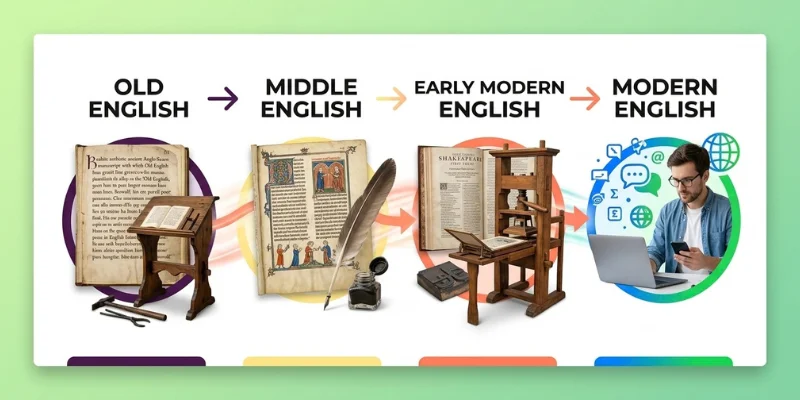
To understand Modern English, it helps to look at its evolution. English started as Old English, then changed into Middle English, and later developed into Early Modern English. Over time, new words, sounds, and writing styles shaped the Modern English we use today. This evolution explains why today’s English feels easier, has a larger vocabulary, and includes wide varieties like British and American English.
In this guide, you will learn what Modern English means today, how it developed, and why understanding its features can help you grow as a learner.
What Is Modern English?
Modern English is the current form of the English language that evolved following significant changes in spelling, pronunciation, and vocabulary. It has a stable grammar system, a large and growing vocabulary, and forms that closely resemble the English we read and hear today.
Modern English began around the late 1700s. This period matters because English began spreading across many countries through education, travel, trade, science, and printed books. New inventions and ideas introduced fresh words, and English became more organized in spelling and structure.
Modern English is very different from earlier forms. Old English had complex endings and looked closer to German. Middle English brought many French words and changed sentence structure. Early Modern English shaped modern grammar and introduced many classic texts.
Today’s English feels simpler and more stable. It follows a fixed word order, uses clear verb forms, and welcomes new words from science, technology, and the internet. These changes make Modern English easy to learn and suitable for global communication.
A Quick Timeline of the English Language
English has changed a lot over the centuries. To understand Modern English, it helps to see the main stages it went through.
Old English (450–1100): The earliest form of English, spoken mainly in England after the Anglo-Saxon invasion. The words, spelling, and grammar were very different from what we use today. Example: “Fæder ure” means “Our Father” in a famous Old English prayer.
Middle English (1100–1500): Developed after the Norman Conquest, when French words entered English. Grammar became simpler, but spelling was still inconsistent. Example: “Whan that Aprille with his shoures soote” is the opening line of Chaucer’s Canterbury Tales.
Early Modern English (1500–1800): This period introduced standardization in spelling and grammar. Shakespeare and the King James Bible helped shape the language, and pronunciation and vocabulary started to resemble today’s English. Example: “To be, or not to be, that is the question.” (Shakespeare)
Late Modern English (1800–Present): Modern English as we know it began around this time. Vocabulary grew rapidly with science, technology, and global trade. English spread worldwide and became the language of education, business, and media. Example: Words like “internet,” “television,” and “computer” entered English during this period.
Interesting note: many people assume Shakespeare wrote in Modern English because his plays feel relatively readable today. Technically, though, Shakespeare’s English belongs to Early Modern English, a slightly earlier and grammatically different stage of the language.
Who Invented Modern English?
No single person invented Modern English. Unlike an invention with one creator, Modern English developed gradually over centuries through the combined influence of ordinary speakers, writers, traders, scientists, and eventually global media.
Key moments accelerated this natural evolution: the printing press standardized spelling, dictionaries like Samuel Johnson’s fixed common definitions, and the Industrial Revolution and British Empire spread English worldwide. But no individual “created” it. It emerged the same way most living languages do, through everyday use by millions of people over time.
In years of teaching English learners about this history, one question comes up constantly: if no one invented it, why does it feel so structured? The answer is that structure came later, through dictionaries and education systems, not through a single inventor at the start.
Characteristics of Modern English Language
Modern English has features that make it easy to learn and widely used globally.
1. Simpler Grammar Structure
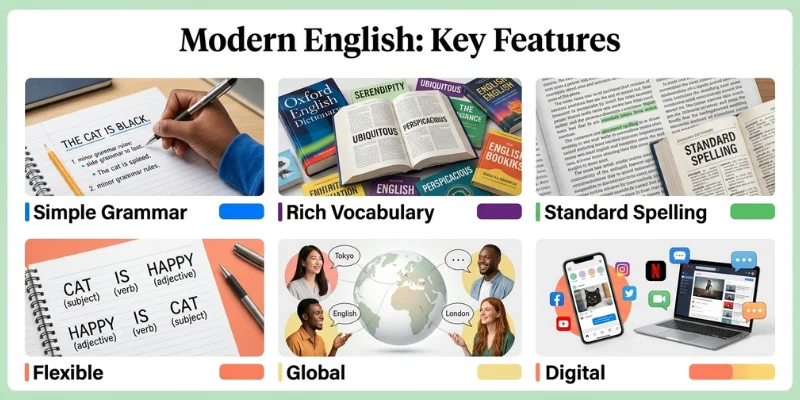
Modern English has fewer word endings and simpler rules than Old or Middle English. Sentences follow a clear word order: subject, verb, object. Example: “She reads a book” is simple and clear, unlike longer, more complex Old English sentences.
2. Huge and Growing Vocabulary (1 Million+ Words)
Modern English has over a million words, many borrowed from Latin, French, Greek, and other languages. Example: “Restaurant” comes from French, “music” from Latin, and “ketchup” from Chinese.
3. Standardized Spelling and Pronunciation
With dictionaries, printing, and education, spelling and pronunciation became more consistent, helping learners read and understand English more easily. Example: Words like “colour” (British) and “color” (American) follow clear rules within their respective regions.
4. Flexible Sentence Patterns
Modern English allows different ways to build sentences while keeping meaning clear. Example: “I went to the park yesterday” or “Yesterday, I went to the park” are both correct.
5. Global Influence and Usage
Modern English is used everywhere: schools, businesses, online platforms, and media, connecting people across countries and cultures. Example: International companies often use English for emails and meetings.
6. Technology and Media Shaping Modern English
Movies, TV, social media, and the internet have introduced new words and phrases, and Modern English continues to grow and adapt. Example: Words like “selfie,” “emoji,” and “streaming” are now part of everyday English.
7. Easy Word Order
Modern English uses a fixed word order, putting words in a simple sequence so meaning stays clear. Example: “I ate breakfast.” “She is studying English.”
Evolution of Modern English: How It Developed
Modern English did not appear suddenly. It developed step by step over many centuries, with each period adding something new.
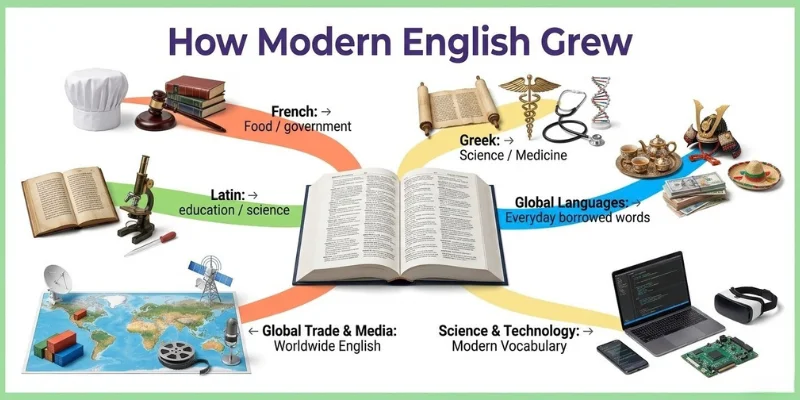
Influence of French, Latin, and Greek: French added many everyday words related to food, law, and government. Latin and Greek added words for science, education, and religion. Because of these languages, Modern English has a rich mix of simple and advanced vocabulary.
Scientific Revolution Vocabulary Growth: During the Scientific Revolution, discoveries needed new words. Terms for chemistry, physics, biology, and mathematics entered English, many from Latin and Greek, making English more precise and scientific.
Industrial Revolution and Global Trade: The Industrial Revolution introduced machines, factories, and new forms of work. People created fresh words for technology, travel, and industry, and global trade brought new items and vocabulary from countries around the world.
British Empire and Worldwide Spread: As the British Empire expanded, English reached Africa, Asia, the Americas, and the Pacific, becoming the language of education, business, and government in many parts of the world.
American English and Global Pop Culture: American English influenced spelling, pronunciation, and new expressions. Movies, music, television, and the internet helped spread American terms quickly, so modern vocabulary often includes words linked to technology, entertainment, and youth culture.
Modern English Grammar Features
Modern English grammar uses clear rules, simple structures, and patterns that help learners speak and write with confidence.
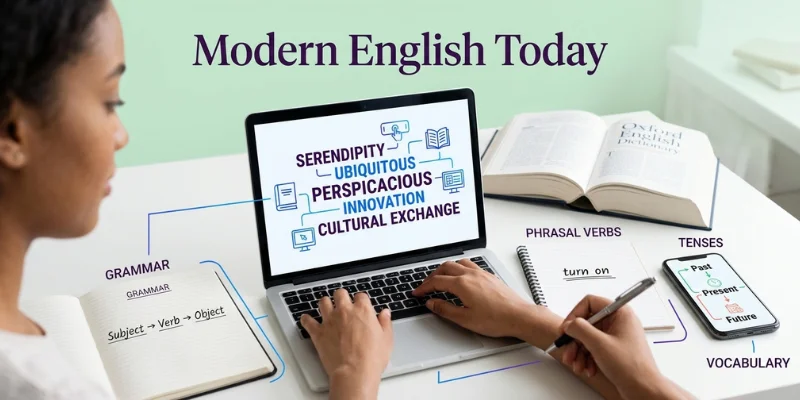
Pronouns and a Simpler Case System: Modern English uses a short set of pronouns: I, you, he, she, it, we, and they. Old English had many more forms, but today’s simpler system makes sentences easier to read and write.
Verb Tenses and Aspects: Modern English uses tenses to show time- past, present, and future- in almost every sentence. It also uses aspects like continuous and perfect to show if an action is in progress or completed.
Modal Verbs (Can, Could, May, etc.) Modal verbs like can, could, may, might, must, and should add meaning without long sentences, showing permission, ability, or possibility.
Use of Phrasal Verbs: Phrasal verbs pair a verb with small words like up, on, off, or after. Examples include “turn on,” “pick up,” and “look after.” They appear constantly in spoken and written English.
Standard Word Order (SVO): Modern English follows the pattern Subject plus Verb plus Object. Example: “She reads books.” This order keeps sentences clear and direct.
Modern English Vocabulary
Modern English has one of the largest vocabularies in the world, growing every year as new ideas, inventions, and cultures add fresh words.
Words Borrowed From Other Languages: Modern English takes many words from Latin, French, Greek, and languages around the world. “Menu” comes from French, “piano” from Italian, and “sushi” from Japanese. These borrowings make English rich, colorful, and useful across many fields.
New Words From Science and Technology: Science and technology continually introduce new words, such as virus, genome, smartphone, laptop, robot, and software, as new discoveries emerge.
Internet and Social Media Vocabulary: The internet introduced words like selfie, tweet, stream, and unsubscribe, which are now part of everyday speech, spreading fast through phones and social media.
Shortened Forms (LOL, BTW, Info, Vet, etc.): Modern English likes shorter forms to save time: info instead of information, fridge instead of refrigerator, vet instead of veterinarian. Online abbreviations like LOL, BTW, IDK, and BRB are common in quick messages.
A strong grasp of this evolving vocabulary is really an extension of ongoing English vocabulary development, since new words enter the language constantly and staying current is part of genuine fluency.
Modern English Pronunciation and Spelling
Modern English pronunciation and spelling can be tricky for learners, but they follow patterns that become easier with practice.
The Great Vowel Shift: A major change in how English vowels were pronounced, happening between the 1400s and 1700s. Before this shift, words like “time” and “name” sounded very different, and this change helped create the sounds used in Modern English today.
American vs British Pronunciation Differences: Americans say “color,” while British speakers say “colour.” In pronunciation, Americans often say “r” more strongly, while British speakers say it more softly. Both versions are correct.
Why Do Some English Spellings Seem Irregular? Some spellings look unusual because they come from older forms of the language. Words like “knight” and “though” still carry letters from Old and Middle English. These irregular words can be confusing at first, but learners remember them with practice and real reading.
Modern English in Daily Life (Real Examples)
Modern English is part of our everyday world, often without us even noticing.
- Conversations: Simple talks with friends, teachers, and family, like “How are you?” or “Can you help me?”
- Social Media: Quick posts, comments, and captions like “Great photo” or “See you soon,” along with phrases like “LOL” and “OMG.”
- Messages and Emails: Clear and direct language, such as “I finished my homework” or “Please check this file.”
- News: Simple, standard English so everyone can follow the story and stay updated.
- Education: Students learn Modern English through books, lessons, and classroom talks that build vocabulary and grammar step by step.
- Entertainment: Movies, songs, and games use natural, engaging Modern English that helps learners improve listening skills.
Beyond daily conversation, Modern English is also the language behind published novels, poetry, and plays, studied in schools and universities worldwide as a living, evolving literary tradition.
Modern English vs Early Modern English
Modern English is simpler and easier to learn compared to Early Modern English. Over time, grammar, vocabulary, and pronunciation changed, making the language more practical for daily use.
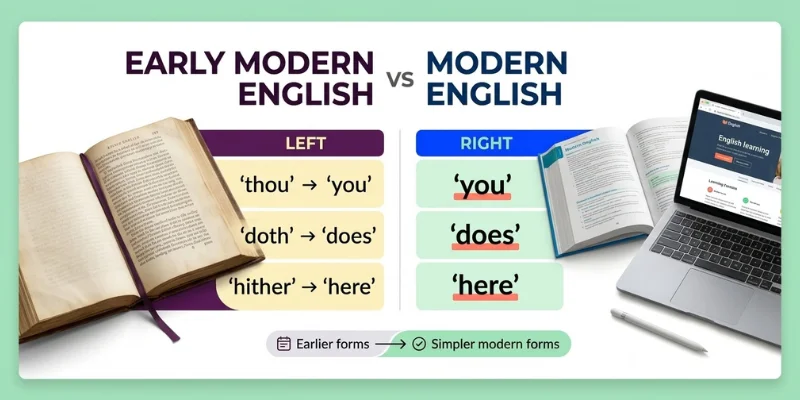
Vocabulary Differences: Early Modern English used words that are no longer common today, like “thou” for “you” and “hath” for “has.” Modern English replaced most of these with simpler, standard words.
Grammar Changes: Early Modern English grammar had many verb endings and different word orders that can confuse learners. Modern English uses a fixed word order and simpler verb forms.
Pronunciation and Spelling Differences: Pronunciation has changed significantly. Some words had different vowel sounds, and many letters that were once pronounced are now silent. Spelling has also been standardized.
| Feature | Early Modern English | Modern English |
| Pronoun | thou | you |
| Verb Ending | doth | does |
| Vocabulary | whence, hither | from where, here |
| Word Order | Verb often at the end | Subject-Verb-Object |
Importance of Modern English Today
Modern English is more than just a language. It is a tool that connects people worldwide, opening doors in education, work, travel, and everyday communication.
- Global Communication: People from different countries use Modern English to talk to each other in meetings, emails, and online chats, avoiding misunderstandings.
- Education: Many schools and universities teach in English, giving access to books, research papers, and videos.
- Business: International companies use English in emails, calls, and reports, increasing career opportunities. This connects closely to how Business English has become a specific professional skill of its own.
- Travel: English is used in airports, hotels, and tourist guides, even in countries where it is not the main language.
- Internet and Media: Most websites and streaming services use English, keeping people connected to global information and entertainment.
The broader importance of the English language extends well beyond Modern English specifically, shaping education, careers, and global opportunity for hundreds of millions of learners.
Modern English in the 21st Century
Modern English continues to grow and change today, shaped by technology, global communication, and cultural exchange.
How Technology Is Changing English: The internet, smartphones, and apps have made English more accessible. New words and expressions appear constantly, especially in tech and online conversation.
AI and Translation Tools: Artificial intelligence helps people understand and use English faster. Translation apps allow non-native speakers to communicate easily, and AI tools help learners practice grammar, pronunciation, and vocabulary.
New Dialects and “World Englishes”: English is spoken differently in different countries. Varieties like Australian English, African English, and Indian English have unique words, accents, and styles, showing how English adapts to local cultures while staying globally understandable.
Future Trends: Modern English will keep evolving with technology, trade, and media. Learning it now helps you stay ready for global opportunities in work, study, and travel.
If you are just starting your learning journey, it helps to first understand what the English language actually is before diving deeper into how its modern form works today.
Conclusion
Modern English is not just a set of rules and vocabulary lists. It is a living language, shaped by centuries of change and still evolving today with every new word, technology, and culture brought into it.
Understanding Modern English opens doors to better communication, study opportunities, and global connections. Even small daily steps, learning a new word, watching a video, or practicing a sentence, can make a real difference over time.
Pick one simple word today, try it in a sentence, or watch a short English video. Small, consistent actions like these are what steadily build real confidence in Modern English.
Modern English is widely used due to its role in education, business, travel, and the internet. Countries like the UK and the US helped it spread through trade, science, and global media, making it the main language for international communication today.
Modern English began in the late 1700s, after Early Modern English. It developed as new words, grammar, and expressions entered the language, shaping the English we speak, write, and read today.
No one person invented it. Modern English developed naturally over centuries through the combined influence of everyday speakers, writers, trade, science, and global media, similar to how most living languages evolve.
Not exactly. Shakespeare wrote in Early Modern English, which is close to but grammatically different from the Modern English used today. Many words and structures from that time have since changed or disappeared.
Modern English is simpler and easier to learn. Grammar rules are less complicated, spelling is more standard, and the vocabulary is much larger, including words from French, Latin, Greek, and other languages.
Modern English has over a million words, including everyday vocabulary, scientific terms, and internet slang, and it keeps growing with new words from technology and global communication.
Yes. Social media, technology, and global communication add new words and expressions constantly, and even grammar and pronunciation evolve slightly as people use English around the world.
Either is fine for beginners. The two have small differences in spelling, pronunciation, and vocabulary. Focus on understanding and communicating first, then learn the other variety later.
English spelling comes from history and borrowed words from other languages. Some words do not follow regular patterns, which can be confusing at first, but reading and practice help learners remember them naturally.
Accents may sound different, but the meaning usually stays clear. Listening to videos, songs, and conversations helps you get used to different accents over time.





- Be Respectful
- Stay Relevant
- Stay Positive
- True Feedback
- Encourage Discussion
- Avoid Spamming
- No Fake News
- Don't Copy-Paste
- No Personal Attacks
- Be Respectful
- Stay Relevant
- Stay Positive
- True Feedback
- Encourage Discussion
- Avoid Spamming
- No Fake News
- Don't Copy-Paste
- No Personal Attacks
