Apostrophes: Definition, Rules, Uses & Examples
Published: 8 Oct 2026
Apostrophes are small punctuation marks, but they can cause big problems in English writing.
Should you write girl’s, girls’, or girls? What is the difference between its and it’s? And when should you use an apostrophe with a plural noun?
This guide explains apostrophes in simple English. You will learn the apostrophe definition, its main uses, possession rules, contractions, common mistakes, and easy examples.
What Is an Apostrophe?
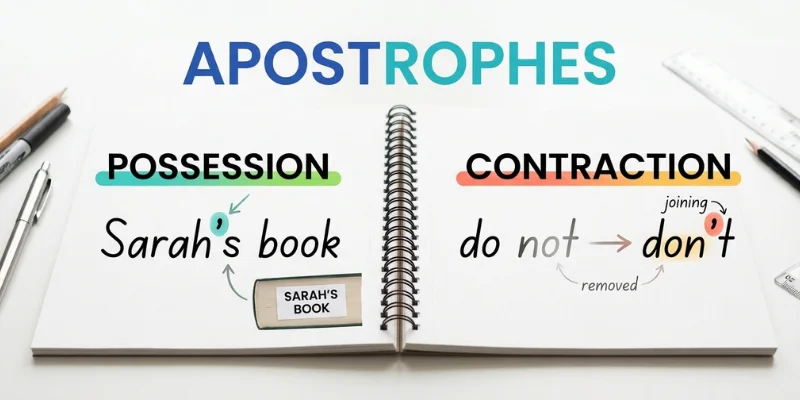
An apostrophe (’) is a punctuation mark used mainly for two purposes:
- To show possession or ownership
- To show missing letters in contractions
Examples
- Sara’s book → the book belongs to Sara.
- The students’ classroom → the classroom belongs to the students.
- I’m → I am.
- Don’t → do not.
The apostrophe is usually placed before or after s, depending on the word and its meaning.
What Does an Apostrophe Mean?
The meaning of an apostrophe depends on how it is used.
Apostrophe for possession
It can show that something belongs to a person, animal, group, or thing.
The teacher’s desk is clean.
The desk belongs to the teacher.
Apostrophe in contractions
It can also show that letters have been removed from two words.
She is → She’s
They are → They’re
Cannot → Can’t
So, apostrophes do not always show ownership.
The Two Main Uses of Apostrophes
Most apostrophe rules fall into two main groups:
| Use | Example | Meaning |
| Possession | Maria’s phone | The phone belongs to Maria |
| Contraction | Maria’s happy | Maria is happy |
This difference is important because ’s can have more than one meaning.
Apostrophes for Possession
A possessive apostrophe shows that one noun owns or is connected to another noun.
The main rule depends on whether the owner is singular or plural.
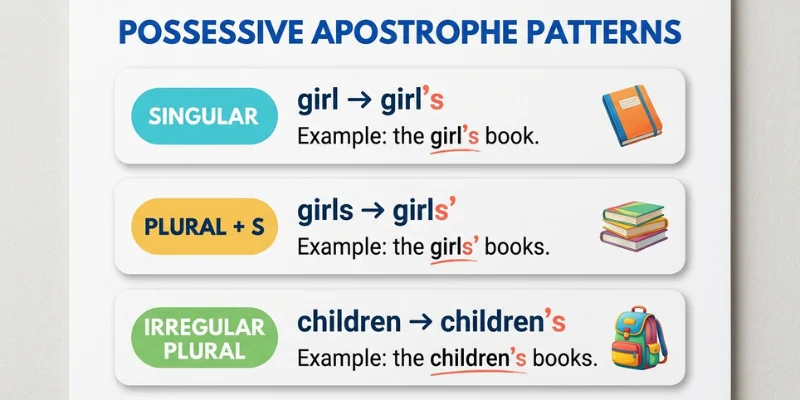
1. Singular Nouns: Add ’s
For a singular noun, usually add ’s.
Examples
- the boy’s bag
- the girl’s bicycle
- the teacher’s desk
- the dog’s tail
- the student’s book
Example sentence
The girl’s notebook is on the table.
One girl owns the notebook, so we write girl’s.
2. Plural Nouns Ending in S: Add Only an Apostrophe
If a plural noun already ends in s, add an apostrophe after the s.
Examples
- students → students’
- teachers → teachers’
- parents → parents’
- players → players’
- dogs → dogs’
Example sentences
The students’ books are on the desk.
The teachers’ room is upstairs.
Here, more than one student or teacher owns or is connected to the thing.
For a deeper explanation of this specific rule, see our guide to [Apostrophes After S].
3. Plural Nouns That Do Not End in S: Add ’s
Some plural nouns do not end in s. These are often irregular plurals.
Add ’s to these words.
Examples
- children → children’s
- men → men’s
- women → women’s
- people → people’s
- mice → mice’s
Example sentences
The children’s toys are everywhere.
The women’s team won the match.
The men’s shoes are near the door.
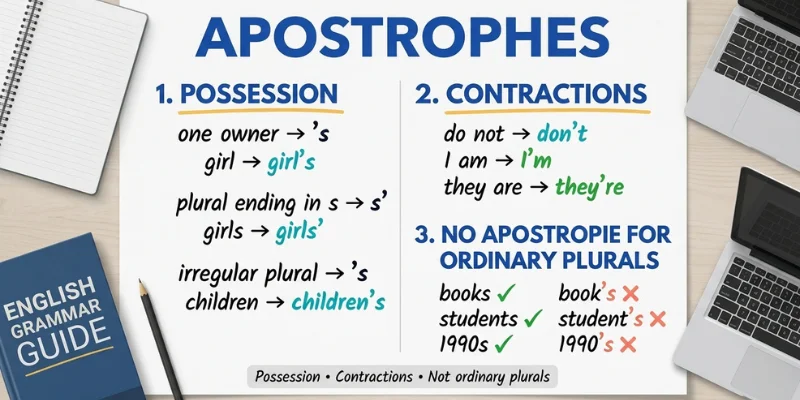
Remember:
Plural ending in s → s’
Plural not ending in s → ’s
Apostrophes in Names
Names can also use possessive apostrophes.
Singular names
For most singular names, add ’s.
- Ahmed’s phone
- Sarah’s book
- James’s car
- Maria’s bag
For names that already end in s, you may see both James’s and James’ depending on the style guide being followed. Many modern English resources use James’s as the regular form, while some styles prefer James’.
The important point is to follow the style required by your school, workplace, or publication.
Apostrophes for Contractions
An apostrophe can replace letters that are left out when two words are shortened.
These shortened forms are called contractions.
Common contractions
| Full form | Contraction |
| I am | I’m |
| You are | You’re |
| He is | He’s |
| She is | She’s |
| It is | It’s |
| We are | We’re |
| They are | They’re |
| Do not | Don’t |
| Does not | Doesn’t |
| Cannot | Can’t |
| Will not | Won’t |
| Did not | Didn’t |
| I have | I’ve |
| They have | They’ve |
Examples
I’m ready for school.
She’s my sister.
They’re playing football.
We don’t have enough time.
Contractions are very common in everyday English. They are also common in conversations, messages, and informal writing.
For more help with choosing language for different situations, see our guide to Formal vs Informal English.
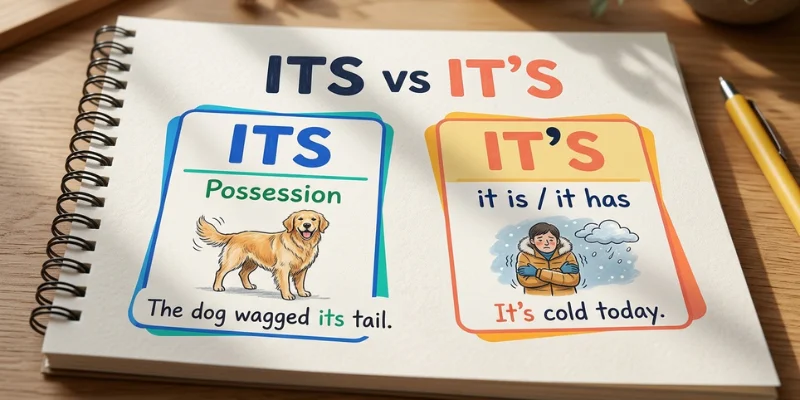
Its vs It’s
One of the most common apostrophe mistakes is confusing its and it’s.
Its = possession
Its shows that something belongs to or is connected with something.
The dog wagged its tail.
The company changed its website.
It’s = it is or it has
It’s is a contraction.
It’s cold today.
= It is cold today.
It’s been a long day.
= It has been a long day.
Easy test
Replace it’s with it is or it has.
If the sentence still makes sense, (it’s) is probably correct.
Your vs You’re
These words are also often confused.
Your = possession
Is this your book?
You’re = you are
You’re very kind.
Apostrophes can change the meaning of a word, so check the full form when you are unsure.
Their vs They’re
Their = possession
The students opened their books.
They’re = they are
They’re ready for class.
They’re is a contraction, so the apostrophe replaces the missing letters in they are.
Who’s vs Whose
Who’s = who is or who has
Who’s coming to the party?
Who’s finished the work?
Whose = possession
Whose bag is this?
Whose phone is ringing?
This is another useful example of why apostrophes should not be added just because a word sounds like a possessive form.
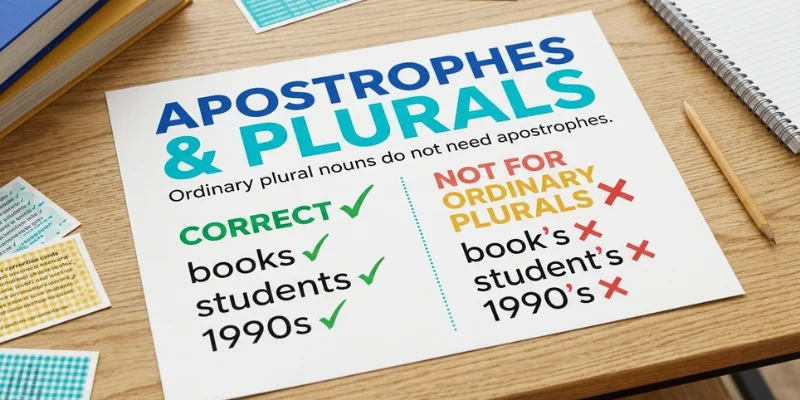
Do Not Use Apostrophes to Make Ordinary Plurals
A common mistake is using an apostrophe before s just to make a word plural.
Incorrect
- apple’s
- book’s
- teacher’s
- student’s
when you simply mean more than one.
Correct
- apples
- books
- teachers
- students
An apostrophe is not normally needed to make an ordinary noun plural.
Compare
The student’s book
= the book belongs to one student.
The students’ books
= the books belong to several students.
The students are reading.
= students is simply plural, so no apostrophe is needed.
Apostrophes With Time Expressions
Apostrophes can also appear in expressions of time.
Examples
- a day’s work
- a week’s holiday
- two weeks’ holiday
- a month’s salary
- three months’ experience
- one year’s study
- two years’ experience
The same possession idea applies.
a week’s holiday
= a holiday of one week
two weeks’ holiday
= a holiday of two weeks
Apostrophes and Years
Apostrophes are sometimes used when letters or numbers are left out of a year.
For example:
the ’90s
The apostrophe shows that the first digits have been omitted from 1990s.
However, when simply making a decade plural, use:
1990s
not:
1990’s
The apostrophe is not needed just to make a decade plural.
Apostrophes in Everyday Writing
You will see apostrophes in many common forms of writing.
Signs and notices
- Children’s Shoes
- Women’s Clothing
- Teachers’ Room
- Today’s Special
Messages
- I’m busy.
- Don’t worry.
- It’s okay.
- We’re coming soon.
School and work
Correct apostrophe use is important in school assignments, emails, reports, and other forms of writing.
If you want to improve your overall writing, see our guide to Improve English Writing Skills.
Apostrophe vs Comma vs Quotation Mark
These punctuation marks look different and have different jobs.
| Mark | Name | Main use |
| ’ | Apostrophe | Possession and contractions |
| , | Comma | Separating parts of a sentence |
| “ ” | Quotation marks | Showing direct speech or quoted words |
Examples
Apostrophe:
Sarah’s book is new.
Comma:
Sarah bought a book, a pen, and a notebook.
Quotation marks:
Sarah said, “This book is interesting.”
Do not confuse an apostrophe with a quotation mark.
Smart Apostrophes
You may see two common apostrophe shapes:
- Straight apostrophe: ‘
- Curly or smart apostrophe: ’
For example:
don’t
don’t
The second form uses a curly apostrophe.
In professionally formatted writing, curly apostrophes are often preferred because they have a more polished appearance.
Apostrophe as a Figure of Speech
The word apostrophe has another meaning in literature.
As a literary device, apostrophe means directly addressing a person who is absent, dead, imaginary, or an object or idea that cannot normally respond.
Example
“O Moon, why are you hiding tonight?”
The speaker addresses the Moon directly as if it could respond.
This literary meaning is different from the punctuation mark discussed in most of this article.
Common Apostrophe Mistakes
Here are some mistakes English learners often make.
Mistake 1: Using an apostrophe for a normal plural
❌ I bought three book’s.
✅ I bought three books.
Mistake 2: Confusing its and it’s
❌ The cat cleaned it’s paws.
✅ The cat cleaned its paws.
Mistake 3: Using ’s with a regular plural possessive
❌ The students’s books are on the table.
✅ The students’ books are on the table.
Mistake 4: Forgetting the apostrophe in a contraction
❌ Dont worry.
✅ Don’t worry.
Mistake 5: Confusing your and you’re
❌ Your very helpful.
✅ You’re very helpful.
A Simple Trick to Remember Apostrophe Rules
When you see an apostrophe, ask:
Question 1: Is it showing possession?
If yes, check whether the owner is singular or plural.
- one student → student’s
- several students → students’
- children → children’s
Question 2: Is it a contraction?
If yes, the apostrophe usually replaces missing letters.
- do not → don’t
- I am → I’m
- they are → they’re
Question 3: Is it just a normal plural?
If yes, you usually do not need an apostrophe.
- books
- cars
- students
- teachers
Quick Apostrophe Guide
| Situation | Correct form | Example |
| Singular possession | ’s | the girl’s bag |
| Plural ending in s | s’ | the girls’ bags |
| Irregular plural possession | ’s | the children’s books |
| Contraction | ’ | don’t, I’m, they’re |
| Normal plural | no apostrophe | books, cars, students |
| Possessive pronoun | usually no apostrophe | its, yours, theirs |
| Decade plural | no apostrophe | 1990s |
| Shortened decade | apostrophe for omitted digits | ’90s |
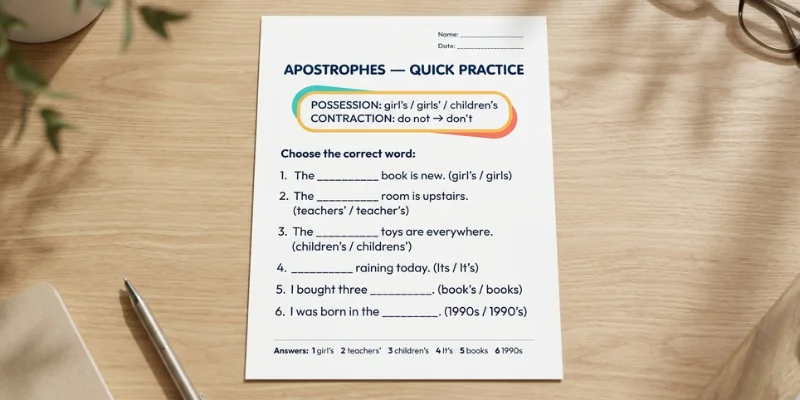
Apostrophes Practice Worksheet
Choose the correct form.
- The (girl’s / girls) bag is blue.
- The (girls’ / girl’s) bags are blue.
- The (children’s / childrens’) books are on the table.
- (Its / It’s) raining today.
- The dog hurt (its / it’s) leg.
- (Your / You’re) very good at English.
- The (teachers’ / teacher’s) room is upstairs.
- I (dont / don’t) understand this rule.
- I was born in the (1990s / 1990’s).
- (They’re / Their) going to the library.
Answers
- girl’s
- girls’
- children’s
- It’s
- its
- You’re
- teachers’
- don’t
- 1990s
- They’re
Examples of Apostrophes in Sentences
Here are some simple examples you can use as a quick reference:
- John’s car is outside.
- The students’ desks are clean.
- The children’s toys are in the box.
- I’m ready for the test.
- She’s my best friend.
- Don’t open the door.
- The cat is licking its paw.
- It’s very hot today.
- Who’s at the door?
- Whose book is this?
- The teachers’ meeting starts at three.
- I lived there in the 1990s.
Why Apostrophes Matter
A small apostrophe can change the meaning of a sentence.
Compare:
The student’s books
This means the books belong to one student.
The students’ books
This means the books belong to several students.
Good punctuation makes your writing easier to understand. It is especially useful when you write assignments, emails, messages, and other important documents.
For broader help with clear written communication, see our guide to English Communication Skills.
Related Guide: Apostrophes After S
One of the most confusing apostrophe rules is knowing when the apostrophe should come after s.
For example:
- students’
- teachers’
- parents’
- girls’
This normally happens when a plural noun already ends in s, and you want to show possession.
Our dedicated guide Apostrophes After S explains this rule in more detail, including plural nouns, names ending in s, common mistakes, and clear examples.
Quick Recap
Remember these simple rules:
- Singular possession → ’s
→ the girl’s bag - Plural ending in s → s’
→ the girls’ bags - Irregular plural → ’s
→ the children’s books - Contraction → apostrophe replaces missing letters
→ do not → don’t - Normal plural → no apostrophe
→ books, students, cars - its = possession
→ The dog hurt its paw. - it’s = it is / it has
→ It’s cold.
Conclusion
Apostrophes become much easier when you first ask what the word is doing in the sentence. Check for possession, contraction, or a simple plural, and the correct form becomes clearer.
Keep practicing these small rules, and your English writing will become cleaner and more confident. For more useful English grammar and writing lessons, keep learning with EnglishLearningHelp.com.
| Practice and improve your skills by solving our Free Grammar MCQs Test. |
|---|
FAQ’s
An apostrophe is a punctuation mark (’) mainly used to show possession or form contractions. For example, Sarah’s book shows possession, while don’t is a contraction of do not.
The two main uses are showing possession and forming contractions. For example, Ali’s phone shows possession, while Ali’s happy can mean Ali is happy.
You usually put the apostrophe after s when a plural noun already ends in s, and you want to show possession. For example, students’ books means the books belong to several students.
Normal plural nouns usually do not need apostrophes. Write books, cars, and students when you simply mean more than one. Use an apostrophe when showing possession or forming a contraction.
It’s shows possession, as in The dog wagged its tail. It’s is a contraction of it is or it has, as in It’s cold today.
When you mean the decade, the standard form is 1990s, without an apostrophe. An apostrophe can be used in a shortened form such as ’90s because the first digits of the year have been omitted.
Yes. Names ending in s can be possessive. You may see forms such as James’s book or James’ book, depending on the style guide being followed. Check the style required for your school, workplace, or publication.
Yes. An apostrophe is a punctuation mark used mainly for possession and contractions. The word apostrophe can also refer to a literary device, which is a separate meaning.


- Be Respectful
- Stay Relevant
- Stay Positive
- True Feedback
- Encourage Discussion
- Avoid Spamming
- No Fake News
- Don't Copy-Paste
- No Personal Attacks
- Be Respectful
- Stay Relevant
- Stay Positive
- True Feedback
- Encourage Discussion
- Avoid Spamming
- No Fake News
- Don't Copy-Paste
- No Personal Attacks
