The Ultimate Guide to Words Mostly Confused in English
Published: 28 Sep 2026
English is full of words that look or sound alike but have completely different meanings. Even fluent speakers mix them up. These confusing word pairs can change your sentence’s meaning without you realizing it.
The good news is that once you learn a few simple rules and memory tricks, these confusing words become much easier to remember and use correctly. Let’s uncover the most commonly confused English words and how to use them correctly.
Why English Speakers Confuse These Tricky Words
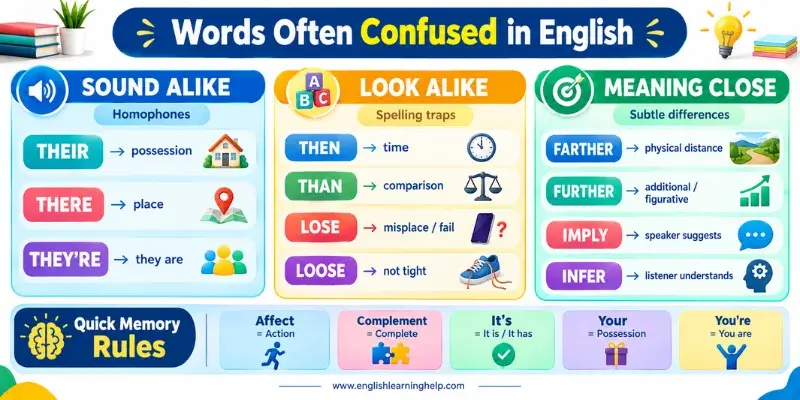
English can be tricky because it borrows from many languages: Latin, French, German, and Greek. Many words sound alike, look similar, or have closely related meanings. For example, their, there, and they’re sound the same, while lose and loose look almost identical but have different meanings.
These confusing words can fall into different groups. Some are homophones that sound alike but have different spellings and meanings, while others have similar spellings or closely related meanings.

Sound-Alikes: Mastering the Most Common Homophones
Homophones are words that sound the same but have different meanings and spellings. Getting them right boosts both your writing accuracy and your speaking confidence.
Affect vs. Effect
Affect (verb): means to influence. “The weather can affect your mood.”
Effect (noun): means the result of something. “The new law had a positive effect on schools.”
Quick tip: Affect means action, and effect means end result.
Their, There, and They’re
Their shows possession: “Their house is beautiful.”
There shows a place or position: “Put the book over there.”
They’re means “they are”: “They’re studying for the test.”
Memory tip: “There” has “here” in it, and both relate to place.
Complement vs. Compliment
Complement means something that completes or goes well with something. “That scarf complements your dress perfectly.”
Compliment means praise or kind words. “She gave me a lovely compliment on my presentation.”
Trick: The “i” in compliment reminds you that “I” say something nice.
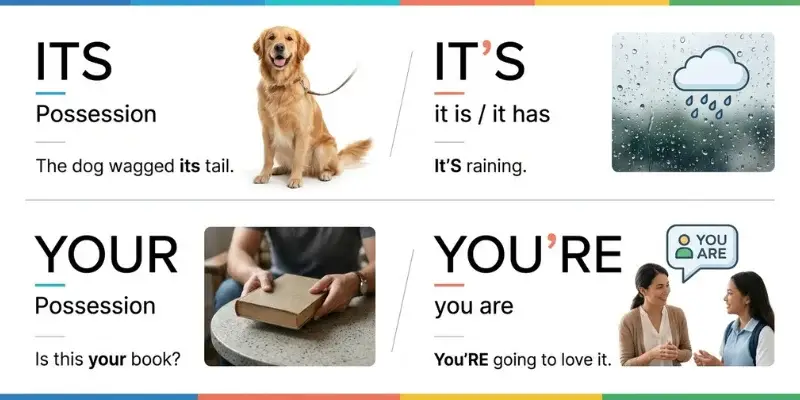
One of the Most Confused Pairs: Its vs. It’s
Its vs. It’s is one of the most commonly confused word pairs in English, so it is worth covering carefully.
Its (no apostrophe) shows possession, just like “his” or “her.” “The dog wagged its tail.”
It’s (with an apostrophe) is short for “it is” or “it has.” “It’s raining today.” “It’s been a long week.”
Quick tip: If you can replace the word with “it is,” and the sentence still makes sense, use it’s. If not, use its.
Your vs. You’re
This pair causes just as many mistakes as its/it’s, especially in quick texts and social media.
Your shows possession: “Is this your book?”
You’re is short for “you are”: “You’re going to love this movie.”
Quick tip: Say the sentence out loud with “you are” instead. If it still sounds right, use you’re.
Look-Alikes: Fixing Near-Identical Spelling Errors
Some words look almost identical but differ in one tiny letter that changes the meaning completely. These are spelling traps that catch even native speakers.
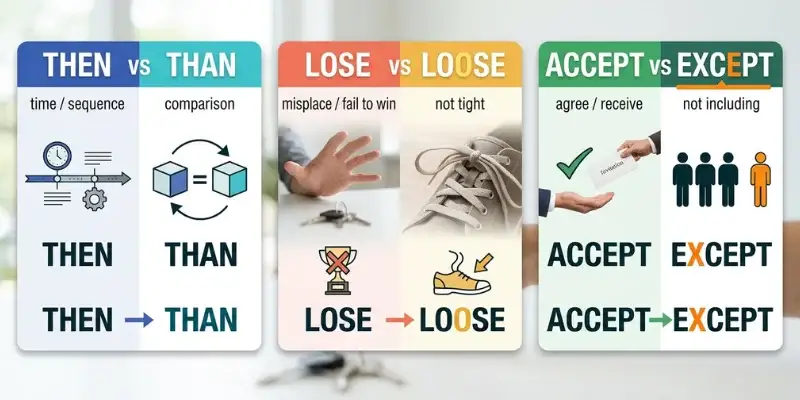
Then vs. Than
Then refers to time or sequence: “We went to the park, then had lunch.”
Than is used for comparison: “She is taller than her brother.”
Memory tip: “Than” compares; “Then” tells when.
Lose vs. Loose
Lose (one “o”) means to misplace or fail to win: “Don’t lose your phone!”
Loose (two “o”s) means not tight or free: “These shoes are too loose for me.”
Trick: “Loose” has more space in its spelling, and it means less tight.
Accept vs. Except
Accept (verb): to agree to receive or approve. “I accept your invitation.”
Except (preposition): not including, other than. “Everyone is going except John.”
Tip: “A” for agree, “E” for exclude.
Words like these are exactly the kind of detail covered in our guide on words to avoid in writing, since small word-choice mistakes can make otherwise strong writing look careless.
Semantic Pitfalls: Words with Closely Related Meanings
Some word pairs share similar meanings but differ subtly in context or precision. These are semantic pitfalls, easy to misuse if you focus only on the general meaning.
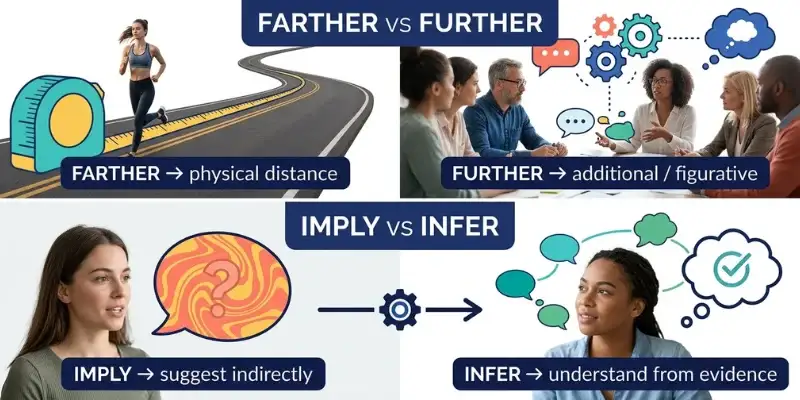
Farther vs. Further
Farther usually refers to physical distance: “He ran farther than I did.”
Further is commonly used for additional, figurative, or non-physical ideas: “We need to discuss this further.”
Think: “Farther” has “far” inside it, so it points to real distance.
Imply vs. Infer
Imply means to suggest something indirectly: “Her tone implied she was upset.”
Infer means to understand something based on evidence: “I inferred that he was tired from his silence.”
Memory trick: The speaker implies, and the listener infers.
Building comfort with subtle word differences like these is really part of ongoing English vocabulary development, since precise word choice is what separates good English from great English.
Mnemonic Devices and Strategies for Quick Recall
Learning through logic alone is not enough. Your brain remembers best when patterns connect to visuals, humor, or sound, which is why mnemonic devices work so well.
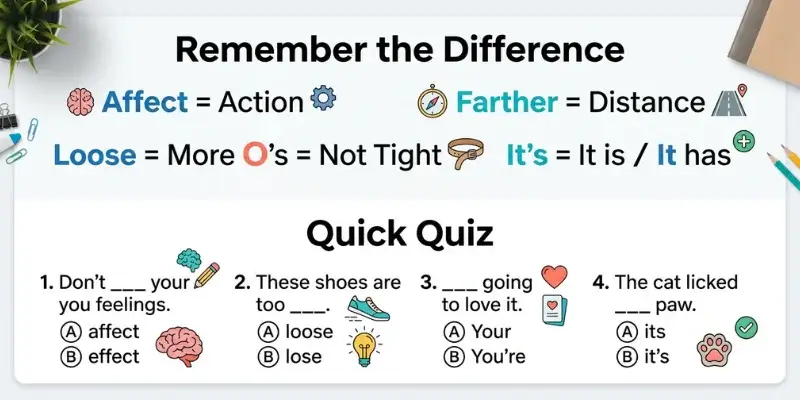
- “Loose” shoes have more “o”s, and they are not tight.
- “Affect” is an Action, and both words start with A.
- “Complement” completes; “compliment” gives praise.
- “Farther” means distance; “further” means an idea.
- If “it is” fits, use it’s. If not, use its.
Using short, visual mnemonics makes it easier for learners to remember confusing words in daily communication, and this same habit strengthens your English writing skills overall, since catching these small errors is a core part of self-editing.
Test Your Knowledge: A Quick Quiz
Choose the correct word:
- I don’t want to ___ your feelings. (affect / effect)
- Please tighten your ___ shoelaces. (lose / loose)
- We’ll go to the market, ___ have dinner. (then / than)
- Everyone ___ Sarah was invited. (accept / except)
- The speech had a great ___ on the audience. (effect/affect)
- ___ going to love this next word pair. (Your / You’re)
- The cat licked ___ paw. (its / it’s)
Answers: 1. affect, 2. loose, 3. then, 4. except, 5. effect, 6. You’re, 7. its
Conclusion
Mastering words often confused in English is not about memorizing rules. It is about understanding patterns and meaning.
With a bit of attention and the tricks you learned today, you can speak and write more confidently without second-guessing yourself. Every time you choose the right word, your English becomes clearer, sharper, and more impressive.
English has many similar-looking or sounding words from different origins, so learners often mix them up. Recognizing their part of speech, verb or noun, makes it easier to tell them apart.
Homophones are words that sound the same but have different meanings and spellings, like their, there, and they’re. They are tricky because pronunciation does not reveal the difference.
Use mnemonic devices or visual memory tricks. For example, “Affect = Action” and “Farther = Distance.” Repetition through reading and writing also helps reinforce memory.
Yes. Native speakers can also confuse words such as “your” and “you’re” or “then” and “than,” especially when typing quickly. Reading carefully and proofreading can help catch these mistakes.
Create flashcards or mini quizzes. Write short sentences using each pair correctly. Reading English blogs and books regularly helps you see words in context, which strengthens understanding naturally.




- Be Respectful
- Stay Relevant
- Stay Positive
- True Feedback
- Encourage Discussion
- Avoid Spamming
- No Fake News
- Don't Copy-Paste
- No Personal Attacks
- Be Respectful
- Stay Relevant
- Stay Positive
- True Feedback
- Encourage Discussion
- Avoid Spamming
- No Fake News
- Don't Copy-Paste
- No Personal Attacks
