Standard English and Non-Standard English Explained in Simple Words So You Finally Get the Difference
Published: 24 Sep 2026

If you’re unsure which English style to use at school, at work, or in daily talk, you are not alone. Many learners struggle with standard English and non-standard English because both forms appear everywhere. It can feel confusing when teachers expect one style but friends speak in another. Learning the difference helps you speak clearly in any situation.
What Do We Mean by “Standard English”?
Simple Definition
Standard English is the form of English that people use in schools, exams, news, and official writing. It follows clear grammar rules, correct spelling, and proper sentence structure that stay the same almost everywhere, so everyone can understand it easily. You can think of it as the official English for learning and formal situations.
Why People Use It
People use Standard English because it helps avoid confusion. They use it when they want their message to sound clear, polite, and professional. When you write or speak this way, anyone reading or listening knows exactly what you mean. You see it in textbooks, newspapers, job applications, and formal speeches.
Examples
A teacher might say, “Please submit your homework on time,” or an office worker might write, “The meeting starts at 10 a.m.” Both follow Standard English rules.

What Do We Mean by “Non-Standard English”?
Simple Definition
Non-standard English is the way many people speak in daily life. It does not always follow the grammar rules you see in schoolbooks, but it still carries a clear meaning. You hear it in homes, markets, streets, and online chats because people use the language that feels natural to them.
Why It Exists
Non-standard English exists because every place, age group, and community develops its own style. People copy the speech they grew up hearing, so their language reflects their background and culture. It helps them feel comfortable and connects them to the people around them.
Examples
You can see non-standard English in sentences like “I ain’t got time” or “We was going there.” Friends often talk this way because it feels easy and relaxed. These forms sound different from Standard English, but they still communicate effectively.

Key Differences Between Standard English and Non-Standard English
Standard and non-standard English may sound similar, but they follow different patterns. Understanding these differences helps you choose the right style for school, work, or casual conversation, and helps you avoid mistakes in formal writing.
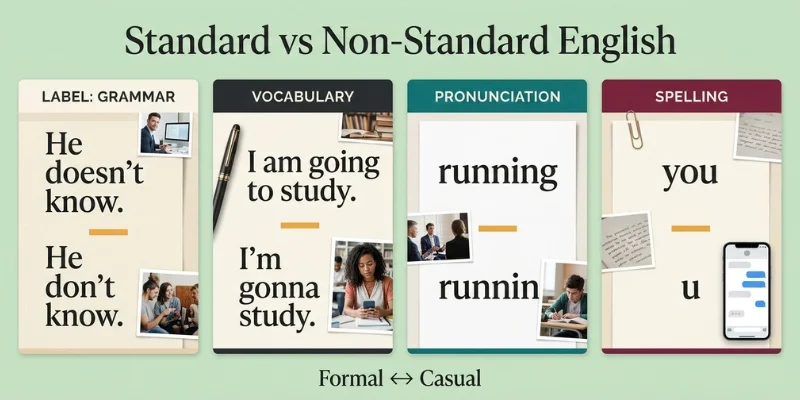
Grammar
Standard English follows fixed rules, so sentences look neat and clear. Non-standard English sometimes drops words or changes verb forms. The meaning stays the same, but the structure changes.
Examples:
- Standard: “He doesn’t know.” / Non-standard: “He don’t know.”
- Standard: “We were late.” / Non-standard: “We was late.”
Vocabulary
Standard English uses words you see in books, emails, and news. Non-standard English uses everyday words that feel relaxed and familiar, like “gonna,” “wanna,” or local slang. Each style shows a different level of formality.
Examples:
- Standard: “I am going to study now.” / Non-standard: “I’m gonna study now.”
- Standard: “I want to go.” / Non-standard: “I wanna go.”
Pronunciation
Standard English sounds smooth and careful. Non-standard English often shortens sounds or changes them based on regional or cultural differences.
Examples:
- Standard: “running” / Non-standard: “runnin”
- Standard: “going to” / Non-standard: “gonna” (spoken)
Spelling
Standard English follows fixed, dictionary-approved spelling in all formal writing. Nonstandard spelling shows up mostly in casual texting or social media, where words get shortened or written the way they sound, like “gonna,” “wanna,” or “u” instead of “you.” This kind of spelling is fine in a text message to a friend, but it does not belong in schoolwork, emails, or professional writing.
When to Use Each
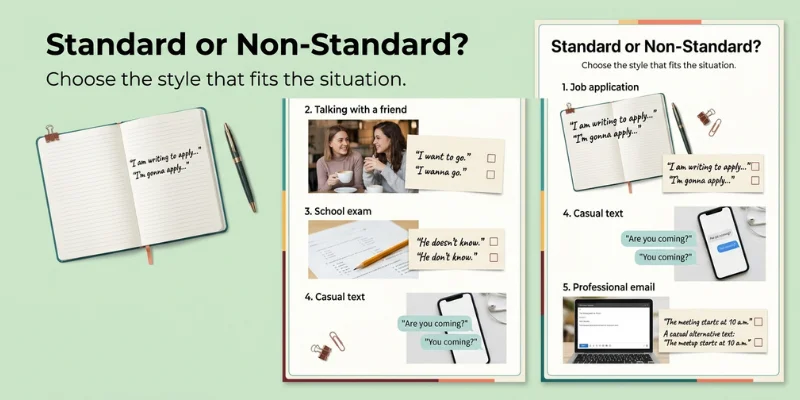
Use Standard English when you write emails, take exams, or speak in class. Use non-standard English when you talk with friends or chat online. Switching between both helps you communicate with confidence.
Examples:
- Standard setting: Writing a job application.
- Non-standard setting: Talking with friends after school.
This kind of register-switching is a core part of strong English communication skills, since knowing which style fits which situation is often just as important as grammar itself.

Why Both Forms Are Important
Standard and non-standard English both play a big role in everyday life. When you know how each one works, you feel more confident in different situations.
Helps You Speak to Different People
You meet many kinds of people every day, and they do not all speak the same way. When you can switch between both forms, you understand others better, and they understand you too, making conversations feel natural and comfortable.
Helps in School and Work
Standard English helps you write clearly in exams, emails, and assignments. It gives you the tools you need for better marks and better communication at work. This is especially true in Business English, where sounding polished and precise in emails and meetings genuinely affects how colleagues and clients perceive you.
Helps You Connect Culturally
Non-standard English reflects community, personality, and local style. It shows where you come from and helps you feel close to your group. It also makes casual conversations feel warm and relaxed, especially in everyday spoken English.
Common Myths About Standard and Non-Standard English
Many learners believe a few things about standard English and non-standard English that are not true. Clearing these myths helps you feel confident about when to use each type.
Myth 1: Non-Standard English Is Wrong
Some people think casual speech or local expressions are incorrect. They are not. Non-standard English works perfectly for everyday conversations. Example: “I ain’t going” is fine when talking to friends.
Myth 2: Standard English Is the Only “Real” English
Standard English is not the only correct form. It is simply the version used in schools, books, and formal writing. Other forms reflect culture and daily life just as validly. Example: “She is running” and “She’s runnin'” both communicate the same idea.
Myth 3: Non-Standard English Shows Poor Education
Using non-standard English does not mean someone is uneducated. It simply shows they speak naturally in informal settings. Everyone uses it, even highly educated people. Example: “Gonna grab lunch” is casual, not wrong.
How Learners Can Handle Both Types
Learners can handle both types by starting with Standard English first. It helps to build a strong base for school, work, and writing. From there, listen to native speakers to notice casual phrases and pronunciation, and practice switching styles depending on the situation. Simple resources like children’s books, videos, and subtitles help you see both forms in action, making your English flexible, confident, and easy to use in daily life.
In years of teaching this distinction, the students who adapt fastest are not the ones who avoid non-standard English altogether, but the ones who learn to recognize exactly when each style belongs.
Standard English and Non-Standard English: Side-by-Side Examples
Here are a few everyday examples so you can see how both versions of the same sentence sound in real life.
- Standard: I am not feeling well today. / Non-Standard: I ain’t feeling good today.
- Standard: Are you coming with us? / Non-Standard: You coming with us?
- Standard: I have not finished my work yet. / Non-Standard: I ain’t done my work yet.
- Standard: He does not know the answer. / Non-Standard: He don’t know the answer.
- Standard: I am going to buy some snacks. / Non-Standard: I’m gonna get some snacks.
Conclusion
Standard English and non-standard English are not competing against each other. They are two tools for two different situations.
Start with Standard English, since it gives you a strong, reliable base for school, work, and formal writing. Once that feels comfortable, pay attention to how people actually use non-standard English in real conversations around you. That balance is what makes communication feel natural and confident in any setting.
Try listening to the people around you today, and notice which style they use and when.
Standard English follows fixed rules that schools, books, and exams use. Non-standard English is the casual way people speak in daily life. Both express the same ideas, but Standard English sounds more formal.
Non-standard English is not wrong at all. It works really well in casual, social situations. People use it to sound natural when talking with friends and family.
Start with Standard English because it helps you write and speak clearly in school and work. It gives you a strong base, and from there you can understand non-standard forms with ease.
People use it because it feels natural and comfortable. It reflects culture, age, and local style, and it helps people express their personality.
Most exams expect Standard English. It helps teachers check grammar and understanding accurately, and non-standard forms may lower marks in writing tasks.
Yes. Pronunciation changes in both types. Standard English follows clearer sounds, while non-standard English often shortens or changes sounds in casual speech.
You can use it with close colleagues during casual talk. Use Standard English in emails, meetings, and professional tasks, since this shows respect and clarity.
They learn when each style fits a given situation. With practice, switching becomes a natural skill, and listening and speaking often help you do it smoothly.
Yes, kids learn both very easily. They hear non-standard English at home and Standard English in school, and they grow comfortable using both naturally.
It will not affect your writing if you know when to switch. Use Standard English for essays, emails, and tests, and keep non-standard forms for casual conversations.

Modern English: A Complete Guide to Its Definition, History, Features, and Evolution With Examples





- Be Respectful
- Stay Relevant
- Stay Positive
- True Feedback
- Encourage Discussion
- Avoid Spamming
- No Fake News
- Don't Copy-Paste
- No Personal Attacks
- Be Respectful
- Stay Relevant
- Stay Positive
- True Feedback
- Encourage Discussion
- Avoid Spamming
- No Fake News
- Don't Copy-Paste
- No Personal Attacks
