Features of the English Language Explained: Learn Faster and Smarter
Published: 26 Sep 2026
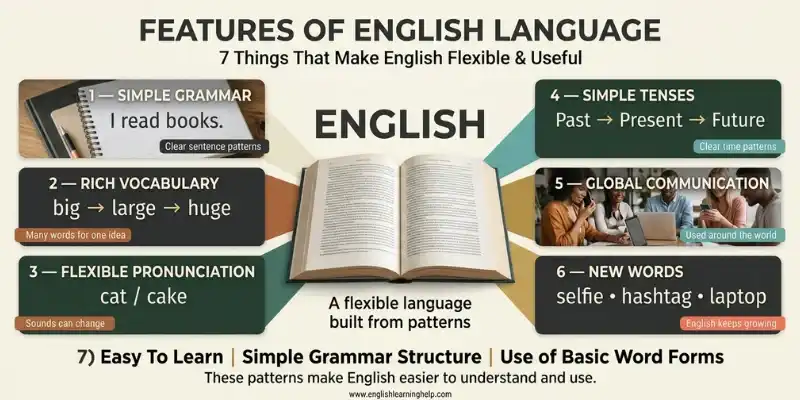
The features of the English language make it one of the most flexible and learner-friendly languages in the world. It has a rich vocabulary, simple grammar, and a clear sentence structure that helps beginners understand ideas quickly.
These features support daily communication, school learning, and professional writing. Whether you read, speak, or write English, its unique features help you express ideas clearly and connect with people from different cultures.
Let’s look at the main features of English that make it easy to learn and use in daily life.
What Do We Mean by “Features of English”?
When we talk about the English language features, we mean the parts that show how the language works: grammar, vocabulary, sounds, and sentence patterns. When you know these features, you understand the language better and use it with more confidence.
Starting with this idea gives you a clear base before moving forward, and it makes the rest of this guide easier to follow, since you will see English as a set of tools you can understand and use in daily life.
English Is Easy to Learn
One of the best qualities of English is that it is simple to start using. Many learners feel confident quickly because the rules are clear and practical.
Simple Grammar Structure
English grammar is straightforward. You can say “I eat,” “You play,” or “We read” without worrying about changing the verb form for each subject. This simplicity helps learners focus on communicating rather than stressing over rules.
Use of Basic Word Forms
English uses basic word forms that are easy to remember. Words like “boy,” “girl,” “teacher,” and “student” stay the same in most situations, helping beginners speak and write faster without mistakes.

English Uses a Large Vocabulary
One of the most interesting features of English is how many words it has. You can express the same idea in different ways: if you want to say “big,” you can also say “large” or “huge.”
Many Words for One Idea
English borrows words from many languages, which is why it has so many ways to describe things. This variety helps you find the exact word or phrase you need, whether writing a story or chatting with friends.
Easy Word Formation
You can also make new words easily in English by adding a small part to a word. “Help” becomes “helpful,” and “play” becomes “player.” This makes learning and using new words feel less intimidating.
Building this kind of vocabulary steadily is really the foundation of ongoing English vocabulary development, since recognizing these word-formation patterns speeds up how quickly new words stick.
Tip: Learn words in small groups each day, and try using them in sentences so they stick.

English Pronunciation Is Flexible
One notable feature of English is its flexible pronunciation. Words can have different sounds, but some patterns help you guess them once you pay attention.
Same Letter, Different Sounds
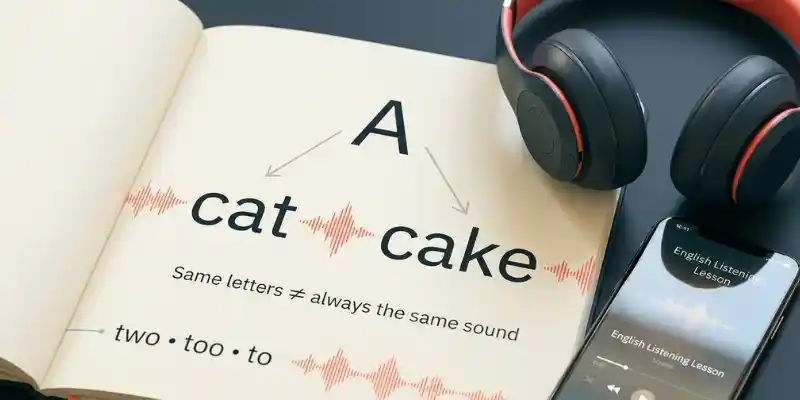
One letter can make different sounds depending on the word. The letter “a” sounds different in “cat” and “cake.” English speakers are used to this, and so can you.
Similar Sounds in Daily Use
Some words sound almost the same but have different meanings, like “two,” “too,” and “to.” Listening to native speakers helps you notice these differences naturally.
Tip: Listen to short videos or songs in English, and repeat the words aloud to practice natural sounds.
Segmental and Prosodic Features of English
Beyond everyday pronunciation, linguists also describe English using two more specific terms worth knowing, especially if you are studying English academically.
Segmental Features
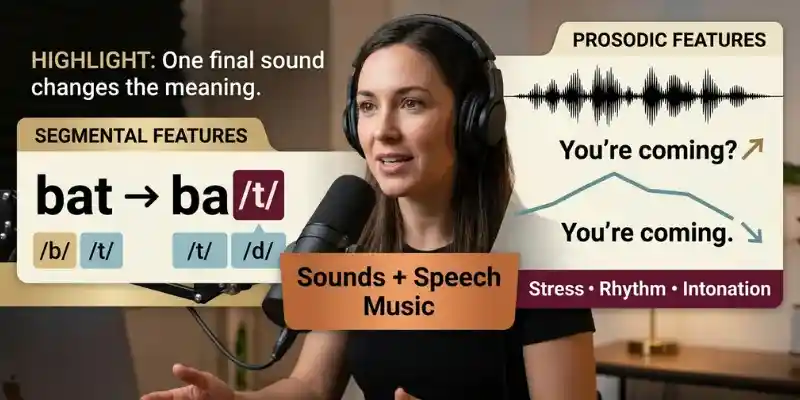
Segmental features refer to individual sound units, the vowels and consonants that make up words, sometimes called phonemes. For example, the words “bat” and “bad” differ by just one segmental sound at the end, but that single sound changes the entire meaning.
Prosodic Features
Prosodic features describe the “music” of speech rather than individual sounds: stress, rhythm, intonation, and pitch. For example, the sentence “You’re coming?” said with a rising tone at the end sounds like a question, while the same words said with a falling tone can sound like a statement. Word stress also matters: “REcord” (the noun) and “reCORD” (the verb) are spelled the same but stressed differently.
Together, segmental and prosodic features explain why English can sound so different depending on tone, emphasis, and rhythm, even when the actual words stay the same.
English Uses Simple Tenses
Another key feature of English is its simple tense system, mainly built around three time ideas: past, present, and future.
Clear Time Forms
English shows time clearly with simple verb changes. “I walked” shows the past, “I walk” shows the present, and “I will walk” shows the future, without needing to change the verb for every subject.
Easy Patterns
Most English verbs stay the same across different subjects: “I play,” “you play,” “we play.” This predictable pattern is easy to remember.
Why This Matters: Simple tenses let learners focus on practicing communication without getting lost in complex grammar rules.
Tip: Practice making small sentences in the past, present, and future every day.
English Works Well for Global Communication
One of the best features of English is how well it helps people from different countries talk to each other.
Used Around the World
English is spoken in schools, offices, travel, and online. A student from Pakistan can talk to a student from the United States without problems because they both know English.
Simple Sentence Patterns
English follows a clear order in sentences: subject, verb, object. “I read books” is understood by nearly everyone learning the language, since this structural pattern stays consistent.
Tip: Try chatting with friends or classmates in English for a few minutes each day to become more comfortable.

English Adopts New Words Easily
A genuinely useful feature of English is how quickly it adds new words, keeping the language modern and flexible.
New Technology Words
English regularly creates words for new inventions, tools, or ideas, like selfie, hashtag, and laptop. These words become part of everyday speech quickly.
Words From Different Cultures
English borrows words from many languages: pizza comes from Italian, and karate comes from Japanese. This exact pattern of continuous borrowing and adaptation is explored in more depth in our guide on the history of the English language, which traces how this openness to new words developed over centuries, and in Modern English, which covers how technology keeps adding fresh vocabulary today.
Tip: When you see a new word, try using it in a sentence or writing it down in your vocabulary notebook.
Why These Features Matter for Learners
When you understand the features of English, learning starts to feel easier. You begin noticing patterns in words, sounds, and sentences, which helps you learn faster and use English with more confidence.
These features also guide you when you read, write, or listen. You start to understand why some words look different, why some sentences feel simple, and why new words appear so often, making English feel less confusing and more familiar over time.
Tip: The students who improve fastest are not the ones memorizing every rule, but the ones who start noticing these features actively in whatever they read, watch, or listen to.
Conclusion
Understanding the features of the English language gives you a real advantage as a learner, because you start seeing the language as a system of patterns rather than a list of random rules to memorize.
Keep a small notebook where you write down each feature with your own example. It helps you learn faster and remember better. As you grow more comfortable, keep noticing these patterns in everything you read, watch, and hear in English.
The main features include clear basic sentence patterns, a large and flexible vocabulary, flexible pronunciation, segmental and prosodic features, clear tense patterns, wide global use, and the ability to adopt new words.
English has borrowed vocabulary from many languages throughout its history, which is why you find so many synonyms and expressions for one idea. This large vocabulary helps you express yourself in many different ways.
Many learners find English easier than other languages because it has simple verb forms and a clear sentence structure. You do not need to memorize many different forms for each word, and with regular practice, you can improve quickly.
English takes sounds from many languages, so there is more than one way to pronounce some words. This might feel confusing at first, but with more listening and practice, you get comfortable with the variety.
English adds new words through technology, culture, social media, and everyday use. If enough people start using a word, it often becomes part of the language, keeping English modern and current.
English is spoken in many countries and used in business, science, travel, and the internet. People learn it because it helps them connect with others, and it works well as a common language in international situations.
No. You can start with the basic tenses and speak well in daily life, since English uses simple tense structures that are easy to apply. You can learn the more advanced tenses as you grow.
Read a little every day and note new words in a small notebook. Use each word in your own sentence to remember it better, since active use makes new vocabulary stick faster than passive reading alone.
English is flexible, open to new words, and easy to build sentences with. It focuses more on word order than long grammar rules, and these qualities help learners make progress faster.
Try speaking or writing a little every day. Notice examples of pronunciation, vocabulary, and tenses in movies, books, or conversations. Small daily practice helps you understand these features naturally.






- Be Respectful
- Stay Relevant
- Stay Positive
- True Feedback
- Encourage Discussion
- Avoid Spamming
- No Fake News
- Don't Copy-Paste
- No Personal Attacks
- Be Respectful
- Stay Relevant
- Stay Positive
- True Feedback
- Encourage Discussion
- Avoid Spamming
- No Fake News
- Don't Copy-Paste
- No Personal Attacks
