Will vs Going To: The Real Future Tense Difference Explained with Practical Examples
Published: 19 Sep 2026
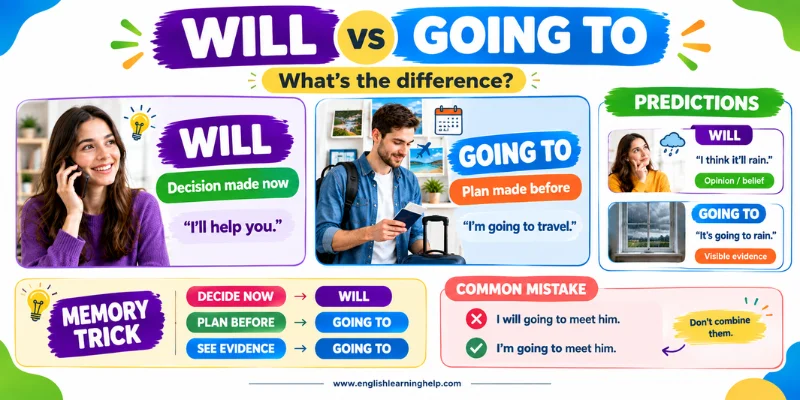
Have you ever wondered whether to say “I will call you” or “I’m going to call you”?
Both sound right, but they are not always the same. I know how confusing will vs going to can feel. They both talk about the future, right? So why do teachers and grammar books make such a big deal about them?
Here is the truth: they sound similar, but their meanings and usage differ slightly. Both are part of what grammar books call future forms, the different ways English expresses something that has not happened yet. Once you understand when and why to use each one, you will start sounding a lot more natural and confident in English.
Today, I will explain this in the simplest way possible, with real examples, a comparison table, and quick tips you can actually remember and use right after reading. Let’s finally clear up the will vs going to confusion once and for all.
Quick Comparison Table: Will vs Going To
| Use | Will | Going To |
| Meaning | Future decision or prediction (no prior plan) | Planned action or prediction based on evidence |
| Decision timing | Made at the moment of speaking | Made before speaking |
| Focus | Intention or belief | Plan or visible evidence |
| Example | “I’ll answer the phone!” | “I’m going to meet Sarah tomorrow.” |
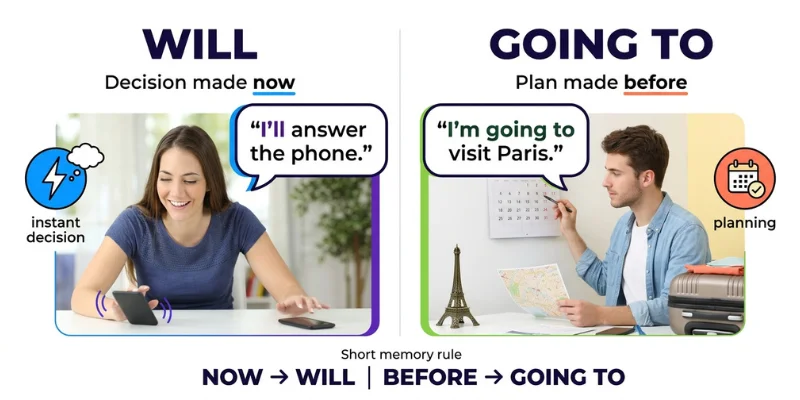
When Do You Use Will?
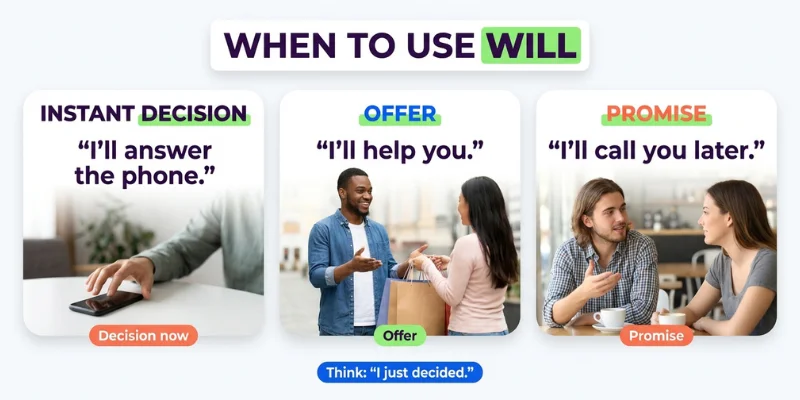
Use will when you decide something spontaneously, make a promise, or predict the future without proof.
1. Spontaneous Decisions
You decide right now, at the moment of speaking:
- I’m cold; I’ll close the window.
- That looks heavy. I’ll help you.
2. Promises and Offers
Used for promises, offers, or willingness:
- I’ll always love you.
- I’ll carry your bag.
3. Predictions Without Evidence
When it is just your opinion or belief:
- I think it’ll rain tomorrow.
- She’ll be a great teacher someday.
Quick Tip: If you just decided while speaking, use will.
When Do You Use Going To?
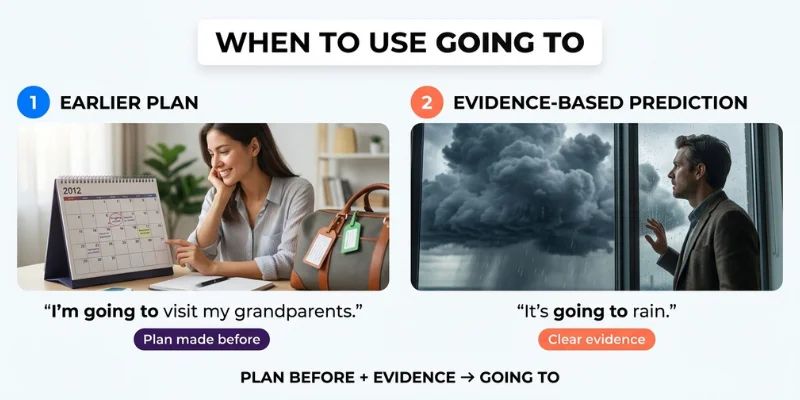
Use going to for plans made earlier or when there is clear evidence that something will happen.
1. Future Plans or Intentions
You already decided before speaking:
- I’m going to visit my grandparents next week.
- He’s going to start a new job soon.
2. Predictions Based on Evidence
You can see or sense it happening:
- Look at those clouds; it’s going to rain.
- Be careful! You’re going to spill your drink.
Quick Tip: If it is already planned or obvious, use going to.
This same instinct connects closely to real professional communication, since the difference between a spontaneous promise (“I will follow up”) and a stated plan (“I’m going to launch this next quarter”) genuinely changes how confident and clear you sound in meetings and emails.
Is “Will Be Going To” Correct?
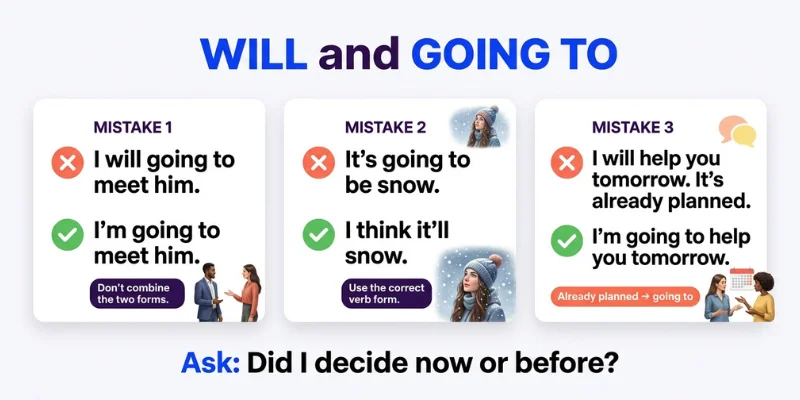
This is a common point of confusion. You should never combine will and going to together in one sentence, such as “I will going to meet him tomorrow.” This is incorrect because will and going to are two separate ways of expressing the future, not two parts of the same structure.
However, “will be going” (without to) is a valid but different tense called future continuous, used to describe an action in progress at a specific future time, such as “I will be going to the market at 5 pm.” This is more advanced than the simple future tense forms covered in this guide, so keep it separate from the core will vs going to comparison.
Common Mistakes to Avoid
Wrong: I will going to meet him tomorrow. Correct: I’m going to meet him tomorrow.
Wrong: It’s going to be snow, I think. Correct: I think it’ll snow.
Wrong: I will help you tomorrow, it’s in my plan. Correct: I’m going to help you tomorrow.
In years of teaching this rule, the mistake above (combining will and going to) is by far the most common one. The simplest fix is to ask yourself one question before speaking: did I decide this just now, or was it already planned? That single question almost always points to the right choice.
Practice Exercises
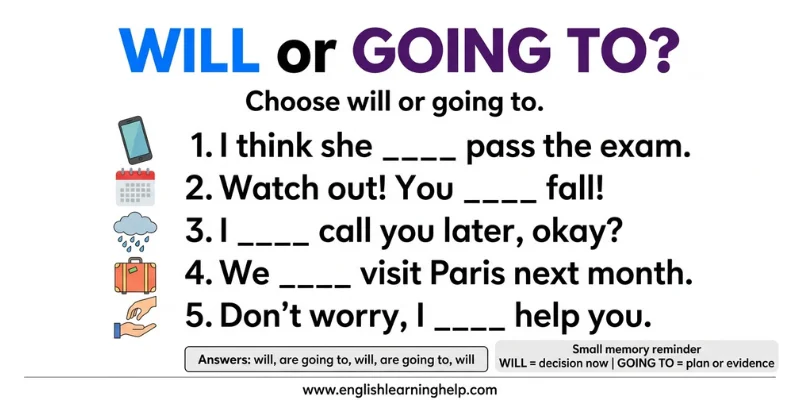
Fill in the blanks using will or going to:
- I think she ___ pass the exam.
- Watch out! You ___ fall!
- I ___ call you later, okay?
- We ___ visit Paris next month.
- Don’t worry, I ___ help you.
Answers: 1. will, 2. are going to, 3. will, 4. are going to, 5. will
Building comfort with simple English sentences for daily use is one of the fastest ways to make this rule stick, since will vs going to shows up constantly in ordinary, everyday conversation.
Real-Life Examples
In Movies: “I’ll be back.” Classic will (a promise plus an instant decision).
In Daily Life: “I’m going to start exercising tomorrow.” Already planned.
In Conversation: A: “The phone’s ringing.” B: “I’ll get it!” Instant decision.
Getting comfortable with this distinction naturally in speech is closely tied to spoken English, especially since casual conversation often shortens going to into “gonna,” which sounds completely different from how it is written.
This same tense-based thinking connects to another common English mix-up, been vs gone, where small grammar choices about time and action change the entire meaning of a sentence, just like they do here.
Conclusion
Once will vs going to starts to make sense, choosing between them becomes automatic. Both talk about the future, but how you use them shows when and how you decided.
Use will for quick decisions, promises, or predictions without proof. Use going to for plans or events that already seem sure to happen.
Keep practicing with real-life examples, and soon you will not even think about it. You will just say it naturally, like a fluent English speaker.
Yes, but they do not always mean the same thing. “I’ll study medicine” means you have just decided it now. “I’m going to study medicine” means it was already planned or decided before. Both are correct. It simply depends on when you made the decision.
Yes, gonna is just the informal, spoken form of going to. It is completely fine in everyday conversation or texting, but avoid it in formal writing, school essays, or professional emails.
Both will and going to are used in the UK and the US. However, going to sounds more natural in casual spoken English, while will is more often used in formal or written English, especially in academic or professional settings.
Always use will when making a promise or offer. It shows sincerity and willingness to do something, such as “I’ll always support you” or “Don’t worry, I’ll help you.”
Not exactly. Going is the present participle of the verb go, and it works together with a form of be (am, is, are) to create the going to structure. So “going to” is part of a verb phrase, not a single verb on its own.
Here is the quick memory trick most learners love: will means you just decided right now. Going to means you already decided or planned before. If you made the choice earlier, use going to. If you just made it, use will.

Been vs Gone: Simple Grammar Guide with Clear Examples + Exercise for English Learners





- Be Respectful
- Stay Relevant
- Stay Positive
- True Feedback
- Encourage Discussion
- Avoid Spamming
- No Fake News
- Don't Copy-Paste
- No Personal Attacks
- Be Respectful
- Stay Relevant
- Stay Positive
- True Feedback
- Encourage Discussion
- Avoid Spamming
- No Fake News
- Don't Copy-Paste
- No Personal Attacks
