Most Common English Idioms: 50 Everyday Expressions With Meanings and Examples
Published: 29 Sep 2026
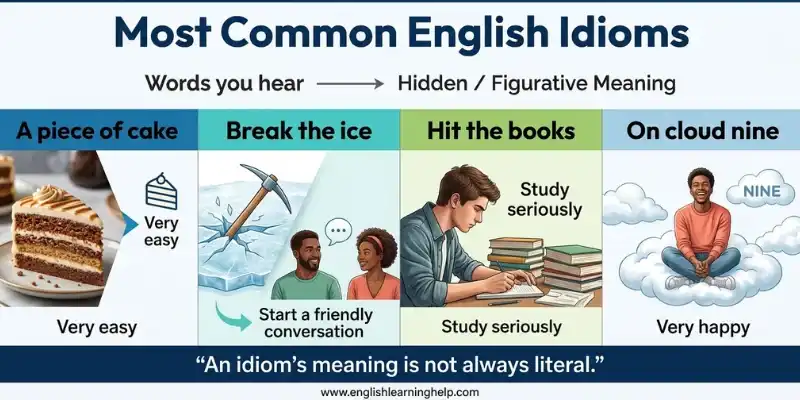
English can be confusing when a phrase means something different from the words it contains. If someone says, “That test was a piece of cake,” they are not talking about food. They mean the test was very easy.
These expressions are called idioms. They are common in conversations, books, movies, classrooms, and everyday English.
In this guide, you will learn the most common English idioms, their meanings, and simple example sentences. You will also learn how to use idioms naturally, avoid common mistakes, and practice them in daily conversation.
What Is an Idiom?
An idiom is a group of words that has a meaning different from the literal meaning of the individual words.
For example:
It’s raining cats and dogs.
The sentence does not mean that cats and dogs are falling from the sky. It means that it is raining very heavily.
In simple words, you cannot always understand an idiom by translating each word separately. You need to learn the meaning of the whole expression.
Idiom vs. Literal Meaning
Compare these two sentences:
- Literal: The student broke the ice on the table.
- Idiom: The teacher told a joke to break the ice.
In the second sentence, break the ice means to make people feel more comfortable and start a conversation.
Idioms are a type of figurative expression. Phrasal verbs and proverbs are related forms of language, but they are not the same as idioms.

The 50 Most Common English Idioms
Here is a practical list of commonly used English idioms with their meanings and example sentences.
| # | Idiom | Meaning | Example |
| 1 | A piece of cake | Something very easy | The English test was a piece of cake. |
| 2 | Break the ice | Start a friendly conversation | I told a joke to break the ice. |
| 3 | Under the weather | Feeling sick or unwell | I am feeling under the weather today. |
| 4 | Hit the books | Study seriously | I need to hit the books tonight. |
| 5 | Once in a blue moon | Very rarely | We eat at that restaurant once in a blue moon. |
| 6 | Spill the beans | Reveal a secret | Don’t spill the beans about the party. |
| 7 | Bite the bullet | Face something difficult | I was nervous, but I decided to bite the bullet. |
| 8 | Call it a day | Stop working for now | We have finished the main work, so let’s call it a day. |
| 9 | Cost an arm and a leg | Be very expensive | That new laptop costs an arm and a leg. |
| 10 | Hit the nail on the head | Say or do exactly the right thing | You hit the nail on the head with your answer. |
| 11 | Break a leg | Good luck | Break a leg before your performance! |
| 12 | Go the extra mile | Make an extra effort | She always goes the extra mile for her students. |
| 13 | Cut corners | Do something carelessly or cheaply | Don’t cut corners when doing important work. |
| 14 | On cloud nine | Extremely happy | She was on cloud nine after getting the job. |
| 15 | Miss the boat | Miss an opportunity | I applied too late and missed the boat. |
| 16 | Back to the drawing board | Start again after a failure | Our plan did not work, so it is back to the drawing board. |
| 17 | Pull someone’s leg | Joke with someone | Don’t worry. I’m just pulling your leg. |
| 18 | A blessing in disguise | Something that seems bad but has a good result | Losing that job was a blessing in disguise. |
| 19 | Add fuel to the fire | Make a bad situation worse | His angry reply added fuel to the fire. |
| 20 | Actions speak louder than words | What you do matters more than what you say | She helps people instead of just talking about it. Actions speak louder than words. |
| 21 | Burn the midnight oil | Work or study late at night | He burned the midnight oil before his exam. |
| 22 | Cut to the chase | Get to the main point | Let’s cut to the chase and discuss the problem. |
| 23 | Hang in there | Do not give up | Hang in there. You are almost finished. |
| 24 | In hot water | In trouble | He is in hot water after missing the deadline. |
| 25 | Keep an eye on | Watch carefully | Please keep an eye on my bag. |
| 26 | Kill two birds with one stone | Achieve two things with one action | I killed two birds with one stone by shopping and visiting my friend. |
| 27 | A dime a dozen | Very common or easy to find | Cheap souvenirs are a dime a dozen in tourist areas. |
| 28 | Cry over spilled milk | Worry about something that cannot be changed | There is no use crying over spilled milk. |
| 29 | The best of both worlds | Enjoy two different advantages | Working from home gives me the best of both worlds. |
| 30 | Make matters worse | Make a bad situation even worse | To make matters worse, it started raining. |
| 31 | A fish out of water | Feel uncomfortable in a new situation | I felt like a fish out of water at the new school. |
| 32 | See eye to eye | Agree with someone | My brother and I do not always see eye to eye. |
| 33 | Hit the sack | Go to bed | I am tired, so I am going to hit the sack. |
| 34 | On the same page | Have the same understanding | Let’s make sure we are all on the same page. |
| 35 | Bite off more than you can chew | Take on more than you can handle | Don’t bite off more than you can chew. |
| 36 | Let sleeping dogs lie | Avoid restarting an old problem | We should let sleeping dogs lie. |
| 37 | Every cloud has a silver lining | Something good can come from a bad situation | I lost the competition, but every cloud has a silver lining. |
| 38 | Hit the road | Leave or start a journey | It is getting late, so we should hit the road. |
| 39 | Give it a shot | Try something | I have never cooked it before, but I will give it a shot. |
| 40 | Hold your horses | Wait or be patient | Hold your horses! We are not ready yet. |
| 41 | In the same boat | Be in the same situation | We are all in the same boat because the test was difficult. |
| 42 | Jump the gun | Do something too early | He jumped the gun and announced the news too soon. |
| 43 | On thin ice | In a risky situation | You are on thin ice after missing another deadline. |
| 44 | Throw in the towel | Give up | She refused to throw in the towel. |
| 45 | Get cold feet | Become nervous before doing something | He got cold feet before the interview. |
| 46 | Out of the blue | Unexpectedly | My old friend called me out of the blue. |
| 47 | In the nick of time | Just before it is too late | We arrived in the nick of time. |
| 48 | Think outside the box | Think creatively | We need to think outside the box to solve this problem. |
| 49 | Take a rain check | Postpone something until later | Can I take a rain check on dinner tonight? |
| 50 | The ball is in your court | It is your turn to take action | I have given you the information. Now the ball is in your court. |

Common English Idioms for Daily Conversation
Some idioms are especially useful in everyday conversations. You may hear them when people talk about work, school, plans, feelings, or problems.
1. Break the ice
Meaning: Start a friendly conversation.
Example:
I asked everyone a simple question to break the ice.
2. Give it a shot
Meaning: Try something.
Example:
I have never played tennis, but I will give it a shot.
3. Hang in there
Meaning: Keep going and do not give up.
Example:
Hang in there. You are doing a great job.
4. On the same page
Meaning: Have the same understanding.
Example:
Before we start the project, let’s make sure we are on the same page.
5. See eye to eye
Meaning: Agree with someone.
Example:
We do not always see eye to eye, but we respect each other.
6. Call it a day
Meaning: Stop working for now.
Example:
We have finished enough work. Let’s call it a day.
7. Out of the blue
Meaning: Unexpectedly.
Example:
She called me out of the blue after five years.
8. Keep an eye on
Meaning: Watch something carefully.
Example:
Can you keep an eye on my bag?
These everyday idioms are useful because they can appear in natural conversations, movies, interviews, and informal English.
English Idioms for Work and Study
Idioms are also common in conversations about work and education.
Hit the books
Meaning: Study seriously.
Example: I need to hit the books before tomorrow’s exam.
Burn the midnight oil
Meaning: Work or study late at night.
Example: She burned the midnight oil to finish her project.
Go the extra mile
Meaning: Make an extra effort.
Example: Good teachers often go the extra mile for their students.
Cut corners
Meaning: Do something carelessly to save time or money.
Example: Never cut corners when preparing an important report.
Back to the drawing board
Meaning: Start again after a plan fails.
Example: Our first idea failed, so we went back to the drawing board.
Think outside the box
Meaning: Think in a new or creative way.
Example: We need to think outside the box to solve this problem.

English Idioms About Feelings and Emotions
Idioms can make descriptions of feelings more natural and colorful.
On cloud nine
Meaning: Extremely happy.
Example: She was on cloud nine after receiving the good news.
Get cold feet
Meaning: Become nervous about something you planned to do.
Example: He got cold feet before speaking in front of the class.
Under the weather
Meaning: Feel sick or unwell.
Example: I am a little under the weather today.
In hot water
Meaning: Be in trouble.
Example: He is in hot water because he missed the meeting.
A fish out of water
Meaning: Feel uncomfortable in an unfamiliar situation.
Example: I felt like a fish out of water at my first business meeting.

Idiomatic Expressions: What Are They?
Idiomatic expressions are expressions whose meaning may not be completely clear from the individual words.
Idioms are one type of idiomatic expression. Other expressions, such as phrasal verbs and proverbs, are related but have different features.
For example:
- Idiom: Break the ice → make people feel comfortable
- Phrasal verb: Give up → stop trying
- Proverb: Actions speak louder than words → what people do can matter more than what they say
Knowing this difference can help English learners understand vocabulary more clearly.

Why Are English Idioms Important?
Learning common English idioms can help you understand everyday English more easily.
1. They appear in real conversations
People may use idioms when talking about school, work, family, plans, or problems.
2. They appear in movies and books
Understanding common expressions can make spoken and written English easier to follow.
3. They make communication more expressive
Compare:
He is very happy.
with:
He is on cloud nine.
The second sentence gives the reader a stronger picture of his feeling.
4. They improve vocabulary in context
Instead of learning one word at a time, you learn a complete expression and see how it works in a sentence.
5. They help with listening
When an idiom has a figurative meaning, knowing that meaning can help you understand what a speaker really means.
How to Use English Idioms Correctly
Learning the meaning of an idiom is only the first step. You also need to learn when and how to use it.
1. Learn the whole expression
Do not memorize only one word.
Learn:
spill the beans = reveal a secret
Rather than trying to understand spill and beans separately.
2. Learn idioms in context
Read the complete sentence and think about the situation.
For example:
I was nervous before the interview, but I decided to bite the bullet.
The context shows that the person decided to face something difficult.
3. Write your own examples
Create sentences about your real life.
For example:
I have three exams next week, so I need to hit the books.
Personal examples are easier to remember.
4. Listen for idioms
Notice idioms when watching English videos, listening to conversations, or reading stories.
5. Do not use too many idioms at once
Idioms should make your English natural, not forced.
For example:
I hit the books, then hit the road, and later hit the sack.
This is possible, but using several idioms together can sound unnatural if the situation does not call for them.
Use an idiom when it fits the meaning and tone.
Common Mistakes When Learning Idioms
Mistake 1: Taking an idiom literally
If someone says:
It’s a piece of cake.
They usually mean something is easy.
They are not talking about an actual cake.
Mistake 2: Changing the words
Idioms often have a fixed or familiar form.
For example:
Break the ice
is the normal expression.
Changing it randomly can make the sentence sound unnatural.
Mistake 3: Using an idiom in the wrong situation
Some idioms are informal.
An expression that works well in a friendly conversation may not be suitable for a formal academic paper.
Mistake 4: Memorizing lists without examples
A long list is less useful if you do not understand how the expressions work.
Always learn:
Idiom → Meaning → Example → Context
How to Learn English Idioms Faster
You do not need to memorize a huge list in one day. A better approach is to learn a few useful expressions and use them regularly.
Try this simple method:
Step 1: Choose 3–5 idioms.
Step 2: Learn their meanings.
Step 3: Read two example sentences.
Step 4: Write one sentence about your own life.
Step 5: Use the idioms in a short conversation.
Step 6: Review them after a few days.
You can also make flashcards, keep an idiom notebook, or create a daily idiom practice routine.
English Idioms: Practice Quiz
Choose the correct meaning.
1. “Break the ice” means:
A. Break something
B. Start a friendly conversation
C. Become angry
2. “Under the weather” means:
A. Feeling sick
B. Feeling excited
C. Traveling outside
3. “Hit the books” means:
A. Throw books away
B. Buy new books
C. Study seriously
4. “Miss the boat” means:
A. Miss a trip
B. Miss an opportunity
C. Lose a boat
5. “On cloud nine” means:
A. Very happy
B. Very tired
C. Very confused
6. “Give it a shot” means:
A. Stop trying
B. Try something
C. Make a mistake
7. “Out of the blue” means:
A. Very slowly
B. Unexpectedly
C. Carefully
Answers
- B — Start a friendly conversation
- A — Feeling sick
- C — Study seriously
- B — Miss an opportunity
- A — Very happy
- B — Try something
- B — Unexpectedly
How to Practice Idioms in Daily Life
The best way to learn common English idioms is to use them instead of only reading them.
Try these activities:
- Write one new idiom in a notebook each day.
- Create a sentence about your own life.
- Use an idiom in a short conversation.
- Listen for idioms in English videos and podcasts.
- Read stories and notice unfamiliar expressions.
- Review old idioms every week.
- Practice with a friend or classmate.
- Make small quizzes for yourself.
For example, if you learn go the extra mile, write:
I always try to go the extra mile when helping my students.
This connects the expression with a real situation.
Conclusion
Learning the most common English idioms can make everyday English easier to understand and more expressive. The key is not to memorize hundreds of expressions at once. Start with useful idioms, learn their meanings in context, and practice using them in your own sentences.
From break the ice and piece of cake to go the extra mile and think outside the box, each expression gives you another useful way to understand and communicate ideas in English.
Keep reading, listening, speaking, and practicing. The more often you meet an idiom in a real context, the easier its meaning and usage become.
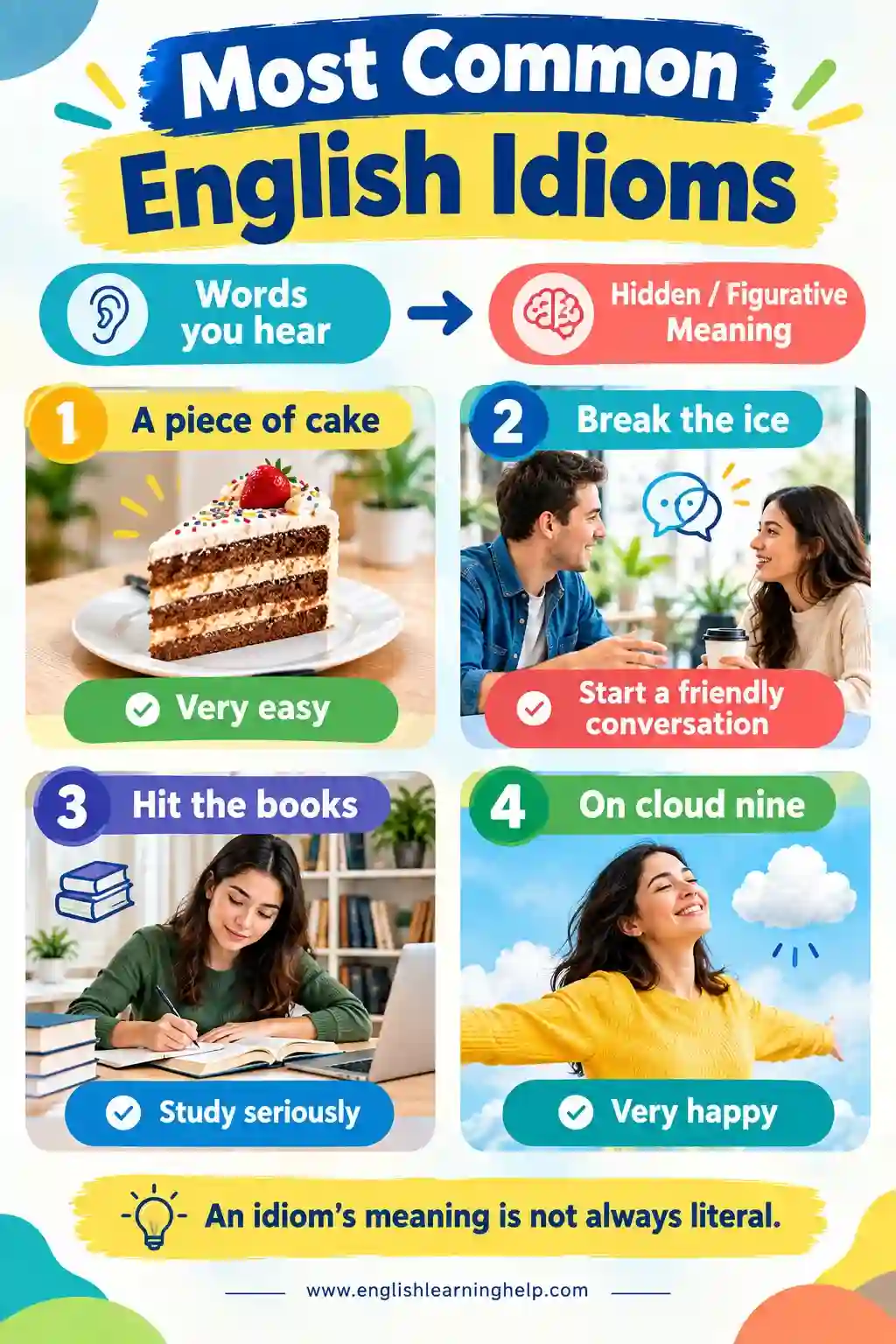
Some widely used English idioms include a piece of cake, break the ice, under the weather, hit the books, spill the beans, go the extra mile, and on cloud nine. Their usefulness depends on the situation, region, and type of English you are learning.
An idiom is a group of words with a meaning that is different from the literal meaning of the words. For example, “piece of cake” means something is very easy, not that you are talking about a dessert.
Start with a small group of common idioms. Learn each idiom with its meaning, context, and example sentence, then use it in your own sentences and review it regularly.
Yes, common idioms can help learners understand everyday conversations, books, movies, and other English content. They can also make communication more expressive when used naturally.
Some idioms can work in professional or formal communication, but not all are suitable for every situation. In academic writing, use idioms carefully and choose language that matches the required level of formality.
An idiom usually has a figurative meaning, such as “hit the sack,” which means to go to bed. A proverb is a short saying that usually expresses advice or a general lesson, such as “Actions speak louder than words.”
No. They are related but different. A phrasal verb combines a verb with another word, such as “give up.” An idiom has a meaning that is not always predictable from its individual words, such as “spill the beans.”
There is no fixed number you need to learn. Start with common expressions that you actually see and hear, then gradually add more as your vocabulary and understanding grow.




- Be Respectful
- Stay Relevant
- Stay Positive
- True Feedback
- Encourage Discussion
- Avoid Spamming
- No Fake News
- Don't Copy-Paste
- No Personal Attacks
- Be Respectful
- Stay Relevant
- Stay Positive
- True Feedback
- Encourage Discussion
- Avoid Spamming
- No Fake News
- Don't Copy-Paste
- No Personal Attacks
