Has Been vs Have Been: What’s the Real Difference? (With Simple & Real Examples)
Published: 20 Sep 2026
If you have ever paused mid-sentence thinking, “Wait, should I say has been or have been?” you are definitely not alone. Many English learners, and even fluent speakers, get stuck right here.
These two forms look almost identical, yet has been vs have been depends entirely on who or what you are talking about. The good news is that once you understand this small but powerful rule, you will never mix them up again.
In this guide, you will learn exactly when to use has been and have been, including the tricky cases that confuse even advanced learners, like words such as team, data, and everyone. Let’s finally clear up the confusion once and for all.
The Main Difference: Has Been vs Have Been
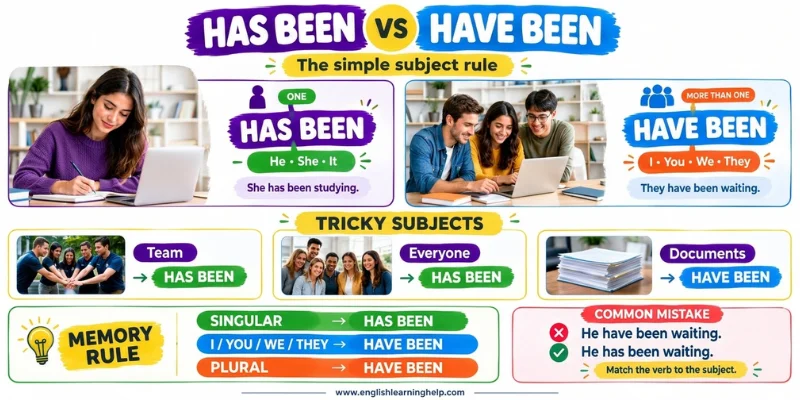
The only difference between has been and have been lies in the subject, the person or thing performing the action.
| Subject Type | Correct Form | Example |
| Singular (He, She, It, or a name) | Has Been | She has been studying since morning. |
| Plural (I, You, We, They) | Have Been | They have been waiting for hours. |
Rule in one line: He/She/It uses has been. I/You/We/They uses have been.

When Do You Use Has Been?
Use has been with he, she, it, or singular nouns to show an action that started in the past and continues into the present, or something that has recently finished.
Structure:
- has been + verb-ing, for ongoing actions
- has been + past participle, for experiences or completed actions
Examples:
- She has been working here for five years.
- He has been sick since yesterday.
- The movie has been released recently.
Quick Tip: If it is one person or one thing, use has been.
When Do You Use Have Been?
Use have been with I, you, we, or they for plural subjects, or when you are talking about yourself.
Structure:
- have been + verb-ing, for ongoing actions
- have been + past participle, for experiences
Examples:
- I have been learning English for two years.
- We have been friends since childhood.
- They have been to Italy twice.
Quick Tip: If the subject includes you or more than one person, go with have been.
Notice how these examples naturally pair with time words like for and since. Choosing correctly between since vs for is the other half of getting present perfect sentences like these exactly right.
Has Been or Have Been With Tricky Words: Team, Data, Everyone, and More
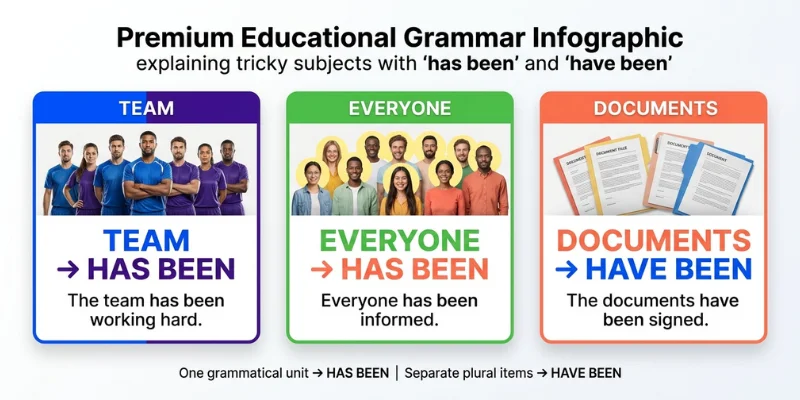
This is where most learners actually get stuck, and it is rarely covered clearly. Some words look plural but are grammatically treated as singular, and others look singular but are actually plural. Here is how to handle the most common tricky cases.
Collective Nouns (Team, Staff, Family, Government)
Words like team, staff, family, and government refer to a group, but grammatically they are treated as one single unit in most everyday English, especially American English.
- The team has been working hard this season.
- Our staff has been trained on the new system.
- My family has been supportive throughout.
Note: In British English, collective nouns are sometimes treated as plural when emphasizing the individuals within the group (“The team have been arguing among themselves”), but has been is the safer, more universally accepted choice.
Indefinite Pronouns (Everyone, Everybody, Each)
Words like everyone, everybody, and each sound like they mean many people, but grammatically they are always singular.
- Everyone has been informed about the schedule change.
- Everybody has been asked to submit the form.
Uncountable or Mass Nouns (Data, Information, News, Equipment)
Words like data, information, news, and equipment refer to a mass or category rather than individual countable items, so they take has been in modern everyday usage.
- The information has been updated on the website.
- The new equipment has been delivered.
Technical note: Data is originally the plural of “datum” in formal scientific writing, where “the data have been analyzed” is sometimes used. In everyday and business English, however, “the data has been analyzed” is now the standard, widely accepted form.
Genuinely Plural Nouns (Documents, Details, Changes, Questions)
Unlike the tricky cases above, words like documents, details, changes, and questions are truly plural, so they take have been.
- The documents have been submitted.
- Several changes have been made to the report.
Quick Tip: Ask yourself one question. Am I talking about one unit (even if it contains many people or things), or genuinely more than one separate item? That question solves almost every tricky case above.
Has Been and Have Been in Passive Voice
Has been and have been are also the backbone of the present perfect passive voice, a structure used constantly in professional and business writing to describe actions done to something, without naming who did it.
Examples:
- The payment has been received.
- Your request has been approved.
- The files have been shared with the team.
- The report has been submitted for review.
This exact pattern shows up everywhere in Business English, especially in emails and status updates, where sounding precise and professional genuinely matters.

Has Been vs Have Been: Real-Life Example
Let’s say you and your sister started reading the same book last week.
You would say: I have been reading this book.
She would say: She has been reading this book.
Both sentences talk about ongoing actions. Only the subject changes, so the verb form changes too.
This same present perfect logic connects closely to another common grammar mix-up, been vs gone, where small subject and tense choices completely change what a sentence means.
Common Grammar Mistakes
Wrong: He have been waiting for you. Correct: He has been waiting for you.
Wrong: They has been working all day. Correct: They have been working all day.
Wrong: The information is been updated. Correct: The information has been updated. (“Is been” is not standard English. It is a common error, not a valid grammatical form.)
Pro Tip: The word has is only used with he, she, or it, never with I or they.
In years of teaching this rule, the tricky-word cases above (team, data, everyone) are consistently where advanced learners still make mistakes, even after mastering the basic he/she/it vs I/you/we/they rule. Learning those exceptions specifically is what actually closes the gap to native-level accuracy.
Practice Exercises
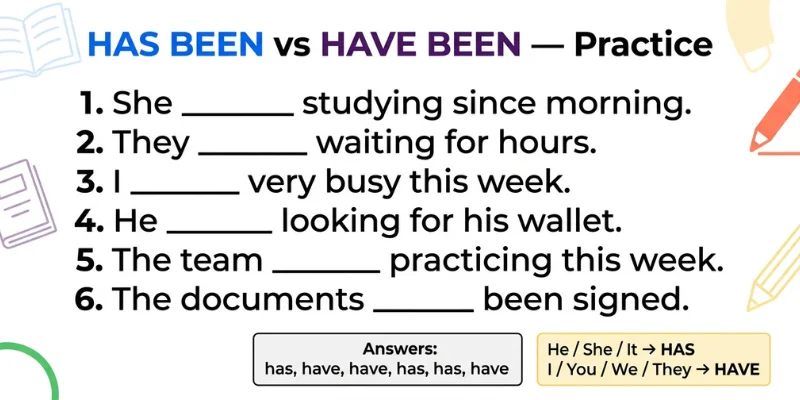
Fill in the blanks with has been or have been:
- She ___ studying since morning.
- They ___ waiting for hours.
- I ___ very busy this week.
- He ___ looking for his wallet.
- We ___ planning a trip.
- The team ___ practicing every day this week.
- Everyone ___ informed about the changes.
- The documents ___ signed and returned.
Answers: 1. has, 2. have, 3. have, 4. has, 5. have, 6. has, 7. has, 8. have
Conclusion
The rule behind has been vs have been comes down to one simple question: is the subject singular or plural?
Use has been for he, she, it, or any single person, thing, or unit, even tricky ones like team or data. Use have been for I, you, we, they, or genuinely plural things like documents or details.
If you have been mixing them up, you are not alone. The fastest way to master them is through noticing, not memorizing. Pay attention to how native speakers use these forms in conversations, emails, and everyday writing, and the pattern will start to feel automatic.
Both come from the present perfect tense, but has been is used with singular subjects (he, she, it) and have been with plural subjects (I, you, we, they). The main difference is simply who or what the action refers to.
Yes. You can mix them when talking about different subjects, such as “She has been working hard, and we have been helping her.” It is completely natural when each clause has a different subject.
Has been describes something connected to the present moment, an action that started in the past and still matters now. Had been describes something further back in the past, before another past event, known as the past perfect tense. For example, “She has been tired all week” (present perfect) versus “She had been tired before the vacation helped her recover” (past perfect).
Been is the past participle of the verb be. On its own, it is not a complete verb form. It only functions correctly when paired with an auxiliary verb like has or have, forming the present perfect tense together.
Yes, but only when referring to a singular subject. For instance, “She has been to London twice” means she visited and came back. When talking about yourself, use “I have been to London twice” instead.
Yes. Both are common in academic and professional English because they sound natural and grammatically precise. Using them correctly, especially with tricky words like team or data, makes your writing sound noticeably more polished.
Mostly no. Both forms follow the same basic rule in British and American English. The main difference appears with collective nouns like team or government, which British English sometimes treats as plural.






- Be Respectful
- Stay Relevant
- Stay Positive
- True Feedback
- Encourage Discussion
- Avoid Spamming
- No Fake News
- Don't Copy-Paste
- No Personal Attacks
- Be Respectful
- Stay Relevant
- Stay Positive
- True Feedback
- Encourage Discussion
- Avoid Spamming
- No Fake News
- Don't Copy-Paste
- No Personal Attacks
