Formal vs Informal English: A Complete Guide with Examples for Learners
Published: 27 Sep 2026
Many studies have shown that a large number of English learners become confused when choosing between a formal and an informal tone. This often happens in emails, schoolwork, and casual conversations. Many students can write correct sentences, yet still feel unsure about which style fits a situation. This makes communication stressful.
This guide helps you understand the meaning, differences, and correct usage of formal vs informal English in a simple way. You will see clear examples, easy rules, and tips you can use right away.
Here is a quick look to start:
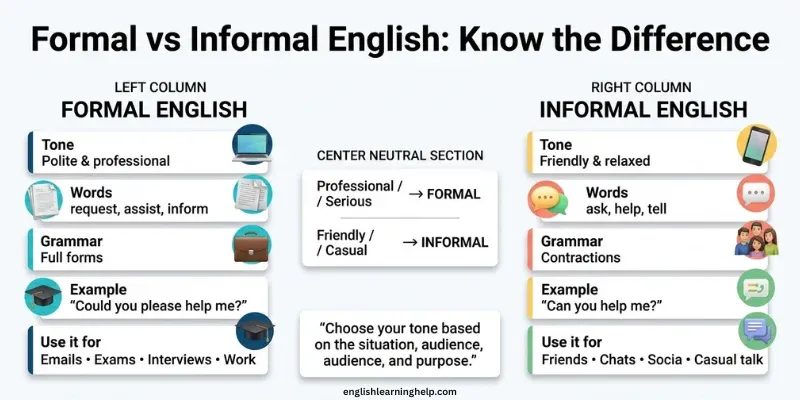
Formal: “Could you please provide the details?” Informal: “Can you give me the details?”
What Is Formal English?
Formal English is a polite and professional style of communication. It uses clear words, proper grammar, and a structured tone. People use this style when they want to sound respectful and serious. Formal English is common in academic writing, business communication, and official work.
You will see formal English in many places. Offices use it for reports and emails. Schools and universities use it for assignments and presentations. It is also important in job interviews, meetings, and any situation where you need to show confidence and respect.
Examples:
- “I would like to request your help.”
- “Could you please send the file?”
What Is Informal English?
Informal English is a casual and friendly way of speaking and writing. People use it in everyday life when they want to sound relaxed and natural. This style is simple, direct, and easy to understand. It is common with friends, family, and anyone you feel comfortable with.
You will hear informal English in daily conversations, text messages, and chats on social media. Students use it when they talk with classmates or share quick notes.
Examples:
- “Hey, what’s up?”
- “Can you send me that?”

Levels of Formality: It’s a Spectrum, Not Just Two Options
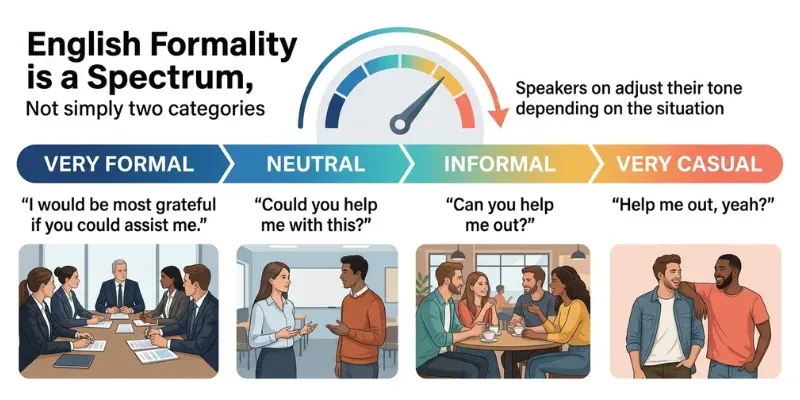
Formal and informal are not the only two choices. Think of it like a dial you can turn, from very formal on one end to very casual on the other, with plenty of room in between.
- Very formal: “I would be most grateful if you could assist me.”
- Neutral: “Could you help me with this?”
- Informal: “Can you help me out?”
- Very casual: “Help me out, yeah?”
This scale is sometimes called the register of a sentence, a word linguists use for how formal or informal language sounds. You do not need to remember that word, but knowing that formality has many levels, not just two, helps you pick exactly the right tone instead of jumping between extremes.
It is worth noting that formal versus informal is not quite the same idea as Standard English and Non-Standard English. Formality is about the situation you are in, while standard and non-standard are about whether the grammar itself follows the official rulebook. The two often overlap, but they answer slightly different questions.
Key Differences Between Formal and Informal English
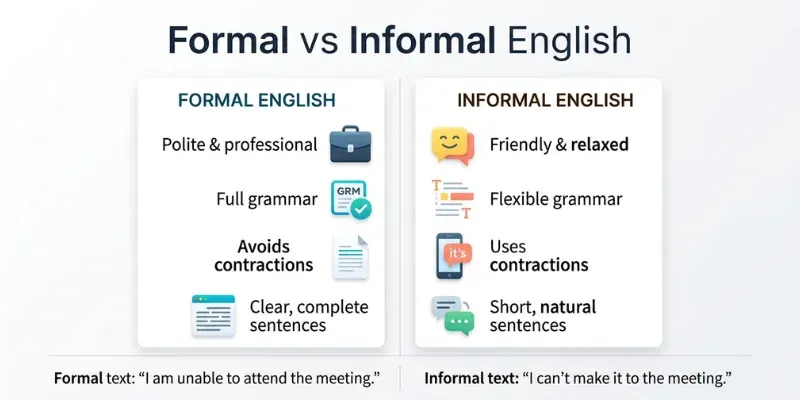
Formal and informal English sound very different, even when you say the same idea.
| Feature | Formal English | Informal English |
| Vocabulary | Uses polite and clear words like “request” and “assist.” | Uses simple words like “ask” and “help.” |
| Grammar | Follows full grammatical rules. | More flexible with grammar. |
| Tone | Polite, calm, and professional. | Friendly, relaxed, and personal. |
| Contractions | Avoids contractions. Example: “do not.” | Uses contractions often. Example: “don’t.” |
| Punctuation | Uses correct and complete punctuation. | Uses lighter punctuation and emojis in casual chats. |
| Sentence Structure | Longer and more formal. | Short and quick. |
Example:
Formal: “I am unable to attend the meeting.” Informal: “I can’t make it to the meeting.”
Formal vs Informal English in Writing
Writing changes a lot depending on your tone. Some situations need formal English, while others feel better with a friendly, informal style.
Sentence Structure
Formal writing uses longer and more complete sentences and sounds calm and polite: “I would like to ask if you are available.”
Informal writing uses short, quick sentences that feel warm and friendly: “Are you free?”
Vocabulary Choice
Formal English uses clear, professional words like request, inform, and assist, while informal English uses simple words like ask, tell, and help. You “request information” in an office, but you “ask for info” in a chat with a friend.
Contractions and Slang
Formal writing avoids contractions like can’t, don’t, and won’t, and avoids slang. Informal writing often uses contractions and casual words.
Formal: “I am not able to join the class today.” Informal: “I can’t join the class today.”
Real Examples
Formal email sample: “Dear Sir, I would like to inform you that I will submit the report tomorrow. Please let me know if you need any changes. Thank you.”
Informal message sample: “Hey, I’ll send the report tomorrow. Let me know if you want anything fixed.”
Building this kind of confident, clear writing across both styles connects directly to broader English writing skills, since knowing when to shift tone is just as important as grammar itself.

Formal vs Informal English in Speaking
Speaking in English changes with the situation. Sometimes you need a formal tone; other times a simple and friendly style feels better.
Speaking Tone
Formal speaking uses a polite, measured voice, speaking slowly with clear words. Informal speaking uses a relaxed, natural tone, just like talking to friends.
Think about how you speak to a teacher compared to a classmate. The tone changes because the setting changes.
Example Phrases
Formal: “Do you have a moment to discuss this?” Informal: “Got a minute?”
Formal: “I appreciate your help.” Informal: “Thanks a lot.”
This kind of tone-switching in real conversation is a core part of spoken English, since sounding natural means knowing which style fits the person you’re talking to.
Cultural Differences
In many cultures, being too informal with teachers, elders, or managers can sound rude. Using slang or casual words in these situations may create a bad impression.
At the same time, being too formal with friends can feel strange, making the conversation sound stiff or distant.
The key is balance. Look at the setting, the people, and the purpose of your talk, then choose the tone that fits best.

When Should You Use Formal or Informal English?
Use Formal English When:
- Writing emails to teachers or managers
- Attending job interviews
- Giving presentations in class or at work
- Speaking to strangers in professional situations
Example: “Could you please guide me on this?”
Use Informal English When:
- Talking to friends
- Chatting online
- Making casual conversation
- Commenting on social media
Example: “Hey, can you help me with this?”
This exact skill of reading a professional room and adjusting your tone is a core part of Business English, where getting the formality level right in emails and meetings genuinely shapes how colleagues see you.
Quick Decision Checklist
Ask yourself:
- Is this a professional or serious situation? Use formal English.
- Am I talking to friends or people I know well? Use informal English.
- Do I want to sound polite and respectful? Choose formal.
- Do I want to keep the conversation light and friendly? Choose informal.
Common Mistakes Students Make
1. Using Slang in Official Emails
Students often add words like hey, yo, or gonna in professional emails, making the message look unprofessional.
Quick Fix: Start with a polite greeting and use full words. Example: “Hello Sir, I would like to ask…”
2. Overusing Contractions
Contractions like can’t, don’t, and won’t are fine in casual chats but too informal for academic or business writing.
Quick Fix: Write full forms in formal English. Example: “I am unable to attend” instead of “I can’t come.”
3. Writing Informal Sentences in Exams
Many students add casual phrases, emojis, or chat-style sentences into exam answers, which lowers clarity and marks.
Quick Fix: Use clear structure, proper vocabulary, and complete sentences. Example: “This study shows…” instead of “This thing shows…”
4. Sounding Too Formal in Casual Conversations
Some learners use very stiff sentences in normal conversations, which can sound unnatural or distant.
Quick Fix: Relax your language with friends. Example: “Want to go out?” instead of “Would you like to accompany me outside?”
In years of teaching this distinction, mistake number one (slang in official emails) is by far the most common, and it is also the one that creates the worst first impression, since a single casual word can undo an otherwise polished message.
30 Examples of Formal vs Informal English
These examples show how meaning stays the same while tone changes. Use them for practice in writing and speaking.
10 Sentence Pairs
- Formal: I am unable to join the meeting. / Informal: I can’t make it.
- Formal: I would like to request more information. / Informal: Can you tell me more?
- Formal: I appreciate your assistance. / Informal: Thanks for helping me.
- Formal: I will contact you soon. / Informal: I’ll get back to you.
- Formal: Please inform me if you need support. / Informal: Let me know if you need help.
- Formal: I am pleased to share the results. / Informal: I’m happy to share the results.
- Formal: I am unable to answer this question at the moment. / Informal: I don’t know right now.
- Formal: I would prefer a different option. / Informal: I want something else.
- Formal: It is necessary to complete the task today. / Informal: You need to finish it today.
- Formal: Your presence is appreciated. / Informal: Glad you came.
10 Speaking Phrase Pairs
- Formal: Do you have a moment to discuss this? / Informal: Got a minute?
- Formal: How may I assist you? / Informal: How can I help?
- Formal: I apologize for the delay. / Informal: Sorry for being late.
- Formal: Could you repeat that, please? / Informal: Say that again?
- Formal: I understand your concern. / Informal: I get it.
- Formal: I agree with your point. / Informal: Yeah, you’re right.
- Formal: That sounds reasonable. / Informal: Sounds good.
- Formal: I will consider your suggestion. / Informal: I’ll think about it.
- Formal: I need clarification on this matter. / Informal: I’m confused about this.
- Formal: Thank you for your time. / Informal: Thanks for your time.
10 Writing Examples
- Formal: I am writing to inform you about the schedule. / Informal: Just letting you know the plan.
- Formal: Please find the file attached. / Informal: I’m sending the file.
- Formal: I would like to request your feedback. / Informal: Tell me what you think.
- Formal: Thank you for your cooperation. / Informal: Thanks for working with me.
- Formal: I appreciate your quick response. / Informal: Thanks for replying fast.
- Formal: Kindly let me know if you have questions. / Informal: Ask me if you’re confused.
- Formal: I will review the document shortly. / Informal: I’ll check it soon.
- Formal: I hope this information is helpful. / Informal: Hope this helps.
- Formal: I look forward to hearing from you. / Informal: Hope to hear from you soon.
- Formal: Your request has been accepted. / Informal: It’s approved.
How to Improve Your Formal English
Read academic articles. Spend a few minutes reading journals, reports, or formal blogs to see how writers use formal tone, vocabulary, and structure.
Practice formal email writing. Write sample emails to a teacher or manager, using clear greetings, full sentences, and proper closing lines.
Use polite expressions. Try phrases like “Could you please,” “I would like to know,” or “Thank you for your time.”
Learn high-level vocabulary. Add words like request, assist, inform, and confirm to your daily use.
Avoid slang. Skip casual words like gonna, wanna, and yeah in formal writing or speaking.
How to Improve Your Informal English
Listen to daily conversations. Pay attention to tone, common phrases, and natural rhythm in real life.
Watch movies, shows, and podcasts. These are great for hearing real expressions and relaxed, casual sentence styles.
Learn common slang and casual phrases. Add expressions like “What’s up,” “No problem,” or “Hang on” in the right setting.
Practice speaking with friends. Try new phrases during normal chats to build confidence and sound fluent.
Mini Practice Exercise
Change these informal sentences to formal:
- “Can you send me the file?”
- “I can’t come today.”
- “Tell me what’s going on.”
Change these formal sentences to informal:
- “I would like to request your help.”
- “I am unable to attend the event.”
- “Could you please provide more information?”
Conclusion
Understanding formal vs informal English is not just about grammar rules. It is about reading a situation correctly and choosing the tone that fits.
Practice a little every day. Start by writing one formal sentence and one informal sentence about the same idea. This simple habit builds real confidence and helps you switch between both styles naturally, in writing and in speech.
Formal English sounds polite and structured. Informal English sounds relaxed and friendly. The main difference is tone and vocabulary choice.
Not always. Academic writing is a type of formal language, but it focuses more on research vocabulary, precise structure, and clear supporting evidence.
We use informal English when we want a natural, comfortable conversation. It helps us sound friendly and personal with people we know well.
Read formal emails and articles, practice writing clear sentences, use polite words, and avoid slang. Check your tone before sending any message.
Both are useful. Choose formal English in professional or serious situations, and informal English when talking to friends or in casual conversations.
Yes. Formality works more like a scale than a simple switch, ranging from very formal to very casual, with everyday neutral language sitting comfortably in the middle.





- Be Respectful
- Stay Relevant
- Stay Positive
- True Feedback
- Encourage Discussion
- Avoid Spamming
- No Fake News
- Don't Copy-Paste
- No Personal Attacks
- Be Respectful
- Stay Relevant
- Stay Positive
- True Feedback
- Encourage Discussion
- Avoid Spamming
- No Fake News
- Don't Copy-Paste
- No Personal Attacks
