Most Common Phrasal Verbs in English: 100 Common Examples and Meanings
Published: 30 Sep 2026
“Turn off the light.”
“Pick up your bag.”
“Come in and sit down.”
You probably hear sentences like these every day. The small words on, off, up, down, in, and out may look simple, but they can completely change a verb’s meaning.
These combinations are called phrasal verbs. They are an important part of everyday English and can help you understand conversations, movies, podcasts, messages, and other real-life English.
In this guide, you will learn what phrasal verbs are, how they work, the main types, and how to use them correctly. You will also find 100 common phrasal verbs with meanings and example sentences, common mistakes, learning tips, and practice exercises.
If you are also building your English vocabulary, our guide to English Vocabulary Development can help you learn new words more effectively.
What Are Phrasal Verbs in English?
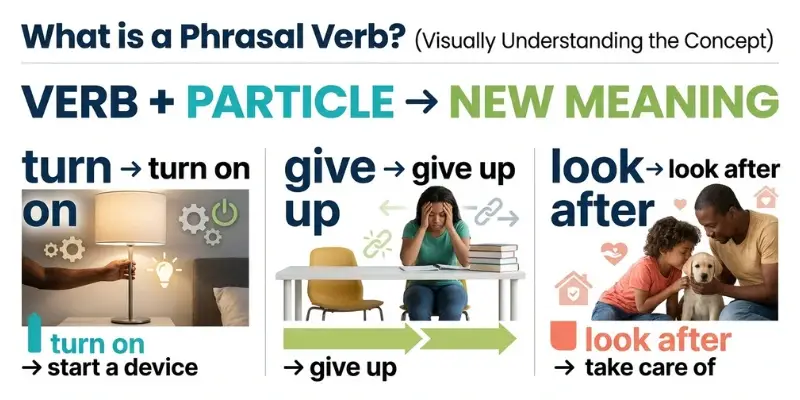
A phrasal verb is a combination of a verb and a small word called a particle. The particle changes or adds to the meaning of the main verb.
For example:
- turn = move or change direction
- turn on = start a machine, light, or device
- give = offer something
- give up = stop trying
- look = use your eyes to see
- look up = search for information
So, a phrasal verb’s meaning isn’t always the same as the main verb’s.
Simple Examples of Phrasal Verbs
- Turn on the TV.
- Please sit down.
- I gave up smoking.
- She looked up the word.
- We ran out of milk.
The best way to learn phrasal verbs is to study the whole expression in context, not just the individual words.
Phrasal Verbs in English Grammar
In simple grammar terms, a phrasal verb is usually made from:
Verb + Particle
For example:
pick + up = pick up
Please pick up your books.
Here, pick is the main verb and up is the particle.
The combination has a meaning that is different from simply understanding the two words separately.
However, English also has other types of multi-word verbs. Some grammar resources use the term phrasal verb more broadly, while others make clearer distinctions between phrasal verbs, prepositional verbs, and phrasal-prepositional verbs.
For learners, the most useful approach is simple:
Learn the complete expression, its meaning, and its sentence pattern together.
For a wider introduction to English grammar, you can also explore our English Grammar Basics guide.
Types of Phrasal Verbs
Phrasal verbs can be grouped in different ways. The most useful groups for learners are transitive, intransitive, separable, and inseparable forms.
1. Transitive Phrasal Verbs
A transitive phrasal verb needs an object to complete its meaning.
For example:
She turned off the radio.
The object is the radio.
Another example:
Please fill out the form.
The object is the form.
2. Intransitive Phrasal Verbs
An intransitive phrasal verb does not need a direct object.
For example:
The plane took off.
Another example:
I woke up early.
The sentences are complete without a direct object after the phrasal verb.
3. Separable Phrasal Verbs
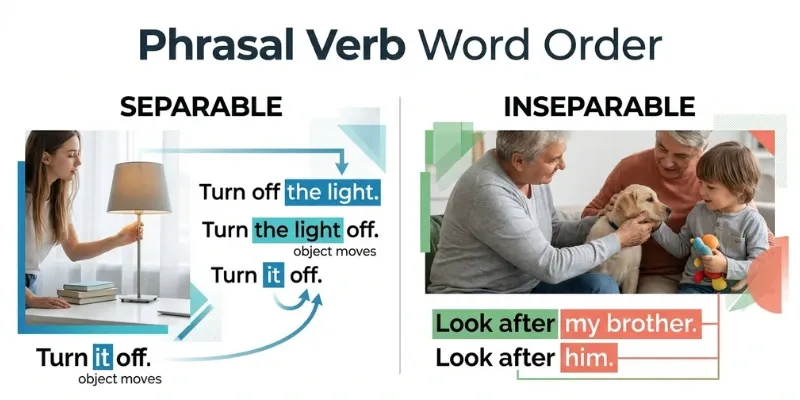
With some phrasal verbs, the object can come between the verb and the particle.
For example:
Turn off the light.
or:
Turn the light off.
Both are correct.
When the object is a pronoun, it normally comes between the verb and particle:
Turn it off. ✅
Turn off it. ❌
4. Inseparable Phrasal Verbs
Some multi-word verbs keep their parts together.
For example:
I look after my sister.
Not:
I look my sister after. ❌
This is why it is important to learn a phrasal verb together with an example sentence.
Phrasal Verbs vs Prepositional Verbs
Phrasal verbs and prepositional verbs can look similar, but they work differently.
Phrasal Verb
A phrasal verb combines a verb with a particle.
Please turn off the light.
Here, off works as a particle and changes the meaning of turn.
Prepositional Verb
A prepositional verb combines a verb with a preposition.
Please listen to the teacher.
Here, to introduces the object the teacher.
You cannot normally move the object between the verb and the preposition:
Listen the teacher to. ❌
Phrasal-Prepositional Verb
Some expressions contain a verb, particle, and preposition.
I can’t put up with that noise.
Put up with means tolerate.
The terminology can vary between grammar resources, so learners do not need to memorize every grammatical label. Focus first on the meaning, structure, and correct word order.
Word Order With Phrasal Verbs
Word order is one of the most important grammar points when using phrasal verbs.
Compare:
Turn off the computer.
Turn the computer off.
Both are possible because turn off can be separated when the object is a noun.
With a pronoun:
Turn it off. ✅
Turn off it. ❌
But some expressions do not allow this separation:
Look after the baby. ✅
Look the baby after. ❌
When you learn a new phrasal verb, learn its meaning and word order at the same time.
How to Use Phrasal Verbs in English
Knowing the meaning of a phrasal verb is only the first step. You also need to know how it works in a sentence.
Step 1: Learn the meaning
For example:
give up = stop trying
Step 2: Learn the pattern
She gave up smoking.
Step 3: Learn the word order
Turn it off. ✅
Turn off it. ❌
Step 4: Make your own sentence
For example:
I will never give up learning English.
This method helps you build both vocabulary and grammar knowledge at the same time.
Why Are Phrasal Verbs Important in English?
Phrasal verbs are common in everyday spoken and informal English. Learning them can help you understand natural conversations and express familiar ideas more comfortably.
For example:
- continue → carry on
- cancel → call off
- discover → find out
- postpone → put off
- return → come back
The phrasal verb is not always the best choice in every situation. Your choice should depend on the meaning, context, audience, and level of formality.
This is especially useful when improving spoken English because many common phrasal verbs appear in everyday conversations.
Phrasal verbs can help you:
- understand everyday conversations
- improve listening skills
- build useful vocabulary
- understand movies and podcasts
- speak more naturally
- communicate more comfortably
- understand informal messages and conversations
You can also practice them through our collection of simple English sentences for daily use.
100 Common Phrasal Verbs in English With Meanings and Examples
The following list contains 100 common and useful phrasal verbs. It is a practical learner’s list, not a statistical ranking of the 100 most frequent phrasal verbs.
1–25: Common Everyday Phrasal Verbs
| # | Phrasal Verb | Meaning | Example Sentence |
| 1 | ask out | invite someone on a date | He asked her out for dinner. |
| 2 | back up | make a copy or support | Please back up your files. |
| 3 | break down | stop working | My car broke down yesterday. |
| 4 | break up | end a relationship | They broke up last month. |
| 5 | bring back | return something | Please bring back my book tomorrow. |
| 6 | bring up | mention a topic | She brought up an important question. |
| 7 | call back | return a phone call | I will call you back later. |
| 8 | call off | cancel | They called off the meeting. |
| 9 | calm down | become less upset | Take a breath and calm down. |
| 10 | carry on | continue | Please carry on with your work. |
| 11 | catch up | reach the same level | I need to catch up on my homework. |
| 12 | check in | register on arrival | We checked in at the hotel. |
| 13 | check out | leave a hotel or examine | We checked out at noon. |
| 14 | cheer up | become happier | Cheer up! Everything will be fine. |
| 15 | clean up | make something clean | Please clean up your room. |
| 16 | come across | find by chance | I came across an old photo. |
| 17 | come back | return | She came back home early. |
| 18 | come in | enter | Come in and sit down. |
| 19 | come out | appear or be released | The new book came out last week. |
| 20 | come up | arise or happen | A problem came up during the meeting. |
| 21 | come up with | think of an idea | He came up with a good plan. |
| 22 | cut back | reduce | We need to cut back on spending. |
| 23 | cut down | reduce the amount | She is trying to cut down on sugar. |
| 24 | cut off | stop a supply or connection | The storm cut off the electricity. |
| 25 | cut out | remove or stop | Cut out the extra words. |
26–50: Useful Phrasal Verbs for Daily English
| # | Phrasal Verb | Meaning | Example Sentence |
| 26 | do over | do again | I made a mistake, so I did the work over. |
| 27 | dress up | wear special clothes | We dressed up for the wedding. |
| 28 | drop off | take someone or something somewhere | I will drop off the package. |
| 29 | eat out | eat at a restaurant | We eat out on Fridays. |
| 30 | end up | finally be in a situation | We ended up staying at home. |
| 31 | fall apart | break into pieces or stop working well | The old chair fell apart. |
| 32 | fall behind | fail to keep up | He fell behind in his studies. |
| 33 | figure out | understand or solve | Can you figure out this problem? |
| 34 | fill in | complete information | Please fill in your name. |
| 35 | fill out | complete a form | Please fill out this form. |
| 36 | find out | discover information | I found out the answer. |
| 37 | get back | return | What time did you get back? |
| 38 | get in | enter or arrive | What time did you get in? |
| 39 | get off | leave public transport | We got off the bus at the next stop. |
| 40 | get on | enter public transport | Get on the bus quickly. |
| 41 | get out | leave | Let’s get out of here. |
| 42 | get over | recover from something | She got over her cold quickly. |
| 43 | get up | rise from bed or a seat | I get up at seven every morning. |
| 44 | give away | give something for free | They gave away old clothes. |
| 45 | give back | return something | Please give back my pen. |
| 46 | give in | stop resisting | He finally gave in. |
| 47 | give up | stop trying | Never give up on your goals. |
| 48 | go ahead | start or continue | You can go ahead with the plan. |
| 49 | go back | return | We went back home early. |
| 50 | go off | make a sound or activate | My alarm went off at six. |
51–75: Common Phrasal Verbs for Speaking and Study
| # | Phrasal Verb | Meaning | Example Sentence |
| 51 | go on | continue | Please go on with your story. |
| 52 | grow up | become an adult | She grew up in a small town. |
| 53 | hand in | submit | Please hand in your assignment. |
| 54 | hang on | wait | Hang on for a minute. |
| 55 | hang out | spend time relaxing | We hung out after class. |
| 56 | hold on | wait | Hold on, please. |
| 57 | keep on | continue | Keep on practicing English. |
| 58 | kick off | start | The meeting kicks off at nine. |
| 59 | leave out | not include | Don’t leave out any important details. |
| 60 | let down | disappoint | I don’t want to let my team down. |
| 61 | log in | enter a computer account | Log in to your account first. |
| 62 | look around | examine a place | We looked around the shop. |
| 63 | look back | think about the past | She looked back on her school days. |
| 64 | look into | investigate | The manager will look into the problem. |
| 65 | look out | be careful | Look out! There is a car coming. |
| 66 | look up | search for information | Look up the word in a dictionary. |
| 67 | make up | invent or become friends again | They made up after the argument. |
| 68 | move on | continue to a new stage | It is time to move on. |
| 69 | pick up | collect or lift | I will pick you up at five. |
| 70 | point out | show or mention something | She pointed out a mistake. |
| 71 | put away | return something to its place | Put your books away. |
| 72 | put off | postpone | We put off the meeting. |
| 73 | put on | place clothes on your body | Put on your jacket. |
| 74 | put out | extinguish | Please put out the candle. |
| 75 | put up | place something higher | They put up a new sign. |
76–100: More Useful English Phrasal Verbs
| # | Phrasal Verb | Meaning | Example Sentence |
| 76 | run away | escape | The dog ran away. |
| 77 | run into | meet unexpectedly | I ran into an old friend. |
| 78 | run out | use all of something | We ran out of time. |
| 79 | set off | begin a journey | We set off early in the morning. |
| 80 | set up | arrange or establish | They set up a new business. |
| 81 | show up | arrive or appear | He showed up late. |
| 82 | sit down | take a seat | Please sit down. |
| 83 | sort out | organize or solve | We need to sort out this problem. |
| 84 | stand up | rise to your feet | Please stand up. |
| 85 | take back | return or withdraw a statement | I take back what I said. |
| 86 | take off | remove or leave the ground | The plane took off on time. |
| 87 | take on | accept work or responsibility | She took on a new project. |
| 88 | take over | gain control | She took over the project. |
| 89 | think over | consider carefully | Think over my suggestion. |
| 90 | throw away | discard | Don’t throw away those notes. |
| 91 | try on | put on clothes to test them | Can I try on this jacket? |
| 92 | turn down | reject or reduce volume | She turned down the offer. |
| 93 | turn off | stop a machine or device | Turn off the lights. |
| 94 | turn on | start a machine or device | Turn on the computer. |
| 95 | turn up | increase volume or arrive | Please turn up the music. |
| 96 | wake up | stop sleeping | I wake up at six. |
| 97 | warm up | prepare through gentle exercise | The players warmed up before the game. |
| 98 | work out | exercise or solve successfully | I work out three times a week. |
| 99 | write down | record in writing | Write down the new words. |
| 100 | go over | review or examine | Let’s go over the lesson again. |
Common Phrasal Verbs for Daily Conversation
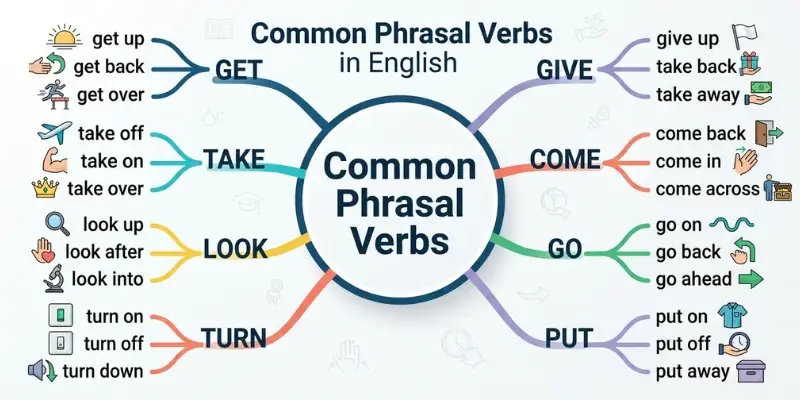
Many phrasal verbs are useful in everyday situations. You may hear them when people talk about home, school, friends, travel, shopping, and daily routines.
At Home
- wake up — I wake up at 6:30.
- get up — I get up after my alarm.
- put on — Put on your shoes.
- turn on — Turn on the fan.
- turn off — Turn off the TV.
- clean up — Clean up your room.
With Friends
- hang out — We hung out after school.
- come over — Come over this evening.
- cheer up — Cheer up! Things will get better.
- catch up — Let’s catch up this weekend.
- find out — I just found out the news.
In Daily Routines
- get up
- go out
- come back
- pick up
- drop off
- eat out
- run out
- go back
Learning these expressions through short conversations can make them easier to remember.
Phrasal Verbs for Work and Study
Phrasal verbs are also useful when talking about school, projects, meetings, and work.
Here are some useful examples:
- hand in — submit an assignment
- catch up — reach the required level
- fall behind — fail to keep up
- look into — investigate a problem
- come up with — develop an idea
- carry out — complete or perform a task
- point out — mention something important
- go over — review something
- take on — accept responsibility
- set up — arrange or establish something
For example:
The students came up with a new project idea.
Please hand in your assignment by Friday.
Let’s go over the answers together.
The manager will look into the problem.
If you want to learn more English for professional situations, see our complete Business English guide.
Phrasal Verbs for Business English
Some phrasal verbs are especially useful in workplace conversations. They can appear in meetings, emails, project discussions, and everyday professional communication.
1. Bring up
Meaning: mention a topic
I want to bring up an important issue in the meeting.
2. Carry out
Meaning: perform or complete a task
The team will carry out the plan next week.
3. Come up with
Meaning: think of an idea or solution
We need to come up with a better solution.
4. Follow up
Meaning: contact someone again about something
I will follow up with the client tomorrow.
5. Look into
Meaning: investigate
The manager will look into the problem.
6. Point out
Meaning: mention or show something
She pointed out an error in the report.
7. Set up
Meaning: arrange or establish
We need to set up a meeting.
8. Take on
Meaning: accept work or responsibility
He took on a new project.
9. Take over
Meaning: take control of something
She will take over the project next month.
10. Go over
Meaning: review or examine
Let’s go over the report before the meeting.
The level of formality matters in professional English. A phrasal verb may sound natural in conversation, but a different verb may be more suitable in a formal document. For more help with this difference, read our guide to Formal vs Informal English.

Phrasal Verbs in American and British English
English has different varieties, including British and American English. Some expressions or their preferred uses can vary between varieties.
For example, both fill in and fill out can be used when talking about completing a form, although usage can vary by region and context.
You do not need to learn every regional difference at once.
Focus first on the expressions you commonly hear and use. As you improve, you can notice differences between varieties of English through books, videos, conversations, and other real-world sources.
Phrasal Verbs With More Than One Meaning
One reason phrasal verbs can be difficult is that the same expression may have different meanings.
Take off
Meaning 1: remove clothing
He took off his jacket.
Meaning 2: leave the ground
The plane took off on time.
Meaning 3: become successful or popular
Her new business really took off.
The sentence around the phrasal verb tells you which meaning is intended.
Pick up
Meaning 1: collect someone or something
I will pick you up at five.
Meaning 2: lift something
He picked up the book.
Meaning 3: learn something informally
She picked up some useful English phrases while traveling.
This is why learning phrasal verbs in context is more useful than memorizing only a translation.
Phrasal Verbs vs English Idioms
Phrasal verbs and idioms are related because both can have meanings that are not obvious from their individual words, but they are not the same thing.
A phrasal verb is built around a verb and particle:
give up = stop trying
An idiom is a fixed expression with a figurative meaning:
a piece of cake = something very easy
If you want to explore this difference further, see our guide to Most Common English Idioms With Meanings.
Common Mistakes With Phrasal Verbs
Mistake 1: Translating Every Word Separately
A phrasal verb often has a special meaning.
For example:
Give up = stop trying
It does not simply mean “give” + “up.”
Mistake 2: Using the Wrong Word Order
Incorrect:
Turn off it. ❌
Correct:
Turn it off. ✅
Mistake 3: Forgetting the Tense
The main verb changes according to the tense.
I turn on the TV every evening.
I turned on the TV yesterday.
I will turn on the TV later.
The particle stays the same.
Mistake 4: Learning Only One Meaning
Some phrasal verbs have several meanings.
For example:
He took off his jacket.
and:
The plane took off on time.
The meaning depends on the context.
Mistake 5: Using a Phrasal Verb Everywhere
Phrasal verbs are useful, but you do not need to use them in every sentence.
Choose the expression that fits your meaning, audience, and situation.
Mistake 6: Memorizing Long Lists Without Context
A list can help you discover new vocabulary, but memorizing 100 expressions without using them can make them difficult to remember.
Learn each phrasal verb with:
- its meaning
- its word order
- an example sentence
- a situation where you can use it
How to Learn Phrasal Verbs Effectively
Trying to memorize a huge list at once can feel difficult. A better approach is to learn a small number of expressions and use them regularly.
1. Learn Phrasal Verbs by Topic
Group expressions around a situation.
For example, travel:
- check in
- get on
- get off
- set off
- take off
2. Learn the Whole Expression
Do not memorize only:
give
Learn:
give up = stop trying
Then make a sentence:
I will not give up.
3. Use Real Sentences
Instead of memorizing:
put off = postpone
learn:
We put off the meeting until Monday.
4. Practice Speaking
Say new phrasal verbs aloud. Try using them when you talk about your day.
Regular speaking practice can also support your wider English communication skills.
5. Write Your Own Examples
Create simple sentences about your real life.
For example:
I get up at seven.
I turn on my computer in the morning.
I write down new English words.
6. Review Regularly
Learn a few expressions, review them later, and use them again.
Regular practice is more useful than trying to memorize a very large list in one day.
You can also build a stronger vocabulary by combining phrasal verbs with the methods in our English Vocabulary Development guide.
Phrasal Verbs Practice Exercise
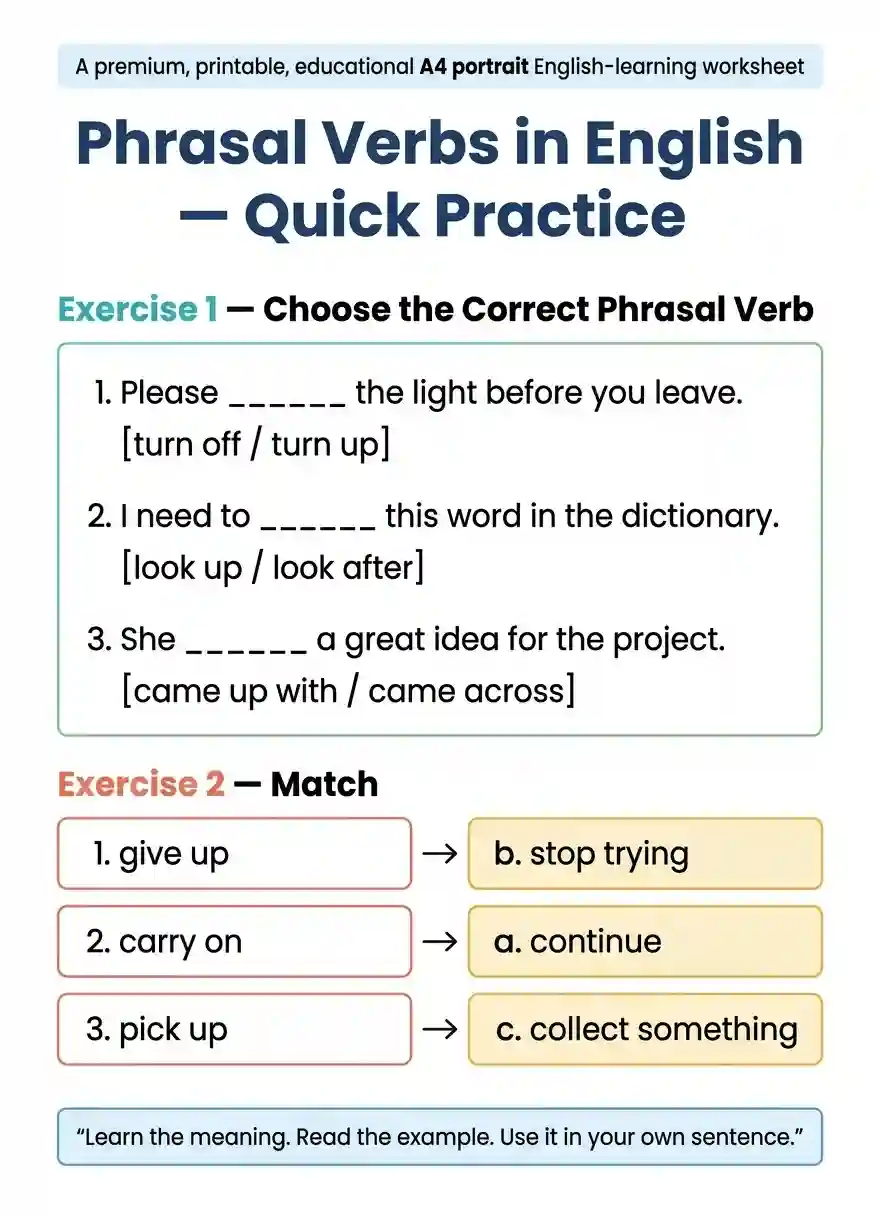
Choose the correct phrasal verb to complete each sentence.
1. Please ______ the lights before you leave.
a) turn off
b) give up
c) look into
2. I need to ______ this word in the dictionary.
a) look up
b) take over
c) go ahead
3. We ______ milk this morning.
a) ran out of
b) turned up
c) broke up
4. Please ______ your assignment tomorrow.
a) hand in
b) hang out
c) wake up
5. She ______ a great idea for the project.
a) came up with
b) went off
c) put away
6. My car ______ on the way home.
a) broke down
b) grew up
c) sat down
7. Let’s ______ the lesson again.
a) go over
b) run away
c) dress up
8. Don’t ______ your old notes.
a) throw away
b) check in
c) come in
9. I ______ my friend at the shopping center.
a) ran into
b) put on
c) gave in
10. Never ______ when learning English.
a) give up
b) check out
c) drop off
Answers
- turn off
- look up
- ran out of
- hand in
- came up with
- broke down
- go over
- throw away
- ran into
- give up
How Many Phrasal Verbs Are There in English?
There is no single exact number of phrasal verbs in English.
Different dictionaries and grammar resources include different expressions, meanings, and grammatical categories. Some resources also classify certain multi-word verbs differently.
English continues to change, so it is more useful for learners to focus on common expressions and learn them in context than to try to memorize every possible combination.
You do not need to know every phrasal verb to communicate effectively.
Start with common expressions, practice them in sentences, and gradually add new ones as you meet them.
Conclusion
Phrasal verbs are an important part of everyday English. They can seem difficult at first because a small word can change the meaning of a familiar verb, but they become much easier when you learn them in context.
Start with a few useful expressions such as get up, find out, give up, look up, put on, take off, and turn off. Make your own sentences and use them when you speak or write.
You do not need to memorize all 100 phrasal verbs at once. Learn a few, review them regularly, and add more as you meet them in real English.
With steady practice, you can understand more natural English, build stronger vocabulary, and communicate with greater confidence.
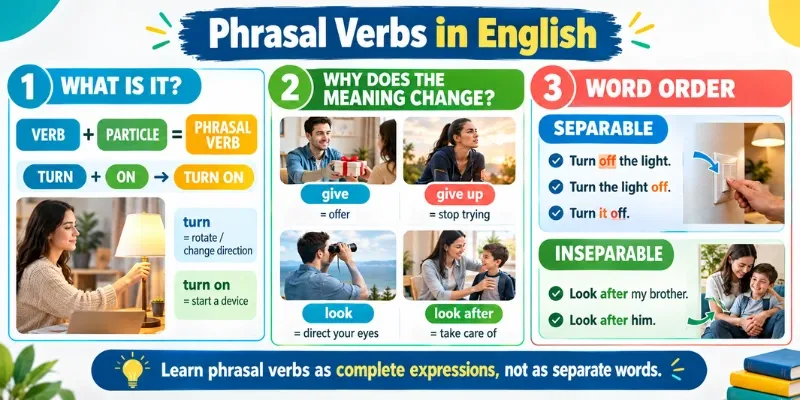
Phrasal verbs are combinations built around a verb and a particle. Together, they can create a meaning that is different from the main verb alone. For example, give up means “stop trying.”
Common examples include get up, wake up, turn on, turn off, find out, give up, look up, pick up, put on, take off, and go on. Learning these expressions can help you understand everyday English more easily.
Phrasal verbs are common in everyday communication. Learning them can help you understand spoken English, conversations, movies, podcasts, and informal messages while giving you more ways to express familiar ideas.
Yes. Some phrasal verbs have several meanings. For example, take off can mean removing clothing, when an airplane leaves the ground, or becoming successful. The surrounding sentence tells you which meaning is intended.
Many common phrasal verbs are frequent in everyday and informal English, but some can also be used in formal situations. The right choice depends on the expression, context, audience, and purpose.
A separable phrasal verb allows the object to come between the verb and particle in certain sentences, such as turn the light off. An inseparable phrasal verb keeps its parts together, such as look after the child.
Start with a small group of common expressions. Learn each one with its meaning, an example sentence, and its word order. Then use the expressions in speaking and writing and review them regularly.
A phrasal verb is built around a verb and a particle, such as give up. An idiom is a fixed expression with a figurative meaning, such as a piece of cake. They are related but are not the same type of expression.
Yes. Some phrasal verbs are useful in workplace communication, including bring up, follow up, look into, carry out, set up, take on, and go over. Their suitability depends on the context and level of formality.




- Be Respectful
- Stay Relevant
- Stay Positive
- True Feedback
- Encourage Discussion
- Avoid Spamming
- No Fake News
- Don't Copy-Paste
- No Personal Attacks
- Be Respectful
- Stay Relevant
- Stay Positive
- True Feedback
- Encourage Discussion
- Avoid Spamming
- No Fake News
- Don't Copy-Paste
- No Personal Attacks
