Use To or Used To — Which Is Correct? Meaning, Rules, Examples & Tips
Published: 6 Oct 2026
Use to and used to look almost the same, so it is easy to mix them up. The small -d in used can make a big difference in a sentence.
For example:
- I used to play cricket.
- Did you use to play cricket?
- I didn’t use to play cricket.
Why does the first sentence use used to, while the other two use use to?
The answer is simple: did and didn’t change the form.
In this guide, you will learn the difference between use to and used to with easy rules, clear examples, common mistakes, and simple exercises. You will also learn how used to, be used to, and get used to have different meanings.
By the end, you will know which form to use and why.
Use To or Used To: Which Is Correct?
Both use to and used to can be correct.
The correct form depends on the sentence.
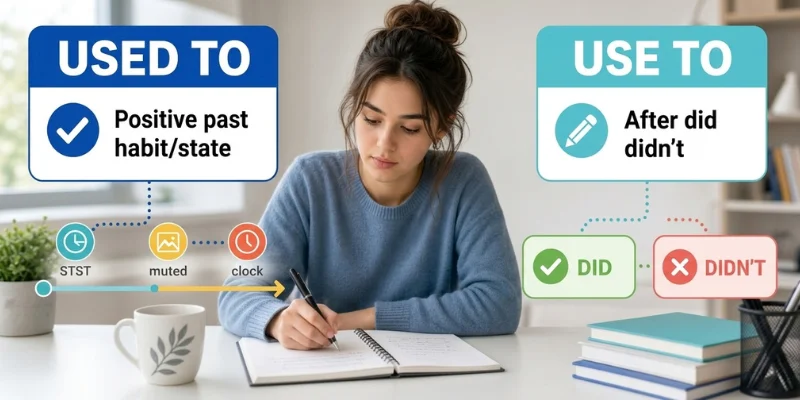
Use “used to” in positive sentences
Use used to + base verb when you talk about a past habit, action, state, or situation that is no longer true.
For example:
- I used to play football.
- She used to live here.
- We used to visit our grandparents.
- He used to watch cartoons.
Use “use to” after “did” or “didn’t”
When you make a question or negative sentence with did or didn’t, use “use to”.
For example:
- Did you use to play football?
- Did she use to live here?
- I didn’t use to like coffee.
- He didn’t use to wake up early.
Here is the basic rule:
| Sentence | Correct form | Example |
| Positive | used to | I used to play cricket. |
| Negative | didn’t use to | I didn’t use to play cricket. |
| Question | Did … use to | Did you use to play cricket? |
This is the main rule you need to remember.
What Does “Used To” Mean?
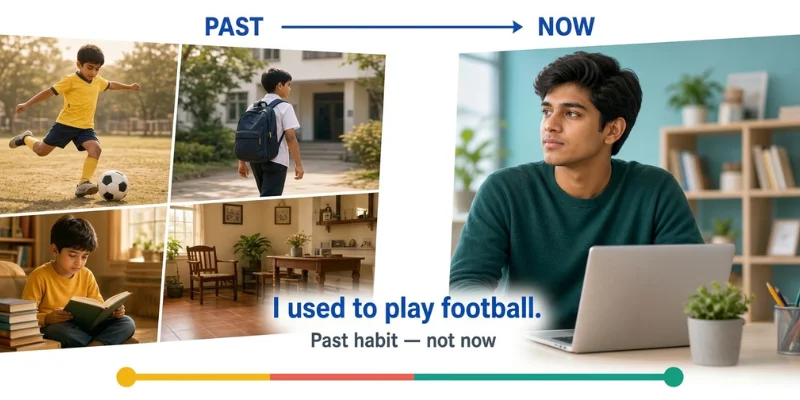
Used to + base verb talks about something that happened or was true in the past but is different now.
It can describe:
- a past habit
- a past action
- a past state
- a past situation
For example:
I used to walk to school.
This means I walked to school in the past, but I do not do it now.
Another example:
Sara used to have long hair.
This means Sara had long hair before, but her hair is different now.
The basic structure
Subject + used to + base verb
Examples:
- I used to play tennis.
- Ali used to ride his bike.
- They used to live in Lahore.
- My father used to work at a bank.
- We used to eat dinner together.
Remember that the verb after used to stays in its base form.
✅ I used to play.
❌ I used to played.
✅ She used to visit us.
❌ She used to visited us.
If you often confuse English words and grammar forms, our guide to words often confused in English can help you avoid similar mistakes.
When Do We Use “Used To”?
We use used to when we look back at the past.
1. Past habits
A past habit is something you did regularly before.
Examples:
- I used to play cricket after school.
- She used to read before bed.
- We used to visit our uncle every Sunday.
- My brother used to watch cartoons every morning.
These actions happened often in the past.
2. Past situations
Used to can also describe a situation that was true before.
Examples:
- I used to live in a small village.
- They used to be our neighbours.
- My school used to be near the park.
- This shop used to be a bakery.
The sentences do not have to describe repeated actions. They can describe something that was true in the past.
3. Past states
We can also use used to with verbs like be, have, like, know, and believe.
Examples:
- I used to be shy.
- He used to have short hair.
- She used to like spicy food.
- We used to know each other.
- They used to believe that story.
The main idea stays the same:
It was true before, but it has changed now.
What About “Use To”?
Now let’s look at use to. In the past-habit structure, we use use to after did or didn’t.
For example:
Did you use to play tennis?
Here, did already shows the past.
That is why we use use, not used, after did.
The same rule works with didn’t:
I didn’t use to like tea.
Here, didn’t already shows the past.
So remember:
Did + use to
Didn’t + use to
Examples:
- Did you use to swim?
- Did he use to live here?
- Did they use to study together?
- I didn’t use to drink coffee.
- She didn’t use to wake up early.
- We didn’t use to have a car.
Did You Use To or Used To?
One of the most common questions is:
Is it “Did you use to” or “Did you used to”?
For standard learner and exam writing, use:
✅ Did you use to…?
Not:
❌ Did you used to…?
Look at the structure:
Did + subject + use to + base verb
For example:
Did + you + use to + play?
So we say:
- Did you use to play football?
- Did she use to live here?
- Did he use to walk to school?
- Did they use to visit you?
Why not “used”?
Because did already carries the past meaning.
You do not need to make use past again.
Think of this pattern:
Did + use
Just like:
Did you go there?
Not:
Did you went there?
The same idea helps you remember:
Did you use to play?
Not:
Did you used to play?
Didn’t Use To or Didn’t Used To?
The standard form for learners is:
✅ didn’t use to
For example:
- I didn’t use to like vegetables.
- She didn’t use to wear glasses.
- He didn’t use to study at night.
- We didn’t use to have a computer.
- They didn’t use to live here.
Avoid this form in standard learner and exam writing:
❌ I didn’t used to like vegetables.
❌ She didn’t used to wear glasses.
The simple pattern is:
didn’t + use to + base verb
For example:
I didn’t use to play cricket.
She didn’t use to eat spicy food.
We didn’t use to live here.
Used To Be Sentences
Many learners search for used to be sentences because used to can describe a past state or situation.
The structure is:
Subject + used to be + noun/adjective/place
Examples:
- I used to be shy.
- She used to be a teacher.
- He used to be very quiet.
- They used to be good friends.
- My brother used to be afraid of dogs.
- This place used to be a school.
More examples
I used to be shy.
Now I am more confident.
My father used to be a driver.
Now he has a different job.
This building used to be a hospital.
It has a different use now.
She used to be my classmate.
We studied together in the past.
Notice the idea of then and now.
That change makes used to useful when we talk about the past.
Use To or Used To Examples
Let’s look at more examples.
Positive sentences
- I used to play football.
- She used to read books.
- He used to walk to school.
- We used to visit our grandparents.
- They used to live in a small house.
Negative sentences
- I didn’t use to play football.
- She didn’t use to read books.
- He didn’t use to walk to school.
- We didn’t use to visit them.
- They didn’t use to live here.
Questions
- Did you use to play football?
- Did she use to read books?
- Did he use to walk to school?
- Did you use to visit them?
- Did they use to live here?
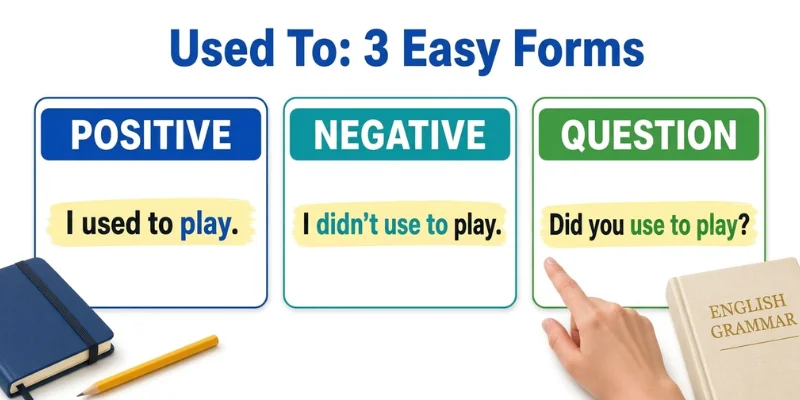
Now look at these three sentences:
I used to play cricket.
I didn’t use to play cricket.
Did you use to play cricket?
The meaning stays connected to the past, but the sentence structure changes.
Use To or Used To: Quick Comparison
| Sentence type | Pattern | Example |
| Positive | used to + base verb | I used to swim. |
| Negative | didn’t use to + base verb | I didn’t use to swim. |
| Question | Did + subject + use to + base verb? | Did you use to swim? |
Easy rule
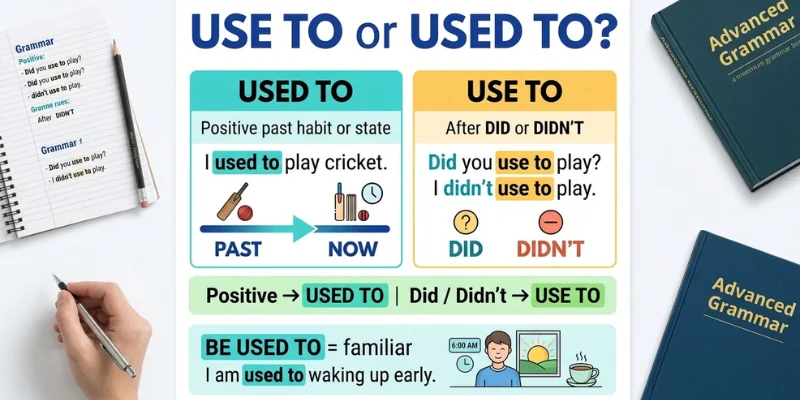
Positive → used to
Negative → didn’t use to
Question → Did … use to?
This simple pattern can help you avoid most mistakes.
Used To vs Be Used To
Be careful with these two forms:
used to
and
be used to
They do not have the same meaning.
Used to + base verb
This talks about a past habit or situation.
I used to wake up late.
This means I woke up late in the past, but I do not do it now.
Be used to + noun or -ing
This means something feels normal or familiar.
I am used to waking up early.
This means waking up early feels normal to me now.
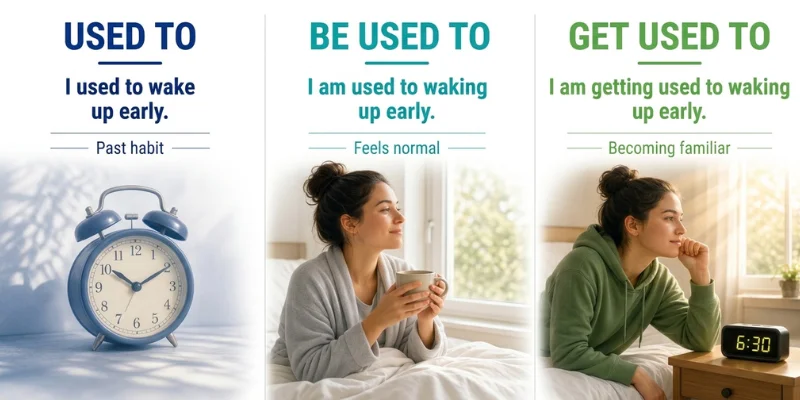
Compare these sentences:
I used to wake up early.
= I did this in the past.
I am used to waking up early.
= This feels normal to me now.
More examples
Used to:
- I used to live in Islamabad.
- She used to work at a school.
- He used to play tennis.
Be used to:
- I am used to city life.
- She is used to working late.
- He is used to cold weather.
The grammar looks similar, but the meaning changes.
Used To vs Get Used To
You may also see:
get used to
This means become familiar or comfortable with something.
For example:
I am getting used to my new school.
At first, the school felt new. Now I am becoming comfortable with it.
Compare these three sentences:
I used to study at home.
= I studied at home in the past.
I am used to studying at home.
= Studying at home feels normal to me.
I am getting used to studying at home.
= I am becoming comfortable with it.
Remember:
- used to + base verb → past habit or situation
- be used to + noun/-ing → something feels familiar
- get used to + noun/-ing → become familiar with something
Can “Use To” Ever Be Correct Without “Did”?
Yes. This is an important point.
Use can also work as a normal verb. In that case, use to does not talk about a past habit.
For example:
What do you use to clean the table?
Here, use means “use something for a purpose.”
Another example:
What do you use to write on the board?
This question does not use the past-habit structure.
So do not think:
“Use to is always wrong.”
That is not true.
The rule in this article is about use to and used to when we talk about past habits, states, or situations.
Common Mistakes With Use To and Used To
Mistake 1: “Did you used to?”
❌ Did you used to play cricket?
✅ Did you use to play cricket?
Mistake 2: “Didn’t used to”
❌ I didn’t used to like milk.
✅ I didn’t use to like milk.
Mistake 3: Using a past verb after “used to”
❌ I used to played cricket.
✅ I used to play cricket.
Mistake 4: Using the wrong form after “be used to”
❌ I am used to play football.
✅ I am used to playing football.
Remember:
used to + base verb
but
be used to + noun/-ing
Mistake 5: Thinking “use to” is always wrong
❌ “Use to” is never correct.
✅ “Use to” can be correct after did or didn’t in the past-habit structure.
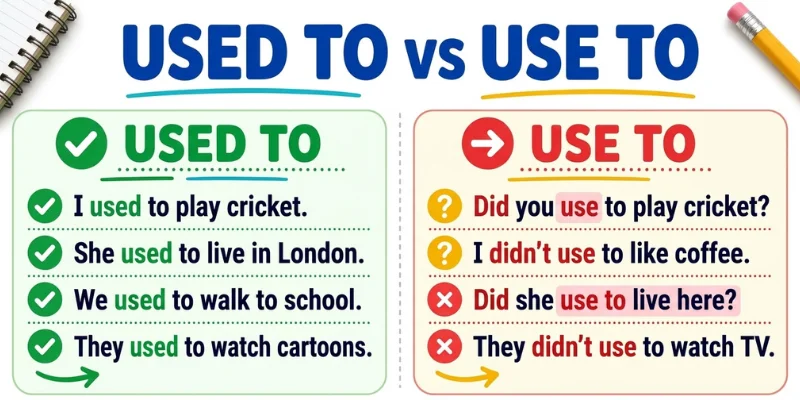
‘Use To’ or ‘Used To’ Meaning
The easiest way to understand the meaning is to think about past and present.
Used to
Used to usually tells us that something happened or was true before but is different now.
For example:
I used to have long hair.
Meaning:
I had long hair before. Now I do not.
Another example:
We used to live in a village.
Meaning:
We lived there before. We do not live there now.
The sentence may not always tell us exactly what changed. The important point is that the past situation is no longer the same.
Use to
Use to does not have a special past-habit meaning by itself. In normal sentences, use can simply be the verb meaning “use” or “make use of,” followed by to + verb.
For example:
What do you use to remove stains?
Here, use means “use something for a purpose.” It does not describe a past habit.
More examples:
What do you use to open this box?
Which app do you use to learn English?
There is also an important grammar pattern to remember:
Did you use to play cricket?
I didn’t use to play cricket.
In these sentences, use to refers to a past habit because did or didn’t already carries the past tense. This is why we write use to, not used to, after did or didn’t.
Practice: Use To or Used To Exercises
Now it is your turn.
Choose used to or use to.
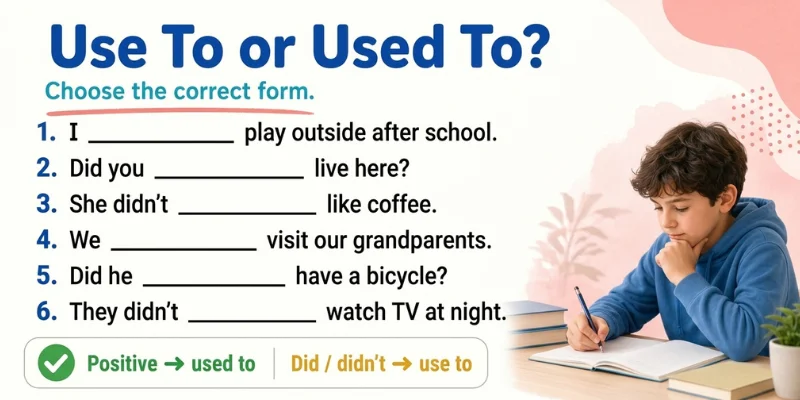
Exercise 1: Fill in the blanks
- I ______ play football after school.
- Did you ______ live here?
- She didn’t ______ like coffee.
- We ______ visit our grandparents every weekend.
- Did he ______ have a bicycle?
- They didn’t ______ watch TV at night.
- My brother ______ be very quiet.
- Did your father ______ work here?
- I ______ walk to school every morning.
- She didn’t ______ have long hair.
Answers
- used to
- use to
- use to
- used to
- use to
- use to
- used to
- use to
- used to
- use to
Exercise 2: Correct the mistakes
Find and correct the mistake in each sentence.
- Did you used to play cricket?
- I didn’t used to like milk.
- She used to played tennis.
- We used to visited our uncle.
- Did he used to live here?
Answers
- Did you use to play cricket?
- I didn’t use to like milk.
- She used to play tennis.
- We used to visit our uncle.
- Did he use to live here?
If you want to build stronger everyday English, you can also practice with these simple English sentences for daily use.
You can also take our English Grammar Test to practice your grammar skills and check your understanding of English.
Real-Life Examples of “Used To”
You can use used to when you talk about your childhood, school days, old hobbies, past routines, or places that have changed.
Talking about childhood
I used to play outside with my friends.
I used to watch cartoons every morning.
We used to visit our grandparents during the holidays.
Talking about school
I used to walk to school.
My teacher used to give us homework every day.
We used to sit together in class.
Talking about hobbies
I used to play cricket.
She used to draw pictures.
He used to collect stamps.
Talking about places
We used to live in a small town.
This shop used to be a bakery.
That building used to be a school.
These examples show how useful used to is in everyday English.
For more speaking practice, see our guide on how to learn spoken English.
A Short Story With “Used To”
Here is a short story to help you see all three forms together.
When I was a child, I used to live in a small village. I used to walk to school with my brother. We used to play football after class.
I didn’t use to like vegetables, but my mother always cooked them for us.
Sometimes I ask my brother, “Did you use to play football every day?”
He laughs and says, “Yes, I did!”
Look at the patterns:
- used to live
- used to walk
- used to play
- didn’t use to like
- Did you use to play?
Seeing the forms in a short story can make the rule much easier to remember.
A Simple Memory Trick
You do not need to memorize a long grammar rule.
Just remember these three sentences:
I used to play.
I didn’t use to play.
Did you use to play?
Now look at the pattern:
- used to → positive
- didn’t use to → negative
- Did … use to? → question
Here is the easiest memory trick:
No did → used to
Did → use to
Didn’t → use to
This trick applies to the past-habit structure.
Use To or Used To: Final Rule
Let’s put everything together.
| Meaning or use | Correct form | Example |
| Positive past habit | used to | I used to play cricket. |
| Positive past state | used to | I used to be shy. |
| Negative past habit | didn’t use to | I didn’t use to play cricket. |
| Past-habit question | Did … use to? | Did you use to play cricket? |
| Familiar with something | be used to | I am used to waking up early. |
| Become familiar with something | get used to | I am getting used to my new school. |
The most important three sentences are:
I used to play.
I didn’t use to play.
Did you use to play?
If you remember these three patterns, you can handle most use to or used to questions.
Conclusion
The difference between use to and used to looks small, but the rule is simple. Use used to + base verb for a positive sentence about a past habit, state, or situation.
Use didn’t use to for a negative sentence.
Use Did … use to? for a question.
Remember:
I used to play.
I didn’t use to play.
Did you use to play?
Try making three sentences about your own life today. Think about something you used to do, something you didn’t use to do, and something you can ask a friend with Did you use to…?
A few minutes of practice can make this grammar point much easier. Keep practicing, keep speaking, and keep learning English with English Learning Help.
FAQ’s
Both can be correct, but they have different uses. Use used to in positive sentences about past habits, states, or situations. Use “use to” after did or didn’t in this past-habit structure.
Use Did you use to…? in standard learner and exam writing. The word did already shows the past, so the verb after it stays in its base form.
Use didn’t use to for the standard past-habit structure. For example: I didn’t use to like coffee.
Used to describes something that happened or was true in the past but is no longer true now. For example, I used to live in a village means I lived there before, but I do not live there now.
Yes. You can use used to be to talk about a past state or situation. For example, She used to be shy means she was shy in the past but is different now.
Used to + base verb talks about a past habit or situation. Be used to + noun or -ing means something feels familiar or normal. For example, I used to work at night is different from I am used to working at night.
Used to talks about a past habit or situation. Get used to means to become familiar or comfortable with something. For example, I used to live in a village and I am getting used to city life have different meanings.
Yes. Use can be an ordinary verb. For example, What do you use to clean your shoes? Here, “use” has its normal meaning. It does not describe a past habit.
Use the base form of the verb. Say I used to play, not I used to played. Say She used to visit, not She used to visited.
Start with three patterns: positive, negative, and question. Write sentences such as I used to play, I didn’t use to play, and Did you use to play? Then make sentences about your own childhood, school days, hobbies, and past routines.






- Be Respectful
- Stay Relevant
- Stay Positive
- True Feedback
- Encourage Discussion
- Avoid Spamming
- No Fake News
- Don't Copy-Paste
- No Personal Attacks
- Be Respectful
- Stay Relevant
- Stay Positive
- True Feedback
- Encourage Discussion
- Avoid Spamming
- No Fake News
- Don't Copy-Paste
- No Personal Attacks
