Academic English: Meaning, Purpose, Skills, Examples & How to Improve
Published: 4 Oct 2026
Academic English is the type of English used for study, teaching, research, and academic communication. It helps students read textbooks, write assignments, understand lectures, give presentations, and share ideas clearly.
You may already speak English well in daily life but still find academic English difficult. That is normal. Academic work often uses different words, writing patterns, and ways of presenting ideas.
The good news is that you do not need big words or very long sentences to use Academic English well. You need clear ideas, accurate grammar, useful vocabulary, and good organisation.
In this guide, you will learn what Academic English means, its purpose, the main skills you need, common examples, and simple ways to improve.
What Is Academic English?
Academic English is the form of English used in schools, colleges, universities, and research settings. It includes the language students need for reading, writing, listening, and speaking.
You may use Academic English when you:
- Read textbooks and academic articles
- Write essays and assignments
- Prepare reports and research papers
- Give presentations
- Join seminars and classroom discussions
- Write exam answers
- Summarise information
- Explain ideas with evidence
Academic English is usually more formal and organised than everyday English. It may also use subject-specific words.
For example:
Everyday English:
“I think this book is really good.”
Academic English:
“This book provides a detailed discussion of the topic.”
The second sentence fits an academic setting better. It is more precise and formal.
However, Academic English does not mean using difficult words all the time. Good academic writing should be clear, precise, and easy for the reader to follow.
What Is the Purpose of Academic English?
The main purpose of academic English is to help learners communicate effectively in academic settings.
It helps you:
- Understand academic information
- Explain ideas clearly
- Organise information logically
- Support ideas with evidence
- Discuss different viewpoints
- Write essays and reports
- Understand lectures
- Take useful notes
- Give presentations
- Complete academic tasks and exams
Academic English also helps you build thinking skills. You learn how to compare ideas, analyse information, explain reasons, and make clear conclusions.
What Is English for Academic Purposes (EAP)?
English for Academic Purposes (EAP) is an area of English learning that prepares students to study in English.
EAP can include:
- Academic reading
- Academic writing
- Listening and note-taking
- Academic vocabulary
- Paraphrasing and summarising
- Referencing
- Presentations
- Seminar discussions
- Critical thinking
The exact skills can change with the learner’s level, subject, and study goals.
Why Is Academic English Important?
Academic English matters because students need more than everyday conversation skills to succeed in academic settings.
For example, a student may need to read a chapter, find the main idea, take notes, write an assignment, and discuss the topic in class. These tasks need different language skills.
Academic English can help you:
- Understand study materials
- Follow lectures and discussions
- Write clear assignments
- Explain your ideas
- Use subject-specific vocabulary
- Work with sources
- Present information clearly
It is also useful for students who plan to study in an English-medium programme. Researchers and professionals may also use academic language when they write reports, research papers, or formal presentations.
Most importantly, strong academic English can build confidence. When you know how to organise and explain your ideas, academic tasks can feel much easier.

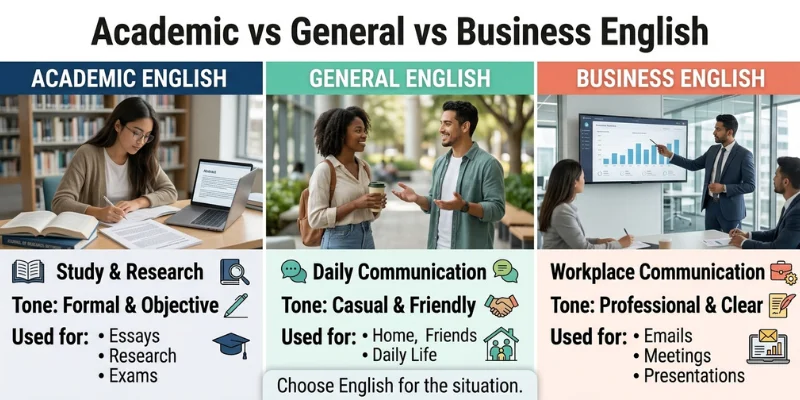
Academic English vs General English
Academic English and General English have different purposes.
General English is mainly used for everyday communication. You may use it when talking with friends, shopping, travelling, or discussing daily activities.
Academic English is used for study, research, and academic communication.
| Feature | Academic English | General English |
| Purpose | Study and academic communication | Everyday communication |
| Tone | Usually formal and objective | Often casual and friendly |
| Vocabulary | Academic and subject-specific | Common everyday words |
| Common tasks | Essays, reports, research | Conversations and daily tasks |
| Structure | Usually organised and logical | More flexible |
You can learn more about everyday English in our General English guide. Neither type is better. You simply choose the style that fits the situation.
Academic English vs Business English
Academic English and Business English also have different goals.
Academic English focuses on study, research, evidence, analysis, and academic discussion.
Business English focuses on workplace communication, such as meetings, emails, presentations, and professional discussions.
| Feature | Academic English | Business English |
| Purpose | Study and research | Workplace communication |
| Tone | Formal and objective | Professional and polite |
| Vocabulary | Academic and subject-specific | Workplace and industry terms |
| Examples | Essays, reports, research papers | Emails, meetings, proposals |
| Main focus | Ideas, evidence, analysis | Clear professional communication |
If you want to improve workplace communication, see our Business English guide.
The Four Main Academic English Skills
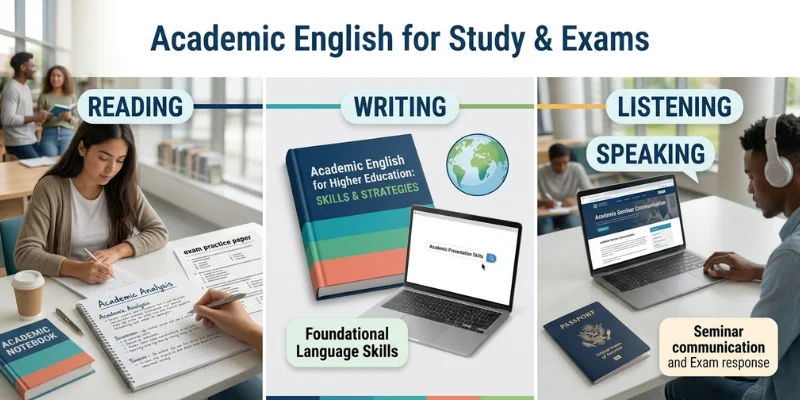
Academic English includes four main language skills:
- Academic reading
- Academic writing
- Academic listening
- Academic speaking
Vocabulary, grammar, research skills, and critical thinking support all four.
1. Academic Reading
Academic reading is more than understanding individual words.
You often need to:
- Find the main idea
- Identify important details
- Understand an argument
- Find supporting evidence
- Compare ideas
- Understand the writer’s purpose
- Take useful notes
When you start a new academic text, do not worry about every difficult word. First, look at the title, headings, introduction, and main points. Then read more carefully.
Regular reading also helps you notice useful vocabulary and sentence patterns.
2. Academic Writing
Academic writing is one of the most important Academic English skills.
Students may need to write:
- Essays
- Reports
- Research papers
- Summaries
- Paragraphs
- Exam answers
- Projects
Good academic writing usually has a clear structure.
A simple essay structure is:
Introduction → Main Body → Conclusion
Each paragraph should have a clear purpose. Your ideas should connect in a logical order. When a task requires evidence, support important claims with suitable sources.
For more help, read our guide on how to improve English writing skills.
3. Academic Listening
Academic listening helps you understand teachers, lecturers, presentations, and discussions.
You may need to listen to:
- Lectures
- Classroom explanations
- Academic presentations
- Seminars
- Group discussions
Good listening means finding the main idea, noticing important details, and taking useful notes.
Do not try to write every word. Write keywords and short notes instead.
4. Academic Speaking
Academic speaking is useful in presentations, seminars, classroom discussions, interviews, and group projects.
You may need to:
- Explain an idea
- Give an opinion
- Present research
- Ask questions
- Answer questions
- Discuss different views
- Explain information from a chart
Academic speaking should be clear and organised. You do not need to sound overly formal. Your main goal is to express your ideas clearly and confidently.
For more everyday speaking practice, explore our English communication skills guide.

Academic English Vocabulary
Academic vocabulary helps you explain ideas more clearly and precisely.
Common academic verbs include:
- Analyse
- Compare
- Evaluate
- Explain
- Identify
- Interpret
- Discuss
- Demonstrate
- Examine
- Suggest
For example:
Simple:
“The study looks at how students learn.”
More academic:
“The study examines how students learn.”
The second sentence is more precise, but it is still easy to understand.
Learn Words in Context
Do not only memorise long vocabulary lists.
Learn new words with:
- Their meaning
- Example sentences
- Common word combinations
- Related word forms
- Real examples
For example:
analyse → analysis → analytical
Learning words in groups can help you use them more naturally.
You can also build your general vocabulary with our English vocabulary development guide.
Transition Words in Academic English
Transition words help readers follow your ideas.
To Add Ideas
- Also
- Furthermore
- In addition
- Moreover
To Show Contrast
- However
- In contrast
- On the other hand
- Although
To Show a Result
- Therefore
- As a result
- Consequently
- Thus
To Give an Example
- For example
- For instance
- Such as
Do not use transition words in every sentence. Use them when they make the connection between ideas clearer.
Academic English Grammar
Academic English uses the same basic English grammar that you learn in everyday English. However, academic writing often requires careful grammar and clear sentence structure.
Clear Sentence Structure
Avoid sentences that try to say too many things at once.
Less clear:
“The students who studied the topic and attended the lectures and completed all the activities were able to understand the subject better.”
Clearer:
“Students who studied the topic and attended the lectures understood the subject better.”
The second sentence is shorter and easier to follow.
Verb Tenses
Choose the tense that matches your meaning.
For example:
“The study examines the effects of online learning.”
When you describe a completed action, the past tense may be suitable:
“The researchers collected data from 200 students.”
Passive Voice
Passive voice can be useful when the action matters more than the person who did it.
“The data were collected from three groups.”
But you do not need passive voice in every sentence. Active voice is often clearer.
Formal Language
Academic writing often avoids very casual expressions.
Casual:
“A lot of students have trouble with this.”
More formal:
“Many students experience difficulty with this topic.”
The goal is not to make every sentence sound difficult. Clear language is more important.
If you want to learn more about formal and informal language, read our guide to Formal vs Informal English.
Academic Tone and Style
Good academic writing is usually:
- Clear
- Formal
- Precise
- Objective
- Well organised
- Supported by evidence when needed
Avoid emotional or extreme claims unless your evidence supports them.
Instead of:
“This is obviously the best method.”
You could write:
“This method may be effective in some learning situations.”
Academic writing often uses careful language when the evidence does not support a strong claim.
Useful words include:
- May
- Might
- Can
- Suggest
- Appear
- Indicate
- Likely
You should also avoid unnecessary words that make writing longer without making it clearer. Our guide to words to avoid in writing can help with this.

Academic Writing Formats
Different academic tasks need different formats.
Essays
An essay usually presents an idea, argument, explanation, or analysis. It often includes an introduction, body paragraphs, and a conclusion.
Reports
A report presents information in a clear structure. Depending on the task, it may include headings, findings, discussion, and recommendations.
Research Papers
A research paper presents research in a formal way. Its structure depends on the subject and assignment.
Summaries
A summary gives the main points of a longer text in a shorter form.
Paraphrasing
Paraphrasing means explaining information from a source in your own words while keeping the original meaning. You should still acknowledge the source when required.
Critical Analysis
Critical writing does more than describe information. It examines ideas, considers evidence, compares viewpoints, and explains why a conclusion makes sense.
Academic English and Research Writing
Research writing needs clear Academic English because researchers must explain ideas and evidence in a way that readers can follow.
Useful research skills include:
- Finding suitable sources
- Taking notes
- Paraphrasing
- Summarising
- Comparing sources
- Using evidence
- Referencing sources
- Building logical arguments
- Editing and proofreading
Always follow the citation style required by your school, university, teacher, or journal.
You should also understand academic integrity. Do not copy another writer’s words or ideas and present them as your own.

Academic English for IELTS, TOEFL, and PTE
Academic English can support preparation for exams such as IELTS Academic, TOEFL, and PTE Academic.
These exams can require skills such as:
- Reading academic texts
- Understanding spoken information
- Writing organised answers
- Explaining ideas
- Taking notes
- Managing time
However, general Academic English practice is not the same as test preparation.
If you are preparing for an exam, also learn the current format and requirements of that specific test. Then practise with suitable sample tasks.
Academic English for International Students
Academic English can be especially useful for students who plan to study in an English-medium programme.
You may need to:
- Understand lectures
- Read textbooks and articles
- Write assignments
- Join discussions
- Give presentations
- Communicate with teachers
- Complete research projects
A simple way to prepare is to start before your course begins.
Read short academic texts. Learn useful vocabulary. Listen to educational talks. Write short summaries. Practise explaining what you have learned.
These small habits can help you feel more comfortable with academic study.
Do You Need an Academic English Course?
An Academic English course can help if you want structured lessons, regular practice, or teacher feedback.
A useful course may cover:
- Academic writing
- Academic vocabulary
- Reading strategies
- Listening and note-taking
- Speaking and presentations
- Grammar
- Paraphrasing and summarising
- Referencing
- Study skills
You may not need a course if you can study independently and practise regularly.
The right choice depends on your level, goals, time, and need for feedback.
Common Academic English Challenges
1. Difficult Vocabulary
Academic texts may contain unfamiliar words and subject-specific terms.
Try this: Learn new words in context. Write your own example sentence for each useful word.
2. Long Sentences
Some academic texts contain long sentences with several ideas.
Try this: Find the main subject and verb first. Then break the sentence into smaller parts.
3. Formal Writing
You may know what you want to say but not know how to say it in an academic style.
Try this: Read good examples and notice how writers introduce ideas, give evidence, and connect paragraphs.
4. Paraphrasing
It can be hard to rewrite a source without changing its meaning.
Try this: Read the original carefully. Understand the idea first. Then explain it in your own words.
5. Lack of Confidence
Some learners think academic writing must sound complicated.
Try this: Focus on clarity. Simple and accurate English is often stronger than difficult English.
How to Improve Academic English
You can improve Academic English through small, regular habits.
1. Read Every Day
Read textbooks, educational articles, academic websites, or other suitable materials.
Start with texts that match your level.
2. Build an Academic Vocabulary List
Write down useful words and phrases. Add an example sentence for each one.
Review your list often instead of trying to learn hundreds of words at once.
3. Write Short Paragraphs
Choose a simple academic topic and write one paragraph.
Focus on:
- One clear main idea
- Good sentence structure
- Accurate grammar
- Useful vocabulary
- Logical connections
4. Practise Summarising
Read a short text and write its main idea in your own words.
This one activity can improve reading, writing, vocabulary, and paraphrasing skills.
5. Listen and Take Notes
Listen to a short educational talk or lecture. Write down the main points.
Then use your notes to write a summary.
6. Speak About Academic Topics
Choose a topic and speak about it for one or two minutes.
For example:
“What are the benefits of online learning?”
Start with your main idea. Add two or three points. Finish with a short conclusion.
For more speaking practice, you can also read our guide on learning spoken English.
7. Edit Your Work
Do not stop when you finish the first draft.
Check:
- Grammar
- Spelling
- Punctuation
- Sentence clarity
- Repeated words
- Paragraph structure
- Sources and references
Good editing can make your writing much clearer.
A Simple Academic English Practice Plan
You do not need to study for many hours every day. A short routine can work well if you follow it regularly.
| Day | Practice |
| Monday | Read a short academic text and learn 5 words |
| Tuesday | Write one academic paragraph |
| Wednesday | Listen to an educational talk and take notes |
| Thursday | Practise paraphrasing |
| Friday | Speak about an academic topic |
| Saturday | Review vocabulary and grammar |
| Sunday | Write a short summary and review your progress |
You can change this plan to match your level and study goals.
Quick Academic English Checklist
Before you submit an assignment, ask yourself:
- Is my main idea clear?
- Is my writing well organised?
- Did I use suitable vocabulary?
- Are my sentences easy to understand?
- Did I check grammar and spelling?
- Did I support important claims with evidence?
- Did I use sources correctly?
- Did I avoid copying?
- Does my writing answer the task?
- Did I proofread the final draft?
This quick check can help you find small problems before you submit your work.
Conclusion
Academic English helps you learn, write, speak, and communicate in academic settings. It supports important tasks such as reading study materials, writing assignments, giving presentations, and working with research.
You do not need to master everything at once. Start small. Read every day. Learn useful words. Write short paragraphs. Practise listening and speaking. Then check and improve your work.
FAQs
Academic English is the type of English used for study, teaching, research, and academic communication. It includes reading, writing, listening, speaking, vocabulary, grammar, and formal communication.
The purpose of Academic English is to help learners understand academic information and communicate ideas clearly. It supports essays, assignments, presentations, research, discussions, and exams.
Academic English can feel difficult at first because academic texts may contain new vocabulary and complex ideas. Regular reading, writing, listening, and speaking practice can make it easier.
The four main skills are reading, writing, listening, and speaking. Vocabulary, grammar, critical thinking, and research skills also support these areas.
No. General English mainly supports everyday communication, while Academic English supports study, research, and academic tasks. Both use the same basic English language but have different purposes.
No. Academic English focuses on study, research, evidence, and analysis. Business English focuses on workplace communication, such as meetings, emails, presentations, and professional discussions.
Start with short academic texts, useful vocabulary, and simple writing exercises. Reading, summarising, listening, and speaking about study topics can gradually build your skills.
Students in English-medium programmes may need Academic English to understand lectures, read study materials, write assignments, join discussions, and communicate their ideas clearly.
Yes. Academic English practice can improve skills that these exams may test, such as reading, writing, listening, speaking, vocabulary, and organisation. You should also practise the current format of your chosen exam.
No. Good Academic English should be clear, accurate, and suitable for the reader. Difficult words do not automatically make writing better. Use the simplest word that expresses your meaning correctly.






- Be Respectful
- Stay Relevant
- Stay Positive
- True Feedback
- Encourage Discussion
- Avoid Spamming
- No Fake News
- Don't Copy-Paste
- No Personal Attacks
- Be Respectful
- Stay Relevant
- Stay Positive
- True Feedback
- Encourage Discussion
- Avoid Spamming
- No Fake News
- Don't Copy-Paste
- No Personal Attacks
