Say vs Tell: What’s the Difference? Easy Rules, Examples & Exercises
Published: 7 Oct 2026
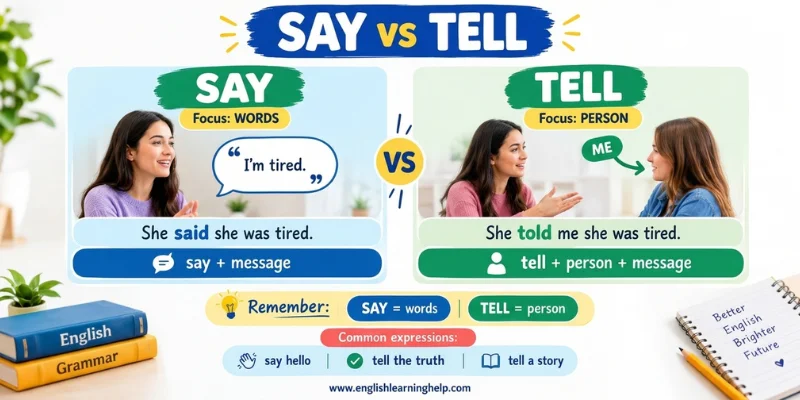
Do you say something or tell someone something?
These two verbs are very common in English, but many learners mix them up. They are also words that are often confused in English, especially when you are learning common communication verbs. The good news is that the main difference is simple:
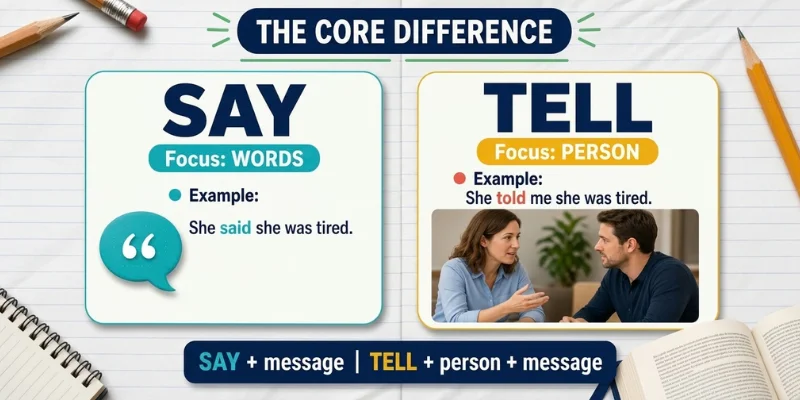
Say = focus on the words or message.
Tell = usually focuses on the person who receives the message.
For example:
She said she was tired.
But:
She told me she was tired.
Both sentences are correct. The sentence pattern is different.
In this guide, you will learn the say vs tell difference, common rules, easy examples, reported speech, useful expressions, common mistakes, and practice exercises.
What Is the Difference Between Say and Tell?
The easiest rule to remember is:
Say something.
Tell someone something.
Look at these examples:
- She said something.
- She told me something.
- He said that he was busy.
- He told us that he was busy.
With say, we often focus on the words or message.
With tell, we often mention the person who receives the information.
Compare
Maria said she was tired.
This tells us what Maria said. It does not name the listener.
Maria told me she was tired.
This tells us what Maria said and who received the information.
Easy memory rule
Think:
Say = words
Tell = person + information
This simple rule will help you in many everyday English sentences.
Say: Meaning, Rules, and Examples
Say means to speak or express words, information, an idea, or a message.
We often use say when we focus on what someone said.
Common patterns with say
say + something
She said hello.
say + that + sentence
He said that he was busy.
say + something + to + person
She said hello to me.
Notice this common mistake:
❌ She said me hello.
The correct sentence is:
✅ She said hello to me.
More examples with say
- I said I was sorry.
- Tom said he would call later.
- Please say that again.
- She said hello to her teacher.
- What did he say?
- They said nothing.
- Please say your name.
Quick tip
When you are mainly talking about the words or message, say is often the right choice.
She said, “I am tired.”
Tell: Meaning, Rules, and Examples
Tell means to give information, a message, or an instruction to someone.
A common pattern is:
tell + person + information
For example:
She told me the truth.
He told us the news.
My teacher told the students to be quiet.
When tell means giving information to someone, we usually put the person directly after tell.
More examples with tell
- Please tell me the answer.
- I told my brother the news.
- She told us that she was busy.
- Can you tell him about the meeting?
- My mother told me to study.
- He told his friend a funny story.
Quick tip
Think:
Tell = person + information
For example:
- tell me
- tell her
- tell us
- tell the teacher
Say vs Tell: Quick Comparison
| Say | Tell |
| Focuses on the words or message | Often focuses on the person receiving the information |
| say something | tell someone something |
| say that… | tell someone that… |
| say something to someone | tell someone something |
| say hello | tell the truth |
| say sorry | tell a lie |
| say a word | tell a story |
Compare these sentences
She said that she was tired.
She told me that she was tired.
Both are correct.
The first focuses on the message.
The second also tells us who received the message.
Said vs Told in Reported Speech
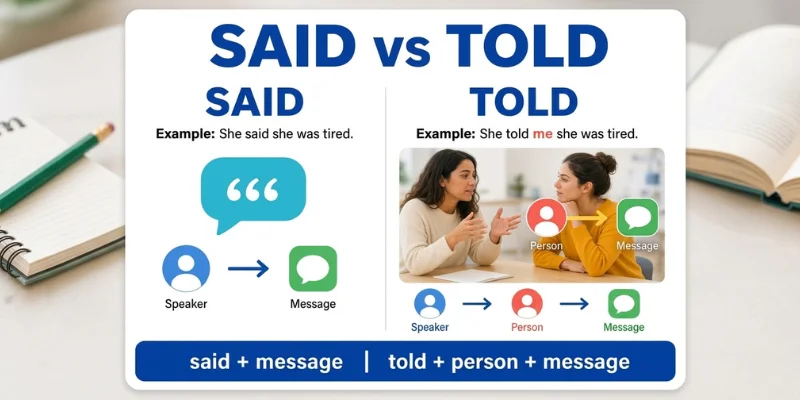
Said is the past form of say.
Told is the past form of tell.
Both are common in reported speech.
Use said when the listener is not named
Jack said that he was tired.
Sarah said she would come later.
They said they were ready.
Use told when you name the person
Jack told me that he was tired.
Sarah told us she would come later.
They told their teacher they were ready.
Compare
❌ She told that she was tired.
✅ She said that she was tired.
Or:
✅ She told me that she was tired.
When tell is followed by a that-clause, we normally include the person who received the information.
Said to vs told
You can say:
She said to me, “I am tired.”
But in reported speech, this is often simpler:
She told me that she was tired.
So remember:
said + message
told + person + message
If you want to build stronger sentence skills, you can also work on how to improve your English writing skills.
Say or Tell the Truth?
The correct common expression is:
tell the truth
Examples:
- Please tell the truth.
- You should always tell the truth.
- She told me the truth.
- He was telling the truth.
We do not normally say:
❌ Please say the truth.
Instead, use:
✅ Please tell the truth.
Say or Tell a Lie?
The usual expression is:
tell a lie
Examples:
- He told a lie.
- She never tells lies.
- Don’t tell a lie.
- I knew he was telling a lie.
So remember:
tell the truth
tell a lie
These are common English expressions.
Other Common Expressions With Say and Tell
Some word combinations sound natural because English speakers commonly use them together.
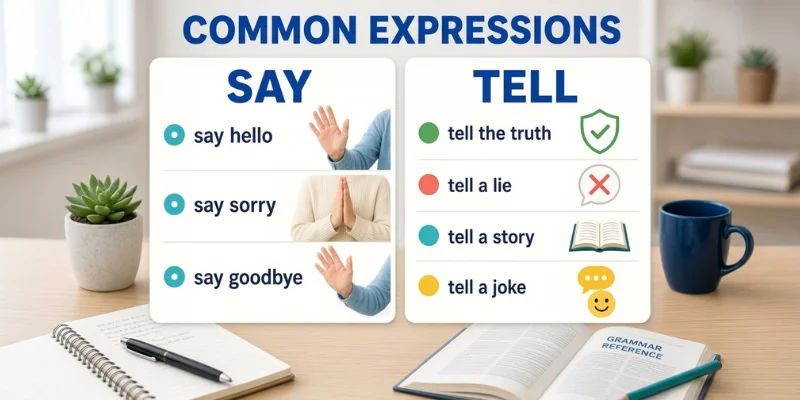
Common expressions with say
- say hello
- say goodbye
- say sorry
- say thank you
- say yes
- say no
- say something
- say nothing
- say a word
- say a prayer
Common expressions with tell
- tell the truth
- tell a lie
- tell a story
- tell a joke
- tell a secret
- tell someone the news
- tell someone your name
- tell the time
- tell the difference
Examples
Please say hello to your family.
She said sorry for being late.
Can you tell me a story?
He told me a secret.
Can you tell the difference between these two words?
These expressions are useful because you can learn them as complete phrases. Cambridge also identifies truth, lies, jokes, news, stories, and secrets as common uses with tell.
Say vs Tell for Commands and Instructions
We commonly use tell to report an instruction or command.
The basic pattern is:
tell + person + to + verb
Examples:
The teacher told us to open our books.
My mother told me to clean my room.
He told her to wait outside.
The doctor told him to rest.
Do not say:
❌ He said me to wait.
Say:
✅ He told me to wait.
With say, we normally use a different structure:
He said that I should wait.
Cambridge notes that tell + person + to + verb is the normal pattern for reporting commands and instructions.
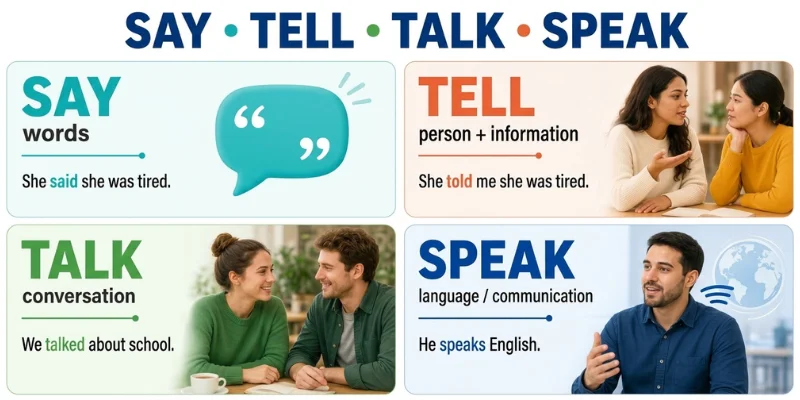
Say vs Tell vs Talk vs Speak
English has several verbs for communication. They are related, but they do not always work in the same way.
| Verb | Main use | Example |
| say | Express words or a message | She said she was tired. |
| tell | Give information to someone | She told me she was tired. |
| talk | Have a conversation | We talked about school. |
| speak | Talk or use a language | He speaks English well. |
Say
What did she say?
Tell
What did she tell you?
Talk
We talked about our plans.
Speak
Can you speak English?
A simple memory trick is:
Say = words
Tell = information to someone
Talk = conversation
Speak = talking or language
Learning these verbs can help you build better English communication skills and speak more clearly in everyday situations.
Who Told You or Who Did Tell You?
Many learners ask about these two questions.
The normal question is:
Who told you?
For example:
“I know what happened.”
“Really? Who told you?”
Here, told is the past form of tell.
What about “Who did tell you?”
Who did tell you? is possible when you want to add extra emphasis or surprise.
For example:
I know you didn’t find out yourself. Who did tell you?
But in normal conversation, use:
Who told you?
What about “Who tell you?”
If you mean the past, this is incorrect:
❌ Who tell you?
Use:
✅ Who told you?
If you mean something that happens regularly, you can say:
Who tells you what to do?
Common Say vs Tell Mistakes
Let’s look at some common mistakes.
Mistake 1
❌ She said me the truth.
✅ She told me the truth.
Mistake 2
❌ He told that he was tired.
✅ He said that he was tired.
Or:
✅ He told me that he was tired.
Mistake 3
❌ She told hello to me.
✅ She said hello to me.
Mistake 4
❌ He said me to wait.
✅ He told me to wait.
Mistake 5
❌ She said a lie.
✅ She told a lie.
Mistake 6
❌ He said me a story.
✅ He told me a story.
These mistakes often happen because learners try to use say and tell in the same sentence pattern. Learning the common patterns is more helpful than trying to translate each sentence word for word.
Say vs Tell Examples in Real Life
At school
The teacher told us to finish our homework.
The teacher said the homework was important.
At home
My mother told me to clean my room.
My brother said he was hungry.
At work
My manager told me about the meeting.
My manager said the meeting would start at ten.
With friends
Sarah said she wanted to watch a movie.
Sarah told me to choose the movie.
These simple examples show how say and tell can work together in real conversations.
They can also help you improve your spoken English because you can practice the sentences aloud.
For more everyday practice, see these simple English sentences for daily use.
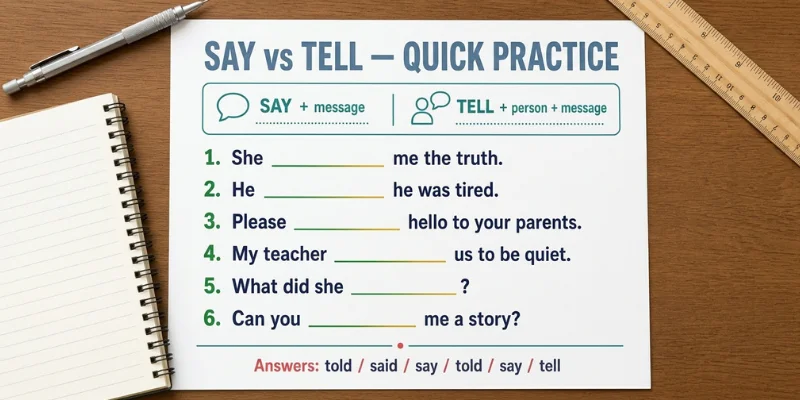
Say vs Tell Exercises
Now it is your turn.
Choose say or tell to complete each sentence.
Exercise 1: Choose the correct verb
- She ___ me that she was tired.
- He ___ that he was busy.
- Please ___ me the truth.
- I ___ hello to my teacher.
- My father ___ me to be careful.
- They ___ they would arrive late.
- Can you ___ me a story?
- What did she ___?
- Who ___ you the news?
- He ___ a lie about what happened.
Exercise 2: Choose the correct form
- She said / told me that she was leaving.
- He said / told he was sick.
- My teacher said / told us to be quiet.
- Please say / tell hello to your parents.
- Did she say / tell you the truth?
Answers
- told
- said
- tell
- said
- told
- said
- tell
- say
- told
- told
- told
- said
- told
- say
- tell
Quick Check
Remember these four patterns:
say something
say something to someone
tell someone something
tell someone to do something
These patterns can make say vs tell much easier to remember.
A Short Story With Say and Tell
Read this short story.
Ali said he was late for school.
He told his mother that he could not find his bag.
His mother told him to check his room.
Ali said he had already checked it.
His mother said the bag was under the table.
Ali found it and said, “Thank you!”
Notice how both verbs appear naturally in the same conversation.
Say tells us the words or message.
Tell often shows the person who receives the message.
A Simple Memory Trick
When you are not sure which word to use, ask yourself one question.
Am I focusing on the words?
Use say.
She said she was happy.
Am I naming the person who receives the information?
Use tell.
She told me she was happy.
Then remember these common expressions:
say hello
say sorry
tell the truth
tell a lie
tell a story
tell a joke
For instructions, remember:
tell someone to do something
Conclusion
The difference between say and tell becomes much easier when you learn their sentence patterns. Use say when you focus on the words or message:
She said she was tired.
Use tell when you give information to a person:
She told me she was tired.
Also remember these common expressions:
tell the truth
tell a lie
tell a story
tell a joke
For instructions, use:
tell someone to do something
You do not need to memorize every rule at once. Start with the basic patterns, practice a few sentences each day, and listen for say and tell when people speak English. With regular practice, these two small verbs will become much easier to use naturally.
FAQ’s
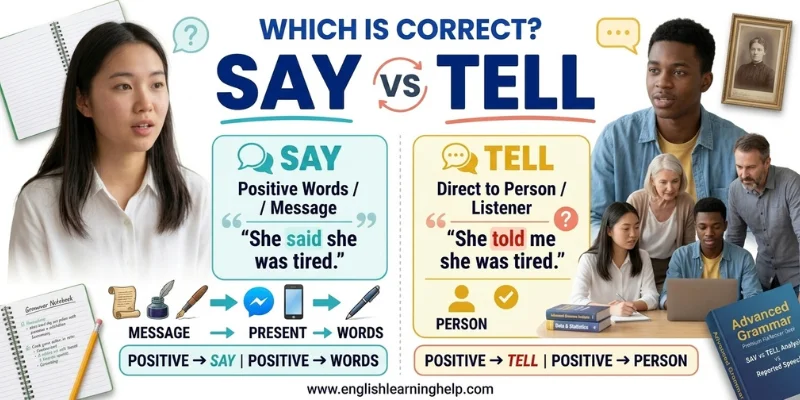
Say usually focuses on the words or message. Tell usually focuses on the person receiving the information. For example, we say “She said she was tired,” but “She told me she was tired.”
Said is the past form of say, while told is the past form of tell. Use said to report a message, and usually use told + person when you name the person who received the information.
Yes. “ Who told you?” is the normal question when you want to know who gave you the information.
Yes, but it usually adds emphasis or surprise. In normal conversation, Who told you? sounds more natural.
Yes. We can use tell without naming a person in common expressions such as:
tell the truth
tell a lie
tell a story
tell a joke
So the rule “tell always needs a person” is too broad. A better rule is that tell usually takes a person directly when it means giving information to that person.






- Be Respectful
- Stay Relevant
- Stay Positive
- True Feedback
- Encourage Discussion
- Avoid Spamming
- No Fake News
- Don't Copy-Paste
- No Personal Attacks
- Be Respectful
- Stay Relevant
- Stay Positive
- True Feedback
- Encourage Discussion
- Avoid Spamming
- No Fake News
- Don't Copy-Paste
- No Personal Attacks
