How to Say No Politely: Easy English Phrases & Examples
Published: 3 Oct 2026
Saying no can feel difficult.
You may worry that the other person will feel bad. You may also think that “no” sounds rude.
But saying no does not have to sound cold or unfriendly.
You can say no kindly, clearly, and respectfully. You only need the right words.
In this guide, you will learn how to say no politely in English. You will find easy phrases and examples for friends, school, work, emails, texts, invitations, offers, and everyday situations.
Let’s make saying “no” simple.
What Is the Easiest Way to Say No Politely?
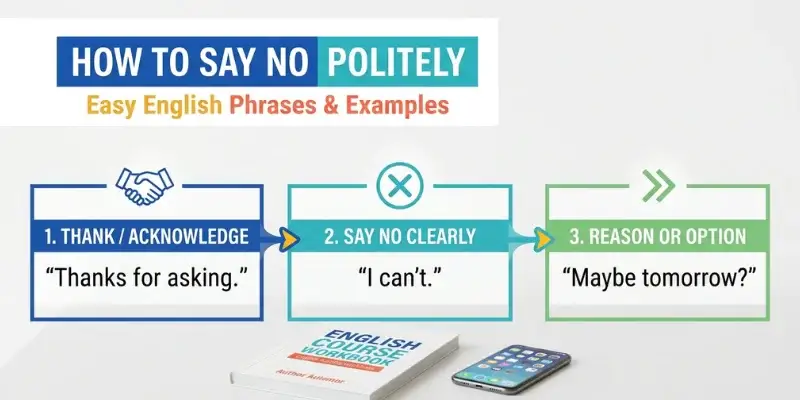
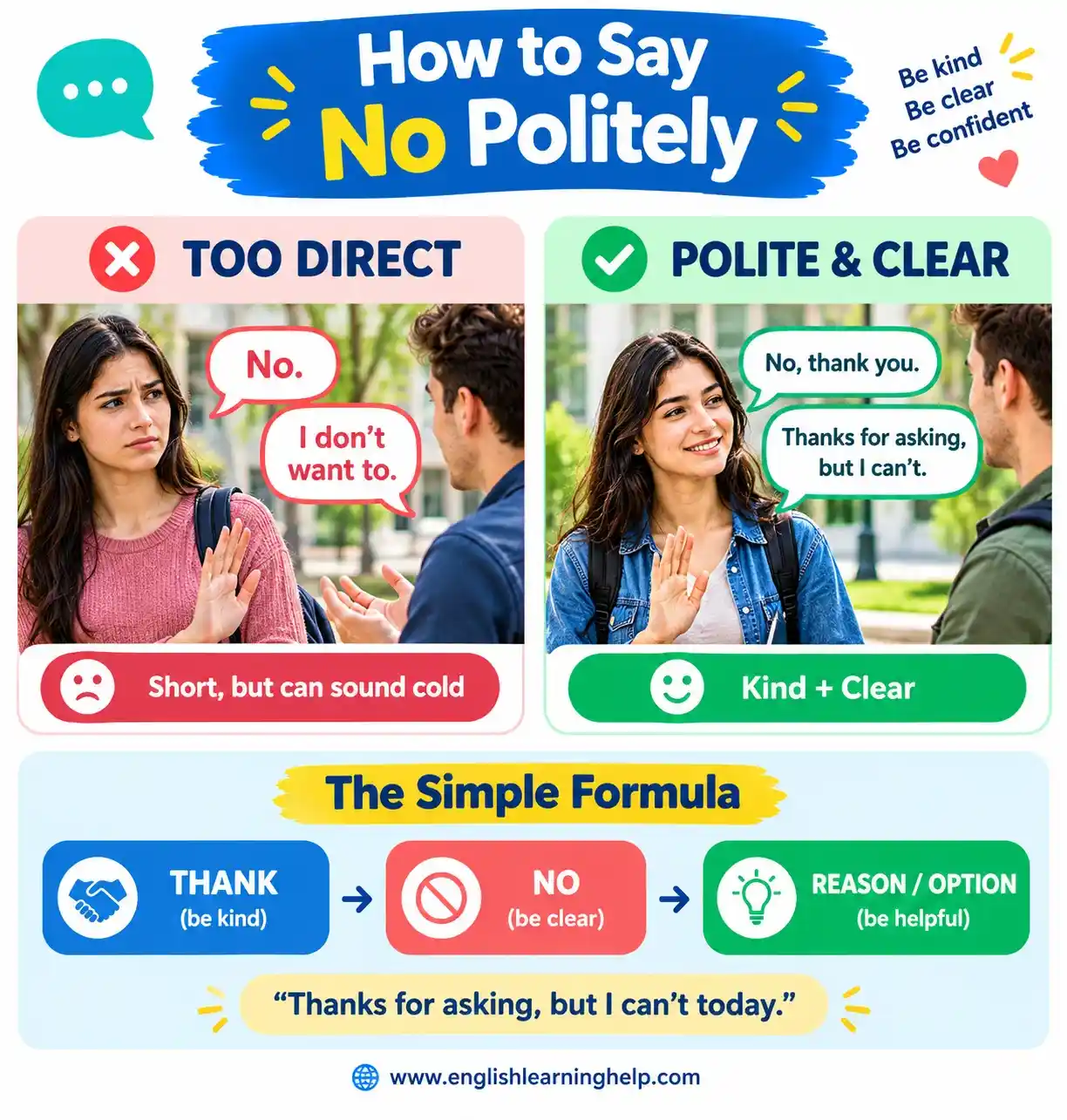
The easiest way is to use three simple steps:
Thank or acknowledge → Say no clearly → Give a short reason or alternative
For example:
“Thanks for asking, but I can’t this time.”
Or:
“I’d love to help, but I’m busy today. Maybe tomorrow?”
You do not always need a long explanation.
A short, kind answer is often enough.
Quick Answer
If you want one simple phrase to remember, use:
“Thank you, but I’ll have to say no this time.”
It is polite, clear, and useful in many situations.
Why Is It Important to Say No Politely?
Sometimes people say yes because they are afraid to say no.
They may be too busy. They may not like the idea. They may feel uncomfortable. They may want to spend their time somewhere else.
You do not have to say yes to everything.
A polite “no” can help you:
- protect your time
- avoid unnecessary stress
- set healthy boundaries
- stay honest with others
- communicate with confidence
- keep relationships respectful
Saying no does not make you a bad person.
The important thing is how you say it.
A clear and kind refusal can be much better than saying yes when you really do not want to.
30 Polite Ways to Say No in English
Here are useful phrases you can use in different situations.
Simple and Friendly Ways
These phrases work well in everyday conversations.
- “I’m sorry, but I can’t.”
- “No, thank you.”
- “Thanks, but I’ll pass.”
- “I’d love to, but I can’t.”
- “Maybe another time.”
- “Not this time, but thank you.”
- “I’d rather not, thanks.”
- “I can’t right now, sorry.”
- “That won’t work for me.”
- “I wish I could, but I can’t.”
Polite Ways With a Short Reason
Sometimes a short reason makes your answer feel more natural.
- “I’m sorry, but I’m busy today.”
- “I’d love to help, but I have other plans.”
- “Thanks for asking, but I have too much work right now.”
- “I appreciate the offer, but I’m not available.”
- “I can’t join you because I already have plans.”
- “I wish I could help, but I don’t have enough time.”
- “I’m afraid I can’t make it today.”
- “I’m focusing on another task right now.”
Professional Ways to Say No
Use these phrases at work, in meetings, or in professional messages.
- “Thank you for asking, but I won’t be able to.”
- “I appreciate the offer, but I’ll have to decline.”
- “Unfortunately, I’m not available at that time.”
- “I’m afraid I won’t be able to take this on right now.”
- “That’s not possible for me at the moment.”
- “I’m unable to commit to that right now.”
- “I don’t think I can take this on at the moment.”
Say No and Offer Another Option
An alternative can help when you still want to be helpful.
- “I can’t today, but I can help tomorrow.”
- “I can’t join the meeting, but I can read the notes later.”
- “I’m not available this week, but I may have time next week.”
- “I can’t do that, but I can help with something else.”
- “I can’t help right now, but let’s find another solution.”
You do not need to memorize all 30 phrases. Start with two or three that feel natural to you.
How to Say No Without Being Rude
A polite “no” does not need complicated English.
Follow this simple pattern:
Be kind → Be clear → Keep it short
For example:
“Thanks for inviting me, but I can’t come tonight.”
This sentence is short, but it does three things:
- “Thanks for inviting me” shows kindness.
- “I can’t come” gives a clear answer.
- “Tonight” gives a simple reason based on time.
Polite Does Not Mean Vague
This is important.
Some learners try to avoid saying “no” because they do not want to sound rude.
They may say:
“Maybe sometime.”
But if you really mean no, this can confuse the other person.
Instead, say:
“Thank you, but I don’t think I can.”
Or:
“Thanks for asking, but I’ll have to decline.”
You can be kind and clear at the same time.
Do You Need to Give a Reason?
No.
You do not always need a long excuse.
Sometimes you can simply say:
“No, thank you.”
Or:
“I’m sorry, but I can’t.”
That is enough.
If you want to give a reason, keep it short.
Too Much Information
“I can’t come because I have to finish my homework, then I need to help my brother, and after that I have to go to the shop…”
Simple and Natural
“Sorry, I can’t come. I have some work to finish.”
Short answers often sound more natural.
You should not feel that you must create a big excuse every time you say no.
How to Say No Politely to a Friend
Friends may ask you to go somewhere, help with something, lend something, or join an activity.
You can stay friendly while saying no.
Example 1: An Invitation
Friend:
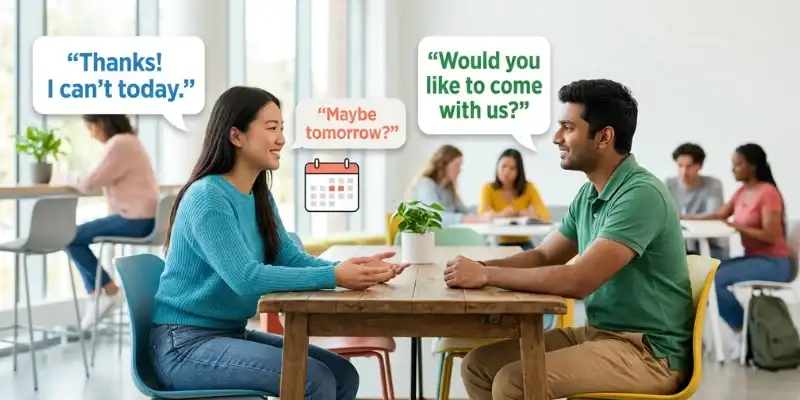
“Do you want to come to the park with us?”
You:
“Thanks for inviting me, but I can’t today. Maybe tomorrow?”
Example 2: A Favor
Friend:
“Can you help me with this project tonight?”
You:
“I’d love to help, but I have homework to finish.”
Example 3: When You Need Rest
“Thanks for asking, but I’m tired today. I think I’ll stay home.”
Example 4: When You Do Not Want to Join
“That sounds fun, but I’ll sit this one out. Have fun!”
Notice that these answers do not sound angry.
They say no while keeping the friendship warm.
How to Say No Politely at Work
Work can make saying no harder.
You may want to help your manager or coworker, but you may already have important work to finish.
In this situation, stay respectful and explain your limit clearly.
When a Coworker Asks for Help
“I’d like to help, but I’m working on another task right now.”
When You Have Too Much Work
“I’m sorry, but I don’t have enough time to take this on today.”
When Your Manager Gives You Extra Work
“I’m happy to help, but I’m already working on two tasks. Which one should I finish first?”
This is useful because you do not simply say no.
You explain your workload and ask for a clear priority.
When You Cannot Attend a Meeting
“Thanks for inviting me, but I’m not available at that time. Could you send me the meeting notes?”
This sounds professional and helpful.
For more workplace English, you can also learn from our Business English guide.

How to Say No Politely and Professionally
Professional English needs a calm and respectful tone.
Avoid very casual phrases when you talk to a manager, client, teacher, or business partner.
For example, avoid:
“Nah, I can’t.”
Instead, try:
“Thank you for asking, but I won’t be able to.”
You can also say:
“I appreciate the offer, but I’ll have to decline.”
Or:
“Unfortunately, I’m not able to take this on at the moment.”
Keep your message clear.
You do not need difficult words to sound professional.
Clear and respectful English is often the best choice.
How to Say No Politely in Business
Business situations may involve clients, customers, partners, meetings, deadlines, or offers.
You need to protect your time while keeping the conversation positive.
Saying No to a Client Request
“Thank you for the request. Unfortunately, we cannot complete it by Friday. We can deliver it on Monday.”
Saying No to a Business Idea
“I appreciate the idea, but I don’t think it is the right option for us at this time.”
Saying No to Extra Work
“I’m afraid I cannot take on another project this week. I can review it next week.”
Saying No to a Meeting
“Thank you for the invitation. I’m not available at that time. Could we meet tomorrow instead?”
A professional refusal should not sound angry.
It should sound calm, clear, and respectful.
How to Say No Politely in an Email
Email needs extra care because the reader cannot hear your voice.
A short sentence can sometimes sound colder in writing than it would in a conversation.
Start with appreciation.
Then give your answer.
Add a short reason if needed.
Finish politely.
Simple Email Example
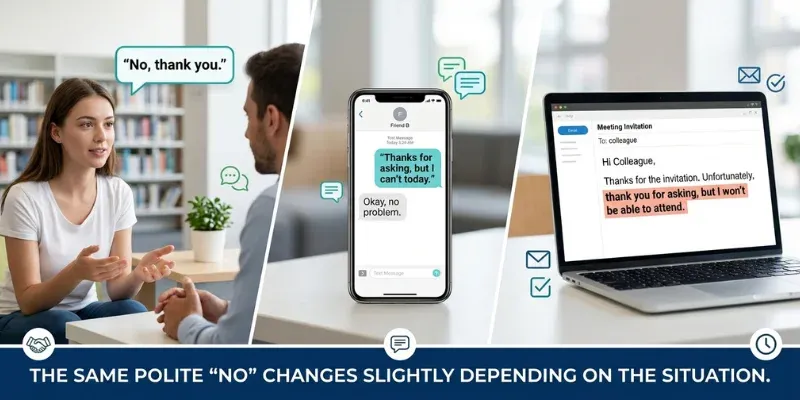
Thank you for the invitation. I appreciate you thinking of me, but I won’t be able to attend the event. I hope it goes well.
Work Email Example
Thank you for asking me to join the project. I appreciate the opportunity, but I’m not able to take on another project right now. I hope we can work together on a future project.
Saying No to a Meeting by Email
Thank you for the invitation. Unfortunately, I’m not available at that time. Could we arrange another time next week?
Keep professional emails simple.
You can also improve your English writing skills to make your emails clearer and more natural.
How to Say No Politely in a Text
Text messages are usually shorter and more relaxed.
You can use simple phrases.
To a Friend
“Thanks for asking! I can’t today, sorry. Maybe tomorrow?”
When You Are Busy
“Sorry, I’m busy right now. I’ll message you later.”
When You Do Not Want to Go
“Thanks for inviting me, but I’ll pass this time. Have fun!”
Professional Text
“Thank you for the message. I’m not available today, but I can speak with you tomorrow.”
Avoid sending only:
“No.”
The word may be correct, but it can sound cold.
A few extra words can make your message much friendlier.
How to Say No Politely to a Guy
If someone asks you to go out, meet, or start a relationship and you do not want to, you can be kind but clear.
You do not need to give a long explanation.
Try:
“Thank you for asking, but I’m not interested.”
Or:
“I appreciate your offer, but I don’t feel the same way.”
You can also say:
“You seem like a nice person, but I don’t want to take this further.”
If someone keeps asking after you have clearly said no, you can be firmer:
“I’ve already said no. Please respect my decision.”
Being polite does not mean you must change your answer.
How to Say No Politely to a Proposal or Offer
The word proposal can mean different things.
It may mean a business proposal, a personal proposal, or another type of offer.
The best response depends on the situation.
Business Proposal
“Thank you for the proposal. We appreciate the offer, but we have decided not to move forward at this time.”
Personal Proposal
“Thank you for being honest with me, but I’m sorry, I don’t feel the same way.”
General Offer
“That’s very kind of you, but I’ll have to decline.”
The key is to give a clear answer without being unkind.
How to Say No to a Job Offer
Sometimes you may receive a job offer but decide not to accept it.
You can say no without burning the relationship.
Simple Example
“Thank you very much for the offer. I appreciate the opportunity, but I have decided not to accept the position.”
If You Want to Stay in Touch
“Thank you for the offer. After careful consideration, I have decided not to accept it at this time. I appreciate your time and hope we can stay in touch.”
This type of message sounds professional and respectful.
How to Say No to a Money Request
Money can be a sensitive topic.
If someone asks you for money and you cannot or do not want to lend it, keep your answer simple.
You can say:
“I’m sorry, but I’m not able to lend money right now.”
Or:
“I wish I could help, but I can’t give you money at the moment.”
You do not need to share private details about your money.
If you want to help in another way, you can say:
“I can’t lend you money, but I can help you look for another solution.”
How to Say No When You Are Too Busy
Being busy is one of the most common reasons people say no.
Do not promise something if you know you cannot do it.
Try:
“I’d love to help, but I’m too busy this week.”
Or:
“I’m sorry, but I already have several tasks to finish.”
You can also offer another time:
“I can’t help today, but I may have time tomorrow.”
This is honest and helpful.
How to Say No and Offer an Alternative
Sometimes you cannot accept the request, but you can suggest another option.
This can make your answer more useful.
Example 1
“I can’t meet today, but I can meet tomorrow.”
Example 2
“I can’t help with the whole project, but I can check one part.”
Example 3
“I can’t attend the meeting, but I can read the notes later.”
“I can’t do it this week, but I can help next week.”
Example 4
Only offer an alternative if you can really do it.
Do not promise something just because you feel guilty.
How to Say No When You Do Not Want to Give a Reason
Sometimes you may not want to explain yourself.
That is okay.
You can say:
“No, thank you. I’d rather not.”
Or:
“Thanks for asking, but I’m going to pass.”
Or:
“I appreciate the offer, but I’ll decline.”
These phrases are polite without giving personal details.
How to Say No When You Are Not Ready to Decide
Sometimes you do not want to say yes or no immediately.
In that case, do not pretend that your answer is no.
Ask for time.
You can say:
“Let me think about it and get back to you.”
Or:
“I need some time to think about this.”
Or:
“Can I give you my answer tomorrow?”
This is different from saying no.
You are asking for more time before making a decision.
How to Say No When Someone Keeps Asking
Sometimes a person may ask again and again.
You can stay polite, but you should make your answer clear.
First, try:
“Thanks for asking, but my answer is still no.”
If they continue:
“I understand, but I’m not comfortable with that.”
If they still do not stop:
“I’ve already said no. Please respect my decision.”
You do not need to create a new reason every time.
A clear answer is enough.
Formal vs. Informal Ways to Say No
The situation changes the words you should use.
| Situation | More Formal | More Informal |
| Friend | “I’m sorry, but I can’t.” | “Sorry, I can’t!” |
| Coworker | “I’m not available at that time.” | “I can’t make it then.” |
| Manager | “I’m afraid I won’t be able to take this on.” | — |
| Business | “I appreciate the offer, but I’ll have to decline.” | — |
| Text to friend | — | “Thanks, but I’ll pass!” |
| New person | “Thank you, but I’m not interested.” | “Thanks, but no.” |
The goal is not to use the most formal English.
The goal is to use the right English for the situation. For more examples, see our guide to Formal vs. Informal English.
Tone Matters When You Say No
Your words are important, but your tone also matters.
The same sentence can sound friendly or angry depending on how you say it.
Compare:
“I can’t.”
with:
“I’m sorry, but I can’t this time.”
The second sentence sounds warmer.
When speaking, try to:
- use a calm voice
- speak clearly
- avoid shouting
- use a friendly expression when appropriate
- avoid sounding angry
- look at the person when the situation feels comfortable
In a text or email, use polite words because the reader cannot hear your voice.
Common Mistakes When Saying No
English learners often make a few simple mistakes.
1. Saying Only “No”
“No.”
This is clear, but it can sound too strong in some situations.
Try:
“No, thank you.”
2. Giving a Very Long Excuse
You do not need to explain everything.
Instead of a long story, say:
“Sorry, I’m busy today.”
3. Being Too Vague
Avoid:
“Maybe.”
If you already know that you do not want to do something.
Try:
“Thanks, but I’ll have to decline.”
4. Saying “I’d Love to, But No”
This sentence sounds unnatural.
Use:
“I’d love to, but I can’t.”
5. Using Very Formal Words With Friends
You probably do not need to say:
“I regret that I must decline.”
to your best friend.
Simply say:
“Sorry, I can’t today.”
6. Saying Yes When You Mean No
Do not say yes just because you feel nervous.
A polite no is better than an unhappy yes.
Real-Life Examples of Saying No Politely
Let’s look at some everyday situations.
| Situation | Polite Response |
| A friend invites you out | “Thanks for inviting me, but I can’t come today.” |
| A coworker asks for help | “I’d like to help, but I’m busy with another task.” |
| Someone offers you food | “Thank you, but I’ll pass this time.” |
| Your boss gives you extra work | “I can help, but I need to finish my current task first.” |
| A classmate asks for homework answers | “I can’t give you my answers, but I can explain the question.” |
| Someone invites you to an event | “Thanks for thinking of me, but I won’t be able to attend.” |
| Someone asks for money | “I’m sorry, but I can’t lend money right now.” |
| Someone asks you to volunteer | “It sounds great, but I’m not available this time.” |
| Someone asks you to do something uncomfortable | “I appreciate the offer, but I’d rather not.” |
| A coworker asks about your weekend | “I’d like to help, but I need to keep this weekend free.” |
These examples show a simple idea: be kind, but make your answer clear.
A Simple Formula to Remember
If you forget everything else, remember this:
KINDNESS → NO → REASON → ALTERNATIVE
You do not always need all four parts.
1. Kindness
“Thanks for asking.”
2. No
“I can’t.”
3. Reason
“I’m busy today.”
4. Alternative
“Maybe I can help tomorrow.”
Put them together:
“Thanks for asking, but I can’t help today. I’m busy with my homework. Maybe I can help tomorrow.”
This formula works in many situations.
Practice: How to Say No Politely
Now it is your turn.
Choose the best answer for each situation.
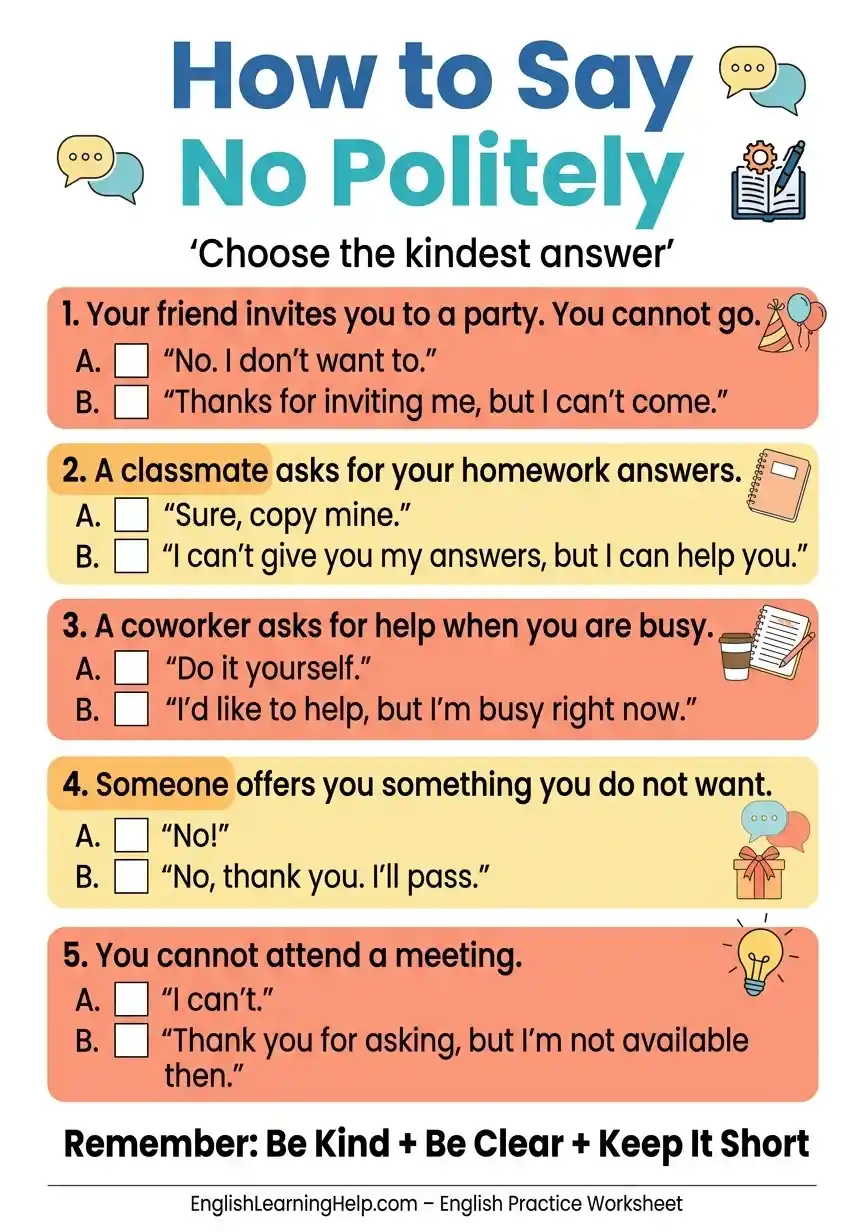
1. Your friend invites you to a party, but you cannot go.
A. “No. I don’t want to.”
B. “Thanks for inviting me, but I can’t come. I hope you have fun!”
Answer: B
2. Your classmate asks for your homework answers.
A. “Sure, copy everything.”
B. “I can’t give you my answers, but I can help you understand the questions.”
Answer: B
3. Your coworker asks you to do another task, but you are already busy.
A. “I have too much work. Do it yourself.”
B. “I’d like to help, but I’m busy with another task right now.”
Answer: B
4. Someone offers you something you do not want.
A. “No!”
B. “No, thank you. I’ll pass this time.”
Answer: B
5. Someone asks you to attend a meeting when you are not available.
A. “I can’t.”
B. “Thank you for the invitation, but I’m not available at that time.”
Answer: B
Practice Challenge
Write one polite “no” for each situation:
- Your friend wants to borrow your favorite book.
- Your teacher asks you to join an activity, but you are busy.
- Your coworker asks you to work this weekend.
- Someone invites you to an event.
- Someone asks you for money.
Try to use this pattern:
Kind words + clear no + short reason
How to Practice Saying No in English
You can improve quickly with simple practice.
Practice in Front of a Mirror
Say:
“I’m sorry, but I can’t.”
Then try:
“Thanks for asking, but I’ll have to pass.”
This helps you feel more comfortable.
Practice With a Friend
Take turns.
One person asks for something.
The other person says no politely.
For example:
A: “Can you help me tonight?”
B: “I’d love to, but I’m busy tonight.”
Then change the situation.
Write Three Sentences Every Day
Write one sentence for:
- a friend
- school
- work
For example:
“Sorry, I can’t come today.”
“Thank you, but I’ll pass.”
“I appreciate the offer, but I’m not available.”
A little practice can make these phrases easier to remember.
Improve Your English Communication
Learning how to say no is only one part of good English communication.
You also need to know how to start conversations, ask questions, answer clearly, and end conversations politely.
If you want to improve your everyday communication, explore our guide to English Communication Skills.
You can also learn useful phrases for daily speaking with our guide to simple English sentences for daily use.
And when a conversation needs to end, our guide on how to end a conversation politely can help you leave in a friendly and natural way.
These skills work together.
When you know how to start, continue, and end a conversation, you can communicate with more confidence.
Conclusion
Learning how to say no politely can make everyday English much easier. You do not need difficult words. You do not need a long excuse. You only need to be kind, clear, and honest.
Remember the simple pattern:
Kindness → No → Reason → Alternative
You can say:
“Thanks for asking, but I can’t this time.”
You can also say:
“I’d love to help, but I’m busy today. Maybe tomorrow?”
Choose the phrase that fits the person and the situation. Use casual English with close friends and more professional English at work.
Most importantly, do not be afraid of the word no. A polite no can protect your time, show your boundaries, and help you communicate with confidence.
Start with one phrase today. Practice it aloud. Then try another one tomorrow. The more you practice, the more natural polite English will feel.
FAQs
Start with a kind phrase such as “Thanks for asking” or “I appreciate the offer.” Then give a clear no and a short reason if you need one. For example, “Thanks for asking, but I can’t today.”
A simple phrase is “No, thank you.” You can also say, “Thanks for asking, but I’ll have to pass.” Both are short, clear, and polite.
You can say, “No, thank you,” “I’d rather not,” or “Thanks, but I’ll pass.” You do not always need to explain your personal reasons.
Keep your tone warm and friendly. Try, “Thanks for inviting me, but I can’t come today. Maybe another time!”
Use clear and professional language. For example, “I’d like to help, but I’m already working on another task. Can we discuss it later?”
Start with appreciation, give your answer, and add a short reason or alternative when useful. For example, “Thank you for the invitation, but I won’t be able to attend.”
Keep the message short but friendly. You can say, “Thanks for asking! I can’t today, sorry. Maybe tomorrow?”
Thank the person for the offer and give a clear answer. For example, “Thank you for the proposal. I appreciate it, but I have decided not to move forward.”
Be kind but clear. You can say, “Thank you for asking, but I’m not interested.” If the person keeps asking, you can firmly ask them to respect your decision.
Keep your answer simple. Try, “I’m sorry, but I’m not able to lend money right now.” You do not need to share private financial details.
No. Saying no is not automatically rude. Your tone and choice of words matter. A clear and respectful refusal can be much better than saying yes when you do not want to.
No. An alternative is useful when you genuinely want to help in another way. You do not need to offer one every time.
Practice short phrases aloud and use them in simple role-play situations. Start with phrases such as “No, thank you,” “I’m sorry, but I can’t,” and “Thanks for asking, but I’ll pass.”
A direct no gives a short and firm answer. A polite no adds friendly or respectful words, such as “thank you,” “sorry,” or “I appreciate the offer.” The best choice depends on the situation.






- Be Respectful
- Stay Relevant
- Stay Positive
- True Feedback
- Encourage Discussion
- Avoid Spamming
- No Fake News
- Don't Copy-Paste
- No Personal Attacks
- Be Respectful
- Stay Relevant
- Stay Positive
- True Feedback
- Encourage Discussion
- Avoid Spamming
- No Fake News
- Don't Copy-Paste
- No Personal Attacks
