What Is the Longest English Word? (189,819 Letters Explained)
Published: 28 Oct 2026
The longest word in English may seem like an easy question to answer, but it’s more complicated than you might think. There isn’t one clear answer because it depends on what we count as a word and which words we include.
In this guide, you will learn all three answers. You will also learn what each word means, how to say it, and how to spell it. We will also look at fun word records and a classic riddle. Let’s start.
| Quick Answer: |
|---|
|
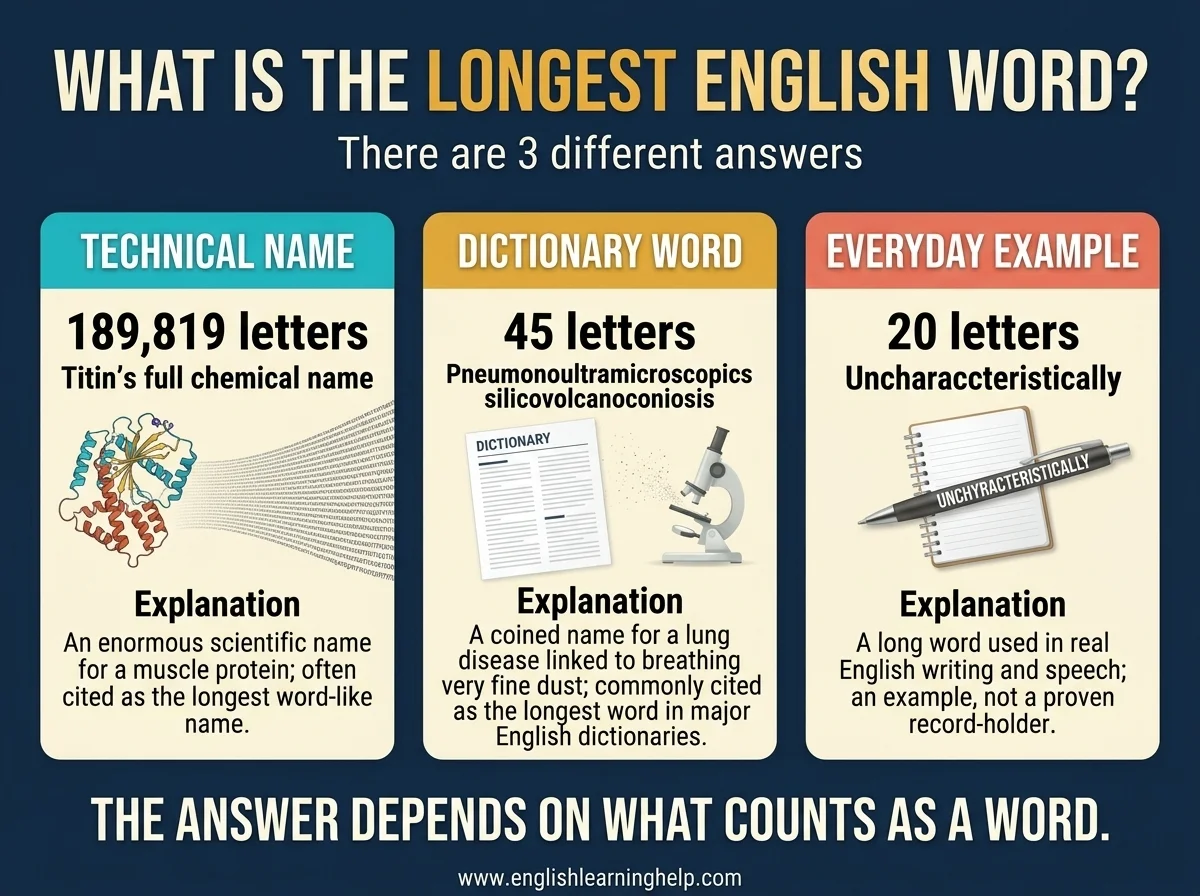
There are three answers. The longest technical word is the chemical name of titin, often cited as having 189,819 letters. The longest word in major dictionaries is pneumonoultramicroscopicsilicovolcanoconiosis, with 45 letters. An example of a long word people really use is uncharacteristically, which has 20 letters. Read on to see why. |
The Longest Word in English: It Depends on What You Count
Most people want one word as the answer. But English has more than one “longest word.” Which one wins depends on what you call a word.
Why There Is No Single Answer
A word is a group of letters that has a meaning and is used by people. That sounds simple. But it gets tricky when you ask these questions:
- Does the word need to be in a dictionary?
- Do people have to use it in daily life?
- Can a scientist build a word by joining many small parts?
If you say yes to the dictionary rule, you get one answer. If you allow science names, you get a very different answer. That is why we have three winners.
The Three Types of Longest Word
| Type | Word | Letters |
| Technical (science name) | Titin (chemical name) | 189,819 |
| Dictionary | Pneumonoultramicroscopicsilicovolcanoconiosis | 45 |
| Everyday use (example) | Uncharacteristically | 20 |
Think of it like a race. Each type has its own track and its own champion.
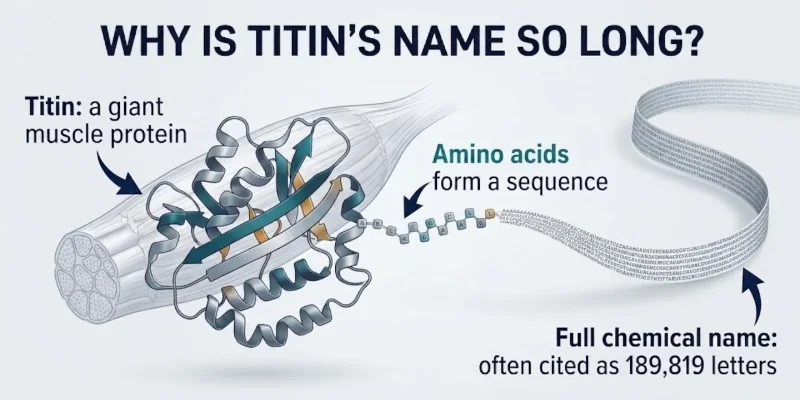
The Titin Chemical Name: The 189,819-Letter Claim
If we count every possible word, the winner is the full chemical name of titin. It is often cited as having 189,819 letters. Some people round it to “190,000 letters.”
What Is Titin?
Titin is a very big protein. It lives in your muscles. It works like a tiny spring. It helps your muscles stretch and snap back.
Why Is Its Chemical Name So Long?
Proteins are made of small blocks called amino acids. Titin has more than 30,000 of them. A chemical name can list every block, one by one. When a protein has this many blocks, the name becomes huge.
How the Name Is Built
The name is made by joining the names of the amino acids in order. Each amino acid name gets a special ending. For example:
- methionyl
- threonyl
- glutaminyl
The name starts with methionyl. It ends with isoleucine. In between are thousands of parts like these, all joined together with no spaces.
Is It Really an English Word?
Many word experts say no. Dictionary makers, called lexicographers, do not count it. Here is why:
- It is a chemical formula written as a word, not a word people speak.
- No one uses it in a normal sentence.
- It is not listed in dictionaries.
So titin is the longest “word” on paper. But it is not the longest word in the dictionary.
How Long Would It Take to Say It?
Reading it out loud would take roughly three to three and a half hours. The exact time depends on how fast you speak. That is longer than most movies. Some people have made videos of this, but you need a lot of patience to watch them.
What Is the Longest Word in the English Dictionary?
Now let’s look at real dictionary words. Here, the champion is much shorter.
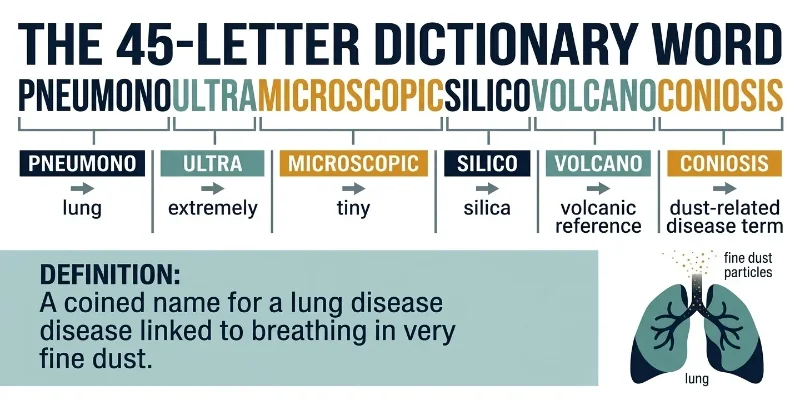
Pneumonoultramicroscopicsilicovolcanoconiosis: Meaning and Origin
This word has 45 letters. It is the longest word in major English dictionaries.
Meaning: Dictionaries describe it as a lung disease caused by breathing in very fine ash and sand dust. In real medical use, doctors usually say silicosis.
Origin: This is a coined word. That means someone made it up on purpose. Everett M. Smith, the president of the National Puzzlers’ League, created it in 1935. He wanted a very long word that sounded scientific. The Oxford English Dictionary itself calls it an artificial long word. So it is famous for its length, not as a common medical word.
You can break the word into small parts to see its meaning:
- pneumono = lung
- ultra = very
- microscopic = so tiny you need a microscope
- silico = silica
- volcano = volcano
- coniosis = a disease caused by dust
Floccinaucinihilipilification: The Longest Non-Technical Word
This word has 29 letters. It is not a medical or scientific word. It is a plain word that people can use in a sentence.
Meaning: The act of thinking that something has no value.
Example: “His floccinaucinihilipilification of the gift made her sad.”
The word is built from four old Latin words. All four mean “little” or “worthless.” That is why it is so long.
Other Long Words in the Dictionary
- Pseudopseudohypoparathyroidism (30 letters): a rare health condition that looks like another condition but is not the same.
- Antidisestablishmentarianism (28 letters): a 19th-century idea. It was against taking away the Church of England’s special status.
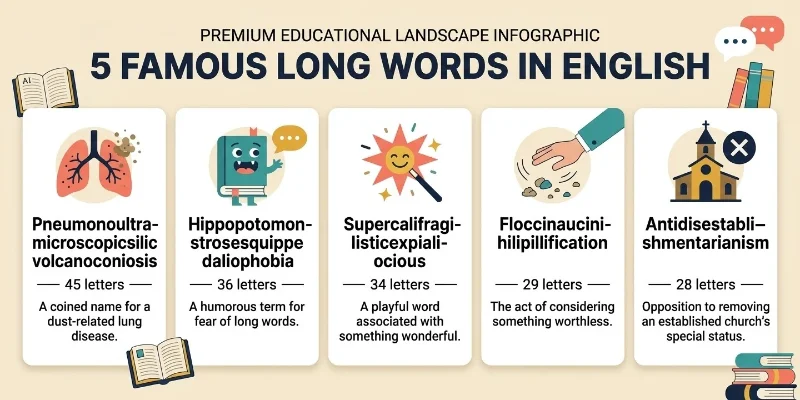
10 Famous Long Words in English: Spelling, Length and Meaning
Here are 10 famous long words in English, from the longest to the shortest. They are different types of words, so this is not one strict ranking. How we chose them: we picked well-known long words from four groups (technical, dictionary, literary, and fun). Then we ordered them by letter count. Experts do not agree on what counts as a word, so other lists may differ a little.
| Rank | Word | Letters | Meaning | Category |
| 1 | Titin (chemical name) | 189,819 | Full name of a muscle protein | Technical |
| 2 | Tryptophan synthase protein name | 1,909 | Full name of a bacterial protein | Technical |
| 3 | Aristophanes’ dish name | 183 (in English letters) | A made-up food dish | Literature |
| 4 | Pneumonoultramicroscopicsilicovolcanoconiosis | 45 | A made-up word for a dust-related lung disease | Dictionary |
| 5 | Hippopotomonstrosesquippedaliophobia | 36 | Fear of long words | Humor |
| 6 | Supercalifragilisticexpialidocious | 34 | A made-up word meaning wonderful | Fun |
| 7 | Pseudopseudohypoparathyroidism | 30 | A rare health condition | Medical |
| 8 | Floccinaucinihilipilification | 29 | Thinking something is worthless | Dictionary |
| 9 | Antidisestablishmentarianism | 28 | Opposing the end of a church’s special status | Dictionary |
| 10 | Honorificabilitudinitatibus | 27 | Honorableness | Literature |
So if someone asks for the 3rd longest word in English or the 10 longest words in English, this table is a good place to start. Spellings can differ between sources. For example, some write hippopotomonstrosesquipedaliophobia with one fewer “p.” The table uses the 36-letter spelling.
Long English Words in History, Literature and Popular Culture
Long words are not new. People have loved them for hundreds of years.
The First Long Word: Aristophanes’ 183-Letter Dish Name
The ancient Greek writer Aristophanes made up a huge word for a made-up food dish. It appeared in one of his plays more than 2,400 years ago. In Greek, it has 171 letters. When we write it with English letters, it is 183 letters long.
It is a mix of many food names, like fish, birds, and honey, all squeezed into one word. It was a joke, and it is one of the oldest long words we know. In 1990, Guinness World Records listed it as the longest word to appear in literature.
The Longest Word in Shakespeare
The longest word in Shakespeare’s works is honorificabilitudinitatibus. It has 27 letters. It appears in the play Love’s Labour’s Lost. It means “the state of being honored.” It is a funny, fancy word that a character uses to show off.
Is Supercalifragilisticexpialidocious the Longest Word?
No. It has 34 letters. That is long, but not the longest. Here is why it does not win:
- It is a made-up word from a movie song, not a standard dictionary word.
- Pneumonoultramicroscopicsilicovolcanoconiosis has 45 letters, so it is longer.
- Titin is far, far longer.
Still, it is the most famous long word. Many children know it. It is just for fun, and it means something like “wonderful.”
Long English Words Used in Everyday Language
Most people never say a 45-letter word. So what is a long word that people really use?
Uncharacteristically (20 Letters)
This word is common in real writing and speech. It is often given as an example of a long word that people really use. No single study proves it is the longest, so think of it as an example, not a record. It has 20 letters.
Meaning: In a way that is not normal for someone or something.
Example: “He was uncharacteristically quiet at dinner.”
Counterrevolutionaries and Deinstitutionalisation (22 Letters)
Two other long words people use are:
- Counterrevolutionaries (22 letters): people who work against a revolution.
- Deinstitutionalisation (22 letters): the process of closing large institutions, like old hospitals, and moving people into community care.
You may see them in news and history books. They are not used in casual chat, but they are real working words.
How to Pronounce the Longest English Words
Long words look scary. But they are easy when you say them in small pieces.
Pneumonoultramicroscopicsilicovolcanoconiosis
This word has 19 syllables. Say it slowly, one piece at a time:
noo-muh-noh-UL-truh-my-kroh-SKOP-ik-SIL-ih-koh-vol-KAY-noh-koh-nee-OH-sis
The first “p” is silent, so the word starts with “noo.” To hear it, check the audio in an online dictionary.
Floccinaucinihilipilification
This one has 12 syllables:
flok-si-naw-si-nigh-HIL-i-pil-i-fi-KAY-shun
Can Anyone Say the Titin Name?
Not easily. The full chemical name would take roughly three hours or more to say. The exact time depends on how fast you speak. Some people have posted audio and video reads online. But no one uses it in daily speech. For fun, watch a short clip to see how long it really is.
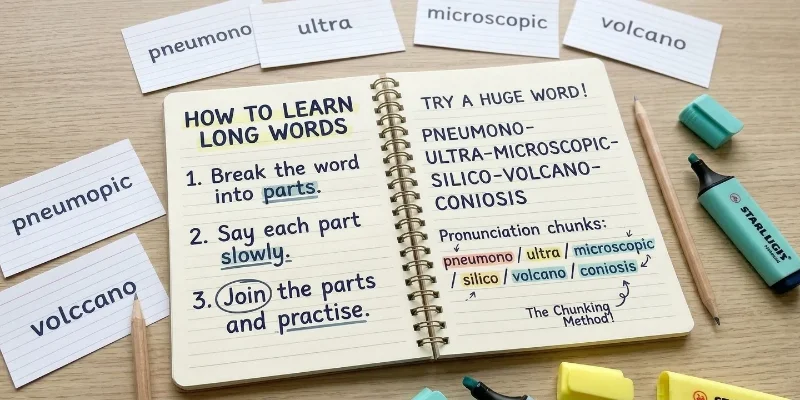
Break Long Words into Smaller Parts
Use the chunking method:
- Split the word into small parts.
- Say each part by itself.
- Say two parts together.
- Add more parts slowly.
- Speed up once you feel comfortable.
Look for parts you already know. In “pneumono-ultra-microscopic,” you already know “ultra” and “microscopic.” That makes it much easier.
How to Spell the Longest English Words
Spelling long words is about breaking them up, too. Try these simple tricks:
- Chunk it. Write the word in parts: floccinauci / nihili / pilifi / cation.
- Find the small words inside. “Antidisestablishmentarianism” has anti, dis, establish, ment, and arian.
- Write it three times. Look, cover, write, and check.
- Make a silly sentence. A funny picture in your head helps you remember.
- Learn prefixes and suffixes. Parts like “pseudo-,” “anti-,” and “-tion” show up again and again.
These tricks work for any long word, not just the champions.
The Longest English Word Without a Vowel
Length is not the only record. Here are some fun ones.
Rhythms, Tsktsks and the Vowel Question
The vowels are A, E, I, O, and U. Two words with none of the letters A, E, I, O, or U are rhythms and tsktsks. Both have 7 letters.
- Rhythms has no A, E, I, O, or U. The letter “y” gives it the vowel sound.
- Tsktsks means making a clicking sound with your tongue to show you do not approve. It has no vowel at all, not even “y.”
Other Unusual Word Records: Vowels and Syllables
- Only vowels: euouae (6 letters). It is a term from old church music.
- One vowel: strengths (9 letters). It has only one vowel, “e.”
- One syllable: strengths and screeched (9 letters). Both are said in one beat.
Other Unusual Word Records: No Repeated Letters
- Subdermatoglyphic (17 letters): related to the skin layer under your fingerprints.
- Uncopyrightable (15 letters): something that cannot be copyrighted.
Every letter in these words is different. That is a hard thing to do in English.
What Is the Longest Word in English? The Riddle Answer
You may have heard this riddle: “What is the longest word in the English language?”
The classic answer is “smiles.”
Why? Because there is a mile between the first letter and the last letter. S-mile-s.
It is a joke, not a real record. But it is a fun trick to share with friends.
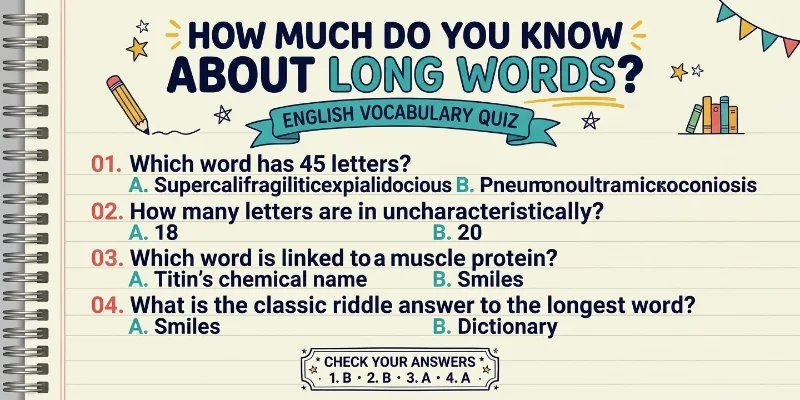
Longest Word Quiz
Test what you learned. Answers are at the end.
- What is the longest word in the dictionary?
- How many letters does uncharacteristically have?
- Which word has a mile between its first and last letter?
- In which Shakespeare play does honorificabilitudinitatibus appear?
- How long does it take to say the chemical name of titin?
Answers:
- Pneumonoultramicroscopicsilicovolcanoconiosis
- 20
- Smiles
- Love’s Labour’s Lost
- Roughly three to three and a half hours (an estimate)
Conclusion
So, what is the longest English word? Now you know there are three answers:
- Technical: the chemical name of titin, often cited as having 189,819 letters.
- Dictionary: pneumonoultramicroscopicsilicovolcanoconiosis, with 45 letters.
- Everyday: an example is uncharacteristically, with 20 letters.
The best way to enjoy long words is to break them into small parts. Once you do, even the scary ones feel easy.
FAQ’s
It depends on the rules. The longest technical word is the chemical name of titin, often cited as having 189,819 letters. The longest dictionary word is pneumonoultramicroscopicsilicovolcanoconiosis (45 letters).
The chemical name of titin is often cited as having 189,819 letters. The longest dictionary word has 45 letters.
It is 45 letters long. The word is pneumonoultramicroscopicsilicovolcanoconiosis.
Pneumonoultramicroscopicsilicovolcanoconiosis is a coined word for a lung disease caused by breathing in very fine dust. It is famous for its length. The titin name describes the exact parts of a muscle protein.
Break it into small chunks. Say “noo-muh-noh-UL-truh-my-kroh-SKOP-ik-SIL-ih-koh-vol-KAY-noh-koh-nee-OH-sis” slowly, then speed up.
The words rhythms and tsktsks both have 7 letters. Tsktsks has no vowels at all.
No. It has 34 letters, so it is shorter than pneumonoultramicroscopicsilicovolcanoconiosis. It is also a made-up word.
The oldest famous long word is Aristophanes’ made-up food dish from ancient Greece. It is 183 letters when written in English letters.
Uncharacteristically is often given as an example of a long word used in daily life. It has 20 letters.


- Be Respectful
- Stay Relevant
- Stay Positive
- True Feedback
- Encourage Discussion
- Avoid Spamming
- No Fake News
- Don't Copy-Paste
- No Personal Attacks
- Be Respectful
- Stay Relevant
- Stay Positive
- True Feedback
- Encourage Discussion
- Avoid Spamming
- No Fake News
- Don't Copy-Paste
- No Personal Attacks
