Business English Skills That Actually Help You at Work in 2026
Published: 25 Jul 2026
You already know some English. Maybe quite a lot of it.
But the moment your manager asks you to lead a meeting, write a client email, or give a presentation, something feels different. The words you know in daily conversation suddenly feel too casual. Too simple. Not quite right for the situation.
That gap between everyday English and professional English is exactly what Business English fills.
Business English is not a separate language. It is the version of English that works in offices, meetings, emails, and professional conversations. It gives you the right words, the right tone, and the right confidence to handle real workplace situations without second-guessing every sentence you write or speak.
In this guide, you will find everything you need. Vocabulary, grammar, email writing, meeting phrases, interview tips, and practical habits that actually make a difference at work.
What Is Business English?
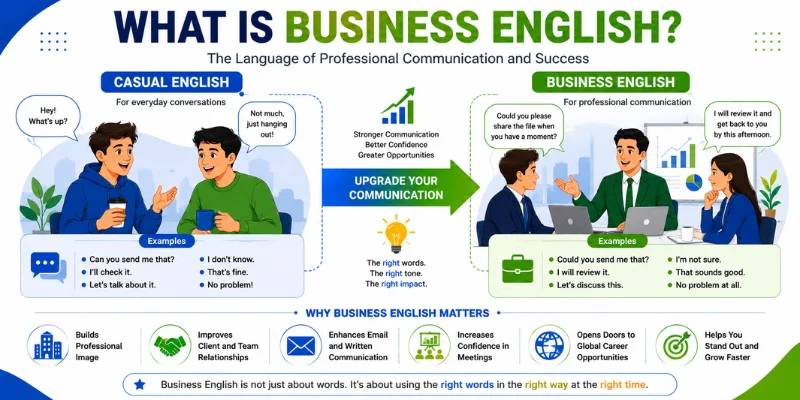
Business English is the type of English used in professional and workplace settings. It covers the vocabulary, tone, grammar, and communication styles that help you perform well in office, corporate, and other professional environments.
It is different from general everyday English in one important way. General English gets you through daily conversations. Business English gets you through job interviews, boardroom meetings, professional emails, and client calls with confidence and clarity.
The vocabulary is more specific. Instead of “talk about,” you say “discuss.” Instead of “find out,” you say “investigate” or “determine.” Instead of “help,” you say “assist” or “support.” These are not just fancier words. They signal professionalism and show that you understand the environment you are working in.
Many learners who already have strong everyday English find that building English communication skills gives them the bridge they need between general fluency and professional confidence.
Why Is Business English Important in the Workplace?
The answer becomes obvious the moment you sit in your first professional meeting or send your first client email.
Business English matters because most professional environments, especially those working with international teams or clients, operate in English. If your English is too casual or unclear in those settings, your ideas get lost. Your professionalism gets questioned. And your growth slows down.
Strong business communication does something else too. It builds credibility. When you use the right vocabulary, write polished emails, and speak confidently in meetings, people around you take you more seriously. Your manager notices. Your clients trust you more. Your colleagues see you differently.
The importance of English language in global careers has never been greater than it is right now. Companies across Pakistan, India, the Middle East, and beyond are looking for professionals who can communicate effectively across borders. Business English is what makes that possible.
What Vocabulary Do You Need for Business English?
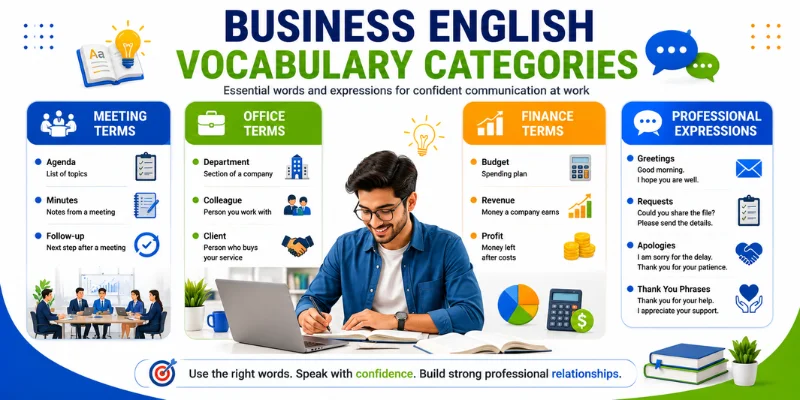
A strong vocabulary helps you speak clearly and feel confident at work. These common words and phrases will guide you in meetings, emails, calls, and daily office tasks.
Common Words and Phrases in Business
Here are everyday terms you hear in most workplaces:
Meeting terms:
- Agenda (list of topics)
- Minutes (notes from a meeting)
- Follow-up (next step after a meeting)
Office terms:
- Department (section of a company)
- Colleague (person you work with)
- Client (person who buys your service)
Finance terms:
- Budget (spending plan)
- Revenue (money a company earns)
- Profit (money left after costs)
These words help you participate in discussions, understand tasks, and communicate clearly.
Industry-Specific Vocabulary
Every field uses its own words. Learning them helps you understand your role better:
- Marketing: campaign, audience, branding
- Finance: invoice, expense, statement
- HR: recruitment, policy, training
- IT: software, network, update
- Customer service: support ticket, feedback, response time
Use these terms when you talk about work in your industry. It builds confidence and improves communication.
Polite and Formal Expressions
Workplaces value polite language. These phrases help you sound professional and respectful:
- Greetings: Good morning. I hope you are well.
- Requests: Could you share the file? Please send me the details.
- Apologies: I am sorry for the delay. Thank you for your patience.
- Thank-you phrases: Thank you for your help. I appreciate your support.
These expressions make your emails and conversations more positive and clear.
Modern Workplace Phrases
Today’s workplaces use many digital tools. These phrases help you talk about online work:
- Email: send, reply, attach, forward
- Remote work: work from home, online meeting, task update
- Video conferencing: join call, screen share, mute, unmute
- Digital communication: message, comment, upload, file share
One thing worth knowing about vocabulary is that learning words in isolation rarely sticks. The most effective approach is learning words inside phrases and sentences that mirror real workplace situations. Our guide on English vocabulary development covers exactly how to do this in a way that actually holds in your memory long term.
How Does Grammar Help in Business English Writing?
Good grammar helps you sound clear and professional in the workplace. These simple rules will help you build strong business communication skills.
Formal Sentence Structures
In business writing, sentences should be clean and easy to read:
- Simple sentences: “Please send the file.”
- Compound sentences: “The team finished the task, and they shared the report.”
- Complex sentences: “I will start the project after I receive the details.”
Common Verb Forms and Tenses
- Present perfect: “We have completed the first step.”
- Passive voice: “The report was sent yesterday.”
- Modal verbs: “You should review the file.” “We must finish today.”
Phrasal Verbs in Business English
- set up: “We will set up the meeting.”
- follow up: “I will follow up with the client.”
- carry out: “They will carry out the plan.”
- take over: “She will take over the project.”
Polite and Professional Tone
A polite tone builds trust and shows respect:
- Avoid “hey,” “what’s up,” or “no worries.” Use “Hello,” “Good afternoon,” or “Thank you.”
- Use indirect language: “Could you share the file?” instead of “Send the file.”
- “I would like to check” instead of “I want to check.”
Grammar does not need to be perfect to be professional. What matters most is that your message is clear and your tone is appropriate. Many learners find that understanding tense usage properly, especially things like since vs for in professional context, removes a lot of the hesitation they feel when writing formal messages.
How to Improve Business English Communication Skills?
Strong communication skills help you work effectively with teams, share ideas, and handle daily tasks with confidence.
Speaking Skills
Speaking is important in meetings, presentations, and phone calls. Keep your tone calm and use simple language when you share ideas.
Practice roleplay activities. One person acts as a manager asking for a project update. The other responds with clear steps. This builds confidence and improves speaking skills fast.
Writing Skills
You use writing for emails, reports, proposals, and memos. Effective business writing is short, simple, and clear.
Basic templates help:
- Email: greeting, purpose, details, closing
- Report: title, summary, facts, conclusion
- Proposal: goal, plan, timeline, cost
Spoken fluency and written clarity are connected skills. Learners who work on their spoken English alongside business writing tend to improve in both areas faster because confidence in one feeds directly into the other.
Listening Skills
Listening is important in meetings, calls, and training sessions. Stay patient and listen carefully. Write short points instead of full sentences. This keeps your focus on the speaker and helps you remember key details.
Reading Skills
Read slowly and look for the main idea first. Then check details like dates, numbers, and action steps. Strong reading skills help you make better decisions at work.
How to Write Professional Business Emails
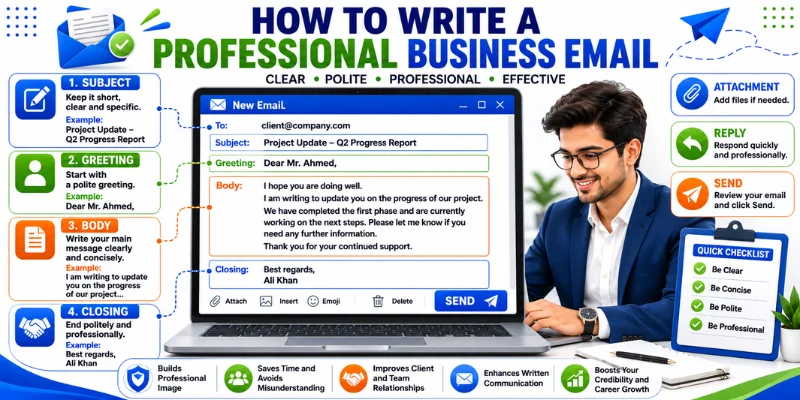
Emails are one of the most common forms of workplace communication. Clear and polite emails help you share information, ask questions, and build professional relationships.
Email Structure
- Subject line: Keep it short. Example: Project Update for Monday.
- Greeting: Dear Mr. Ali, or Hello Sara.
- Body: Write clear and short sentences. Share the main point first.
- Closing: Thank you for your time. Then write your name.
Polite Phrases for Emails
For requests:
- Could you please send the file?
- May I ask for an update?
For apologies:
- I am sorry for the delay.
- Thank you for your patience.
For follow-ups:
- I am writing to follow up on my last email.
- Do you have any updates?
For clarifications:
- Could you explain this part?
- I need a little more detail on the next steps.
Sample Business Emails
1. Request for Information
Subject: Request for Project Details
Hello John,
I need the project timeline for this week. Please share it when you can.
Thank you. James
2. Follow-up Email
Subject: Follow-up on Report
Dear Ms. Eva,
I am following up on the report we discussed. Please let me know if there is any update.
Thank you. Max
3. Apology Email
Subject: Apology for Late Reply
Hello Bert,
I am sorry for the late response. I had a busy schedule. I will share the file today.
Regards, Walter
How to Handle Business English in Meetings and Negotiations
Meetings and negotiations are a big part of professional life. Clear Business English helps you share ideas with confidence and understand others without stress.
Common Meeting Phrases
- Let’s discuss the next step.
- I suggest we review the plan.
- Can we look at the main points?
- I agree with this idea.
- I would like to add something.
Negotiation Expressions
- We propose a new timeline for the project.
- Can we consider a lower price?
- We are open to other options.
- Let’s find a solution that helps both sides.
Tips for Active Participation
- Speak slowly so others understand you.
- Take notes during the meeting.
- Ask short questions to avoid confusion.
- Repeat important details to confirm everyone agrees.
- Listen carefully before sharing your opinion.

Business English for Interviews and Presentations
Strong Business English helps you speak clearly in interviews and give confident presentations.
Interview Phrases
Self-introduction:
- My name is ___. I have experience in ___.
- I am interested in this position because it matches my skills.
Answering questions professionally:
- I handled this task in my previous job.
- I improved our work by doing ___.
Talking about skills:
- I have strong communication skills.
- I can manage time well.
- I worked with clients, reports, and team projects.
Presentation Phrases
Opening:
- Today I will talk about ___.
- Let’s begin with the main idea.
Explaining slides:
- This slide shows the results.
- Let me explain this point simply.
Summarizing:
- To sum up, these are the key points.
- The main idea of this presentation is ___.
Taking questions:
- Do you have any questions?
- I am happy to explain this again.
Common Mistakes in Business English That Hurt Your Credibility
Many learners try to sound professional but make small mistakes that change how they come across. These are the most common ones.
Grammar Errors
Using the wrong verb tense:
- Wrong: “I complete the task yesterday.”
- Correct: “I completed the task yesterday.”
Missing articles:
- Wrong: “Please send report.”
- Correct: “Please send the report.”
Incorrect subject-verb agreement:
- Wrong: “The team are working.”
- Correct: “The team is working.”
Misused Phrases
- “I will revert back” — Use “I will get back to you.”
- “Please do the needful” — Use “Please take the required action.”
- “Kindly advise me” — Use “Please let me know.”
Overly Casual Expressions
Avoid: “Hey,” “Yep,” “Kinda,” “Gonna”
Use: “Hello,” “Yes,” “Please,” “Thank you”
Tips to Avoid These Mistakes
- Read your message before you send it.
- Keep your sentences short and clear.
- Use simple words instead of difficult ones.
- Practice common business phrases regularly.
- Learn from examples of professional emails and reports.
Good English writing skills are built through exactly this kind of attention to small details. The professionals who communicate most effectively are not always the ones who know the most grammar. They are the ones who review their writing before sending it.
How to Keep Improving Your Business English Every Day
You can grow your Business English skills with simple daily habits and the right tools.
Online Courses and Apps
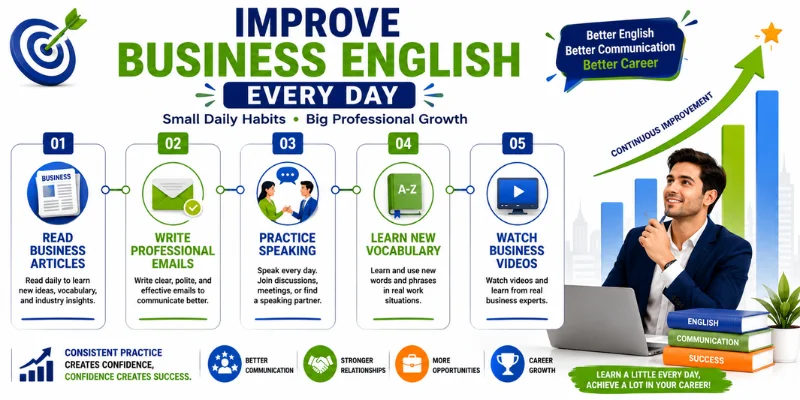
Many learners use online courses to study Business English at their own pace. These tools help you learn vocabulary, email writing, and speaking patterns. You can study for a few minutes each day and see steady progress.
Practice Strategies
- Roleplay: Practice meetings, interviews, and conversations with a friend. This builds natural phrases and real confidence.
- Reading: Read business articles and reports. This builds vocabulary and shows you real professional language in context.
- Listening: Listen to podcasts, business talks, and workplace videos. You learn tone, accent, and common expressions.
Self-Study Tips
- Keep a list of useful business words and phrases.
- Write short practice emails or reports daily.
- Watch workplace videos to learn professional tone and structure.
- Practice speaking for a few minutes each day out loud.
Small consistent practice produces far better results than long occasional study sessions. Even ten minutes of focused Business English practice daily will show clear results within a few weeks.
Conclusion
Most people think Business English is about learning harder words or more complex grammar.
It is not.
It is about learning the right version of English for the right situation. The version that makes your emails get read and taken seriously. The version that makes people listen when you speak in meetings. The version that gets you noticed in interviews.
That shift does not happen overnight. But it does happen. And it happens faster than most learners expect when they focus on real workplace situations instead of textbook exercises.
Start with one email today. Write it the way you normally would. Then go back and make it more professional using what you have read here. That single habit, practiced daily, changes your Business English faster than any course.
The workplace rewards people who communicate clearly. Now you have the tools to be one of them.
Business English is used in offices, meetings, emails, and all forms of professional communication. It helps you speak and write clearly in the workplace and makes it easier to work with colleagues, clients, and international teams.
Yes. General English covers everyday conversations and daily life. Business English focuses on workplace vocabulary, formal tone, and professional communication. It helps you sound confident and appropriate in work settings.
It depends on daily practice. Most learners notice real improvement within four to six weeks of consistent practice. The more regularly you apply new vocabulary and phrases in real situations, the faster you improve.
Absolutely. Most companies, especially those working with international clients or teams, prefer candidates who communicate clearly in English. Strong Business English skills stand out during interviews, in written applications, and in day-to-day work performance.
Read short business articles, write simple practice emails, and watch professional English videos. Apply new phrases the same day you learn them. Speaking practice, even alone, builds confidence faster than passive study.
Exposure is the best solution. Listen to podcasts, interviews, and online talks from different speakers regularly. Your ear adjusts gradually, and understanding different accents becomes easier with time.
Replace casual words with professional ones. Use indirect requests instead of direct commands. Read your email out loud before sending it. If it sounds too relaxed or too informal, adjust the tone before you hit send.






- Be Respectful
- Stay Relevant
- Stay Positive
- True Feedback
- Encourage Discussion
- Avoid Spamming
- No Fake News
- Don't Copy-Paste
- No Personal Attacks
- Be Respectful
- Stay Relevant
- Stay Positive
- True Feedback
- Encourage Discussion
- Avoid Spamming
- No Fake News
- Don't Copy-Paste
- No Personal Attacks
